



FARMINGTON — Mt. Blue High School chemistry teacher Maria Howatt was awarded $2,000 by the Perloff Foundation of the Maine Community Foundation and $1,000 from the Maine Space Grant Consortium to purchase materials to design take-home lab kits.
When schools closed in March due to COVID-19, Howatt had two days to develop lab assignments that her students could perform remotely.
“They weren’t quite what I wanted to do, but I just took what I had,” Howatt said, in a phone interview. “I wanted them to have something tangible to have at home so that when the boredom hit, they would have something physical to do.”
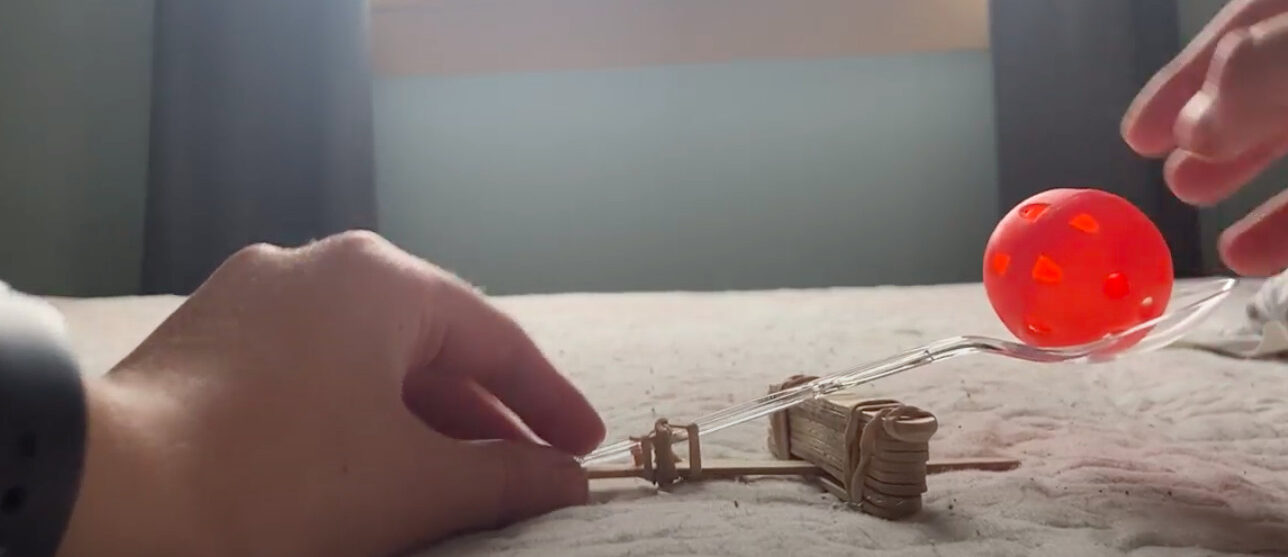
Pictured above is one of Howatt’s take-home labs that she designed last-minute when school closed in March due to the pandemic. Students had to draw free body diagrams during different stages of a balloon car’s journey. Photo Courtesy of Maria Howatt
Howatt was surprised by the amount of students that enthusiastically completed the take-home labs, so she was inspired to design a more comprehensive plan for the upcoming school year. She applied to the Perloff Foundation’s STEM-focused fast grants and within 24 hours of submitting her application, she was approved for funding.
“We want to see things change in the classroom context,” David Perloff of the Perloff Foundation said, in a phone interview. “So in this particular grant, it’s an extended classroom. Your kids are interacting with you remotely, how do you run a lab? So we were really impressed with Maria’s creativity and using things that were familiar to students, but still using good science.”
Howatt has ordered 110 scales, 110 graduated cylinders, test tubes, thermometers, nine-volt batteries and alligator clips which will allow students to conduct a variety of experiments from their homes.
The batteries and alligator clips will be provided to students to build their own conductivity test. This test will be used as a tool in several of Howatt’s labs that will teach students about acids and bases, metallic bonding and ionic bonding.
“There are certain liquids that conduct electricity, that means they have ions in them, and they’ll be able to identify whether something has an ion or not through this conductivity test,” Howatt said.
Students will also learn chemistry through baking labs which will utilize the scales that Howatt has ordered as well as pre-measured ingredients such as flour and baking soda.
“What we have is a biscuit lab that we’re going to be doing. We have the full biscuit recipe, and then we have them go through the stoichiometry steps of cutting down the recipe mathematically using chemistry,” Howatt said. “And then they can choose to make one, two or three biscuits.”
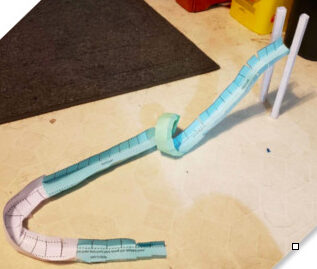
Another one of Howatt’s labs from last spring included constructing a paper roller coast to teach students how to draw free body diagrams with centripetal forces. Photo Courtesy of Maria Howatt
Perloff said that his foundation, which has awarded education grants in Maine for the past 20 years, is interested in ideas that can be turned into templates and replicated in other schools. With the on-going pandemic, he anticipates that Howatt’s project will provide an informative and innovative approach to teaching science remotely.
For Howatt, her main motivator is to encourage student engagement, especially if school will be conducted remotely in the fall due to the pandemic. However, her take-home labs will adapt easily to in-person classes as well because they will provide students with more interactive homework assignments.
“I have a lot of learners that have struggled in science before, in school in general, and we try to make a good, hands-on learning environment because a lot of times, you cannot link information to the brain unless you have experience,” Howatt said.
The Perloff Foundation has also awarded Mt. Blue Middle School librarian Sherry Wyman and alternative education teacher Patti Veayo with two 3-D printers in the past two years. Veayo said she and her students were just getting started with 3-D printing of simple machines before the pandemic caused schools to close. However, she is confident that the printers will greatly impact student engagement.
Copy the Story LinkComments are not available on this story.
Send questions/comments to the editors.
