


JAY — A billing dispute disrupted a group of Maine’s state-funded public-interest payphones in August, leaving phones intended to provide free local and emergency calling unable to make ordinary calls.
The problem surfaced through an independent monitoring project that regularly calls Maine public-interest payphone numbers.
Eleven monitored numbers answered Aug. 16. A week later, only two did.
By Aug. 27, the public-interest payphone at Steep Falls in Newry was the only previously answering public-interest payphone still reachable by the monitor.
The nine public-interest payphone locations that disappeared from the monitoring log during the August collapse are all in Consolidated Communications serving territory. Newry, which remained reachable at the end of the collapse, is served by FirstLight.
The automated calls measure whether the published payphone numbers can be reached from outside. They do not show what happens when someone picks up the handset and tries to make a call.
Field checks Sept. 1 and 2 supplied that half of the story.
Tests at Prince Memorial Library in Cumberland, Lithgow Public Library in Augusta and the Jay Police Department found phones with normal dial tone that accepted numbers from the keypad but would not complete ordinary calls.
Instead, callers heard a Consolidated Communications recording saying the line had been restricted from making outbound calls. The message directed anyone with an emergency to hang up and dial 911 and offered options for customer service and collections.
A fourth public-interest payphone, at Steep Falls in Newry, worked normally.
All four phones are operated by Pacific Telemanagement Services, which owns and maintains the payphone equipment and service. The underlying telephone lines are provided by local carriers: Consolidated Communications serves the Cumberland, Augusta and Jay phones, while FirstLight provides the line at Newry.
The phones remained connected to the network despite the restriction.
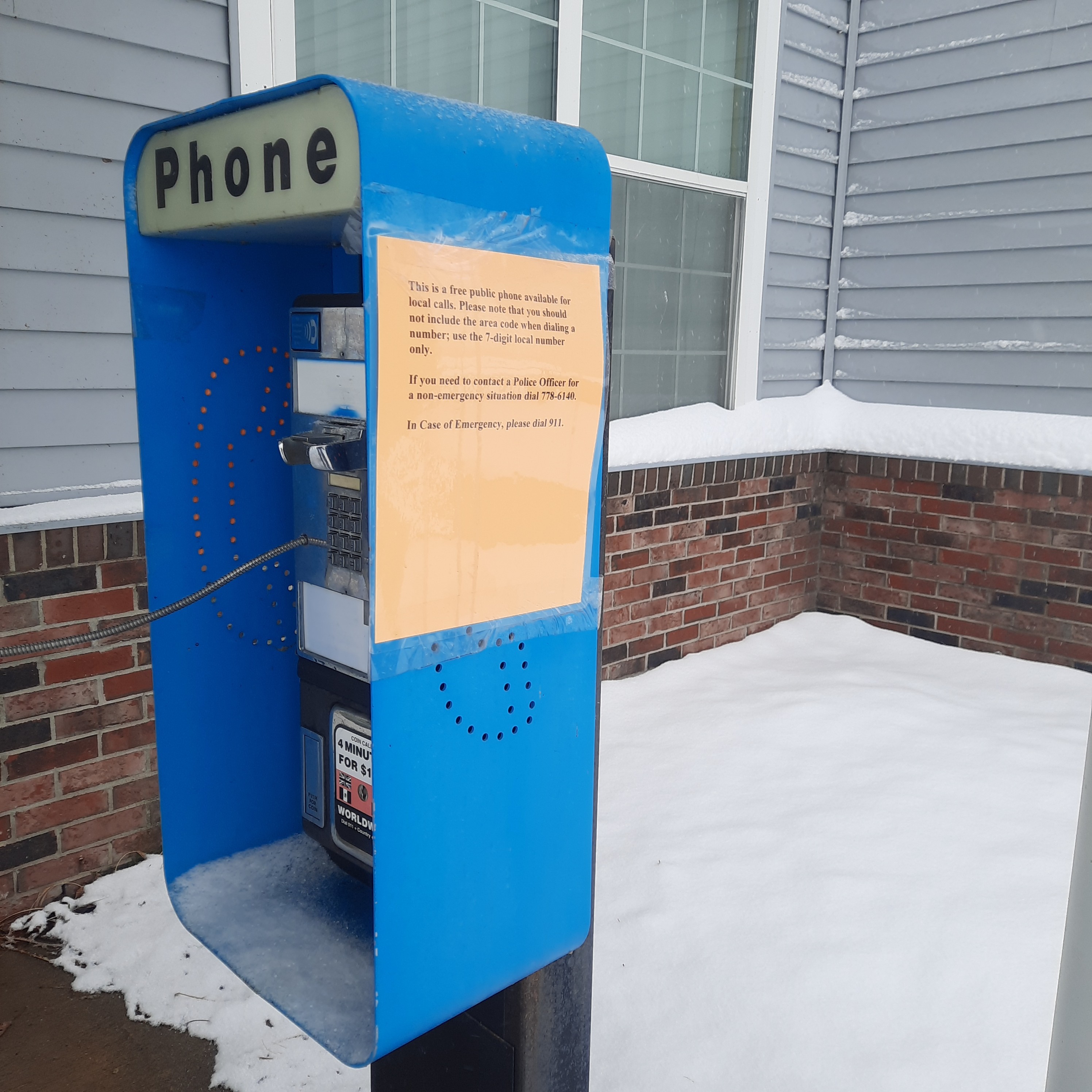
A 911 call placed from the Jay phone while the restriction was in effect was completed successfully. The test was made by Jay Police Department’s Chief Joseph Sage.
Other calls produced unusual results.
At the Augusta library, dialing zero did not reach an operator. Instead, the caller heard a repeated request to “please wait one moment.”
After about 76 seconds, the call transferred to a commercial operation pitching Medicare Advantage plans and a medical-alert device. The recording offered an option to “press 1 for a licensed insurance agent” and warned that remaining on the line could result in additional offers unrelated to Medicare.
The call eventually reached a woman who introduced herself: “Hi, this is Jessica on a recorded line.”
Maine Public Utilities Commission rules require public-interest payphones to be capable of making direct-dialed local, 911 and toll-free calls without charging the caller.
The cause of the disruption became clearer during the field testing. The Consolidated recording offered callers an option for collections, pointing to a billing-related restriction.
A Consolidated representative later confirmed the account had been restricted over a billing issue. Pacific Telemanagement Services subsequently gave the same explanation, saying Consolidated had restricted the lines because of a billing dispute.
Service was later restored.
The reporting also uncovered other, apparently unrelated problems with Maine’s public-interest payphones, including phones that have been removed but still appear on state records, another that has failed to answer for months, and a coinless phone in Rumford that has asked callers to deposit coins.
The August billing dispute appears to be resolved. The episode showed that multiple state-funded public-interest payphones could lose ordinary calling service while continuing to provide dial tone, with the disruption becoming visible through outside monitoring rather than public notice.

Supporting Sponsor for Franklin Journal, Livermore Falls Advertiser, Rangeley Highlander and Rumford Falls Times.
Keeping communities informed by supporting local news. franklinsavings.bank

We invite you to add your comments. We encourage a thoughtful exchange of ideas and information on this website. By joining the conversation, you are agreeing to our commenting policy and terms of use. More information is found on our FAQs. You can update your screen name on the member's center.
Comments are managed by our staff during regular business hours Monday through Friday as well as limited hours on Saturday and Sunday. Comments held for moderation outside of those hours may take longer to approve.
Join the Conversation
Please sign into your Sun Journal account to participate in conversations below. If you do not have an account, you can subscribe here. Questions? Please see our FAQs.