


LEWISTON — Earlier in the summer, a Lewiston police officer was videotaped taking down a criminal suspect following a crash on Bartlett Street.
The arrest wasn’t pretty. The two men wrestled to the ground, where the cop appeared to slap the accused repeatedly on the side of the head.
When video of the arrest went viral, some declared the footage clear evidence of police abuse. As it turns out, the officer had done everything right, applying techniques commonly taught at police training academies across the land.
The arrest was ultimately made without serious injury to either party.
When police try to arrest a person who does not wish to be arrested, things can get ugly very quick — ugly and often confusing to the average person who witnesses the confrontation.
With that in mind, Lewiston police invited the media along this week to behold one of their regular training sessions where the department’s officers refreshed their skills in the latest take-down procedures.
Most of those involved in the daily sessions are Lewiston police officers who have received advanced training in the set of tools known as M.A.R.C, or the Mechanics of Arrest, Restraint and Control.
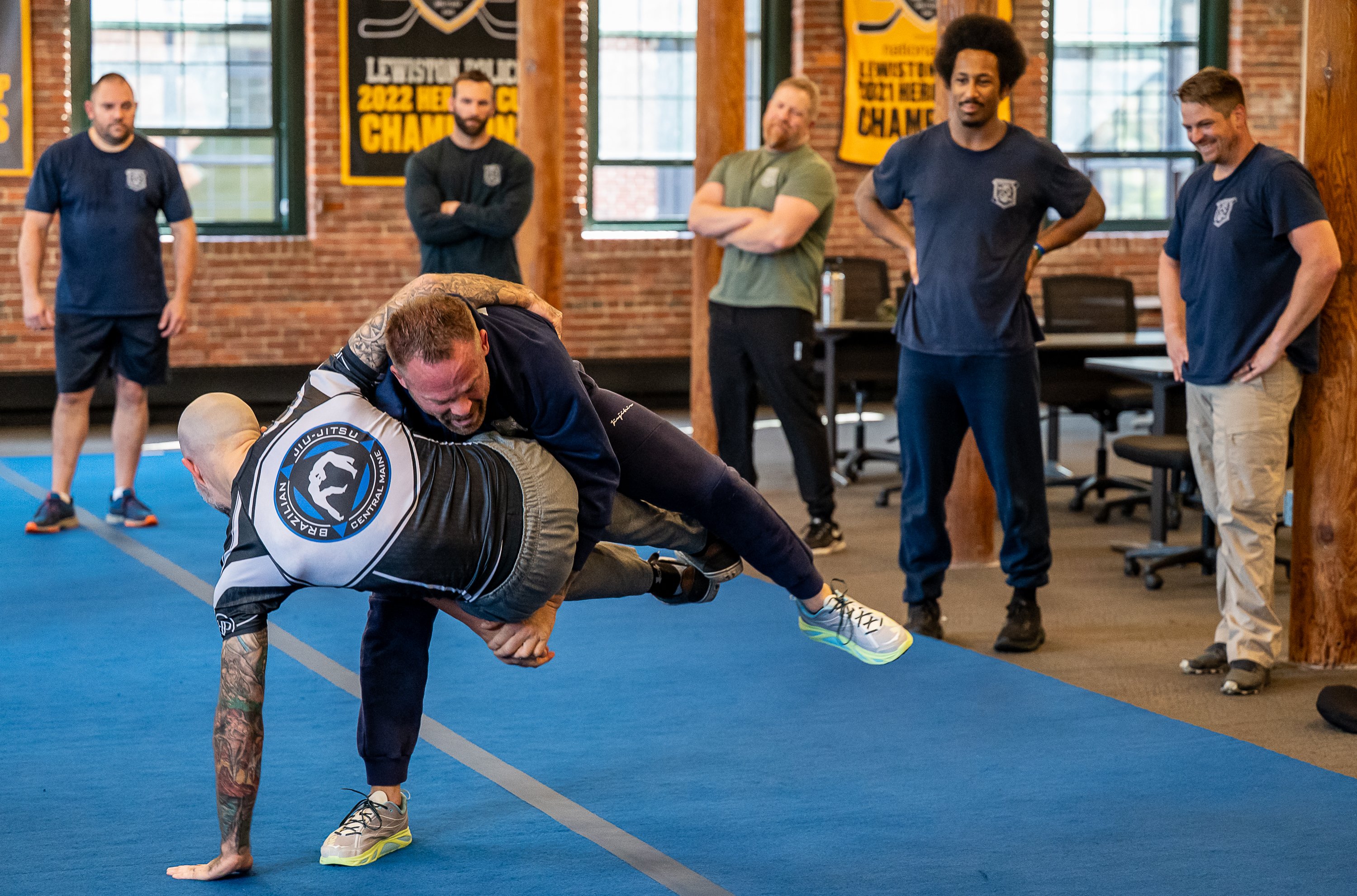
They were also joined by Central Maine Brazilian Jiu Jitsu trainers Jesse Erickson and Travis Wells, who offered their unique insights into the matter of police takedowns.
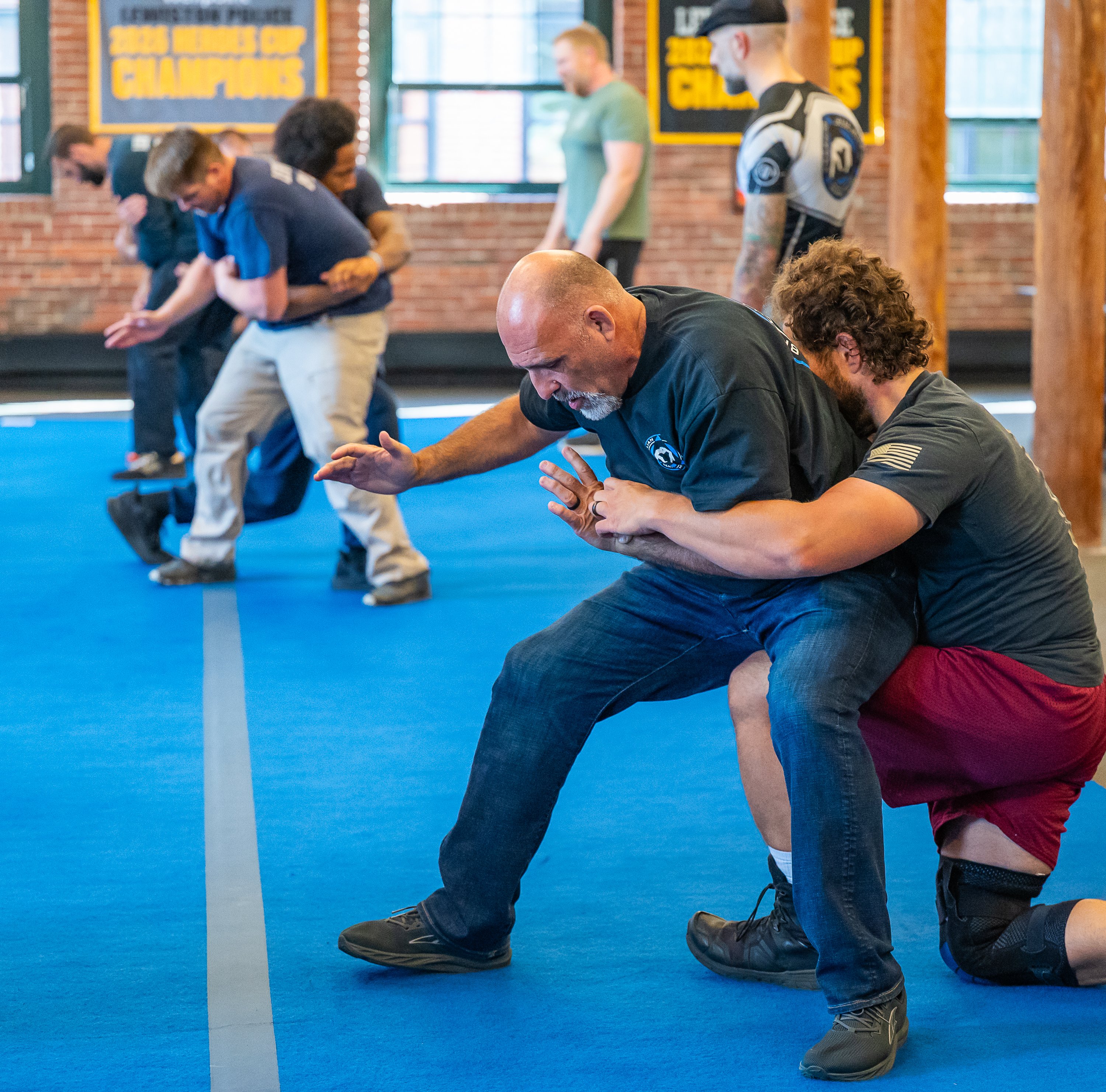
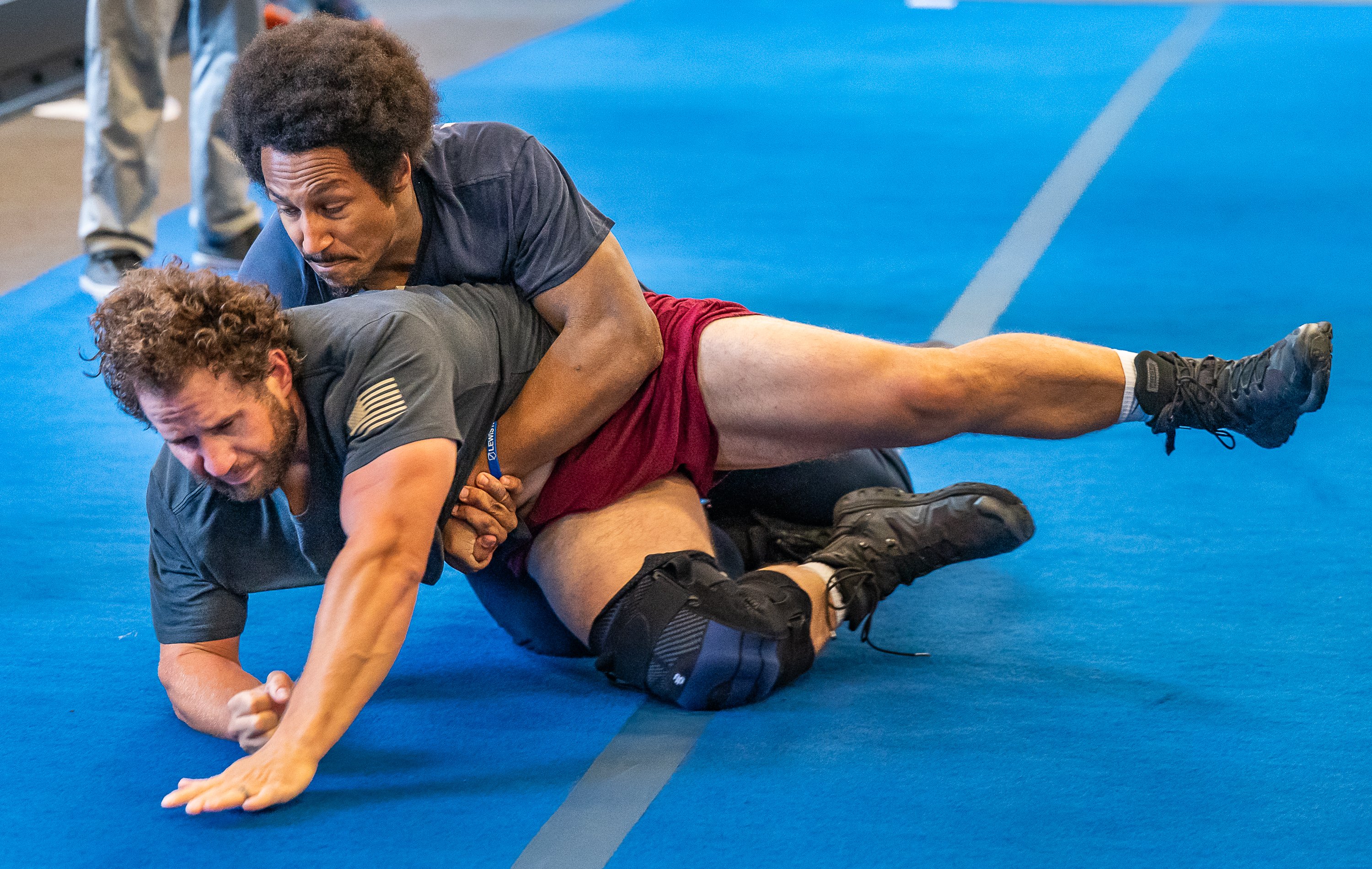
This is not passive training. All day long, Lewiston cops were flinging their fellow officers to the ground. Pinning them. Applying open-hand strikes and other tactics where necessary.
When it was over, both officers would rise from the mats panting, red-faced and out of breath. Then two more officers would take center stage and one would bring the other down.
There is a lot of fighting skill at the Lewiston police station this week, but department administrators are adamant about one thing in particular: This isn’t about flexing. It’s about revealing to the public how hard police work to subdue criminal suspects with minimal risks to all involved.
Because no matter how by-the-book a police takedown goes, officers say, to the average person, it may look like unrestrained violence.
“As much as we try to use our best practices and reduce liability for everyone, it’s never pretty,” said Lewiston police Lt. Derrick St. Laurent.
The cop on the street, St. Laurent stresses, typically will do everything in his or her power to avoid a physical scrap while making an arrest. No police officer wants to take on the danger of a physical confrontation and everything that goes along with it: the scrapes and bruises, reports that need to be written, the public accusations of brutality.
“We do not like going hands-on,” St. Laurent said. “For us, de-escalation is No. 1. That’s what we’ll always try to do. Unfortunately, in the world we live in, that’s not always possible. People don’t always comply, as we’ve seen time and time again.”
In the spacious police station training room, with foam pads spread across the floor, Lewiston cops this week are covering every aspect of dealing with uncooperative suspects.
This isn’t classroom training. It’s hands-on, and every police officer involved will get a sense of what it feels like to be on the other side of the badge.
St. Laurent himself has gone through these drills, at times playing the guy being arrested instead of the cop. The idea is to get a sense of what these take-down procedures feel like to the other person.
“I know how it feels to be put in an arm bar,” he said. “I know how it feels to be in handcuffs. It’s a good thing for us to know what it feels like to be taken down to the ground, to experience wrist locks and all of those types of things.”
Again and again, all week long, the officers will go over the techniques that will give an officer the best chance of getting unruly suspects under control while minimizing the risk of injury.
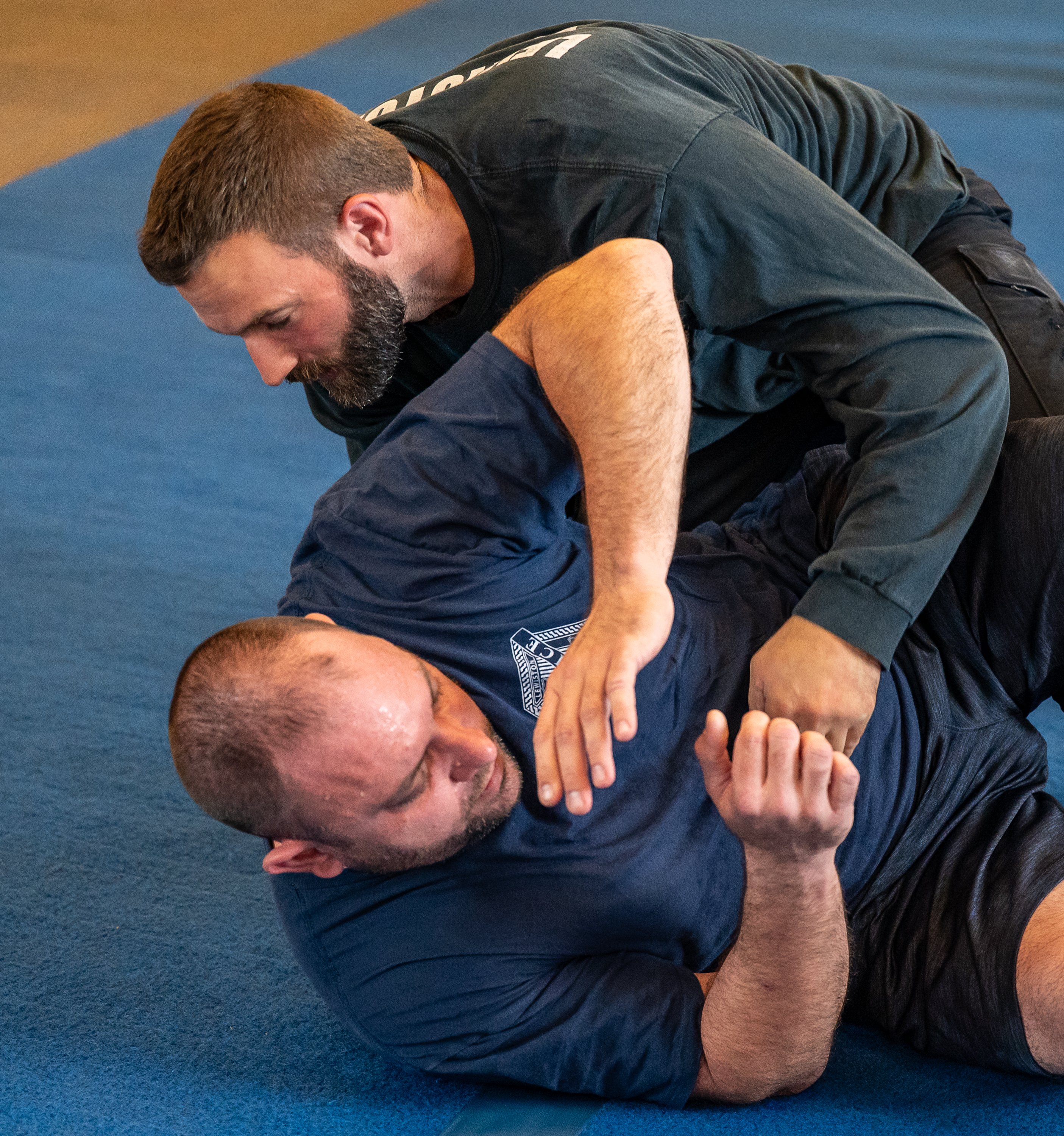
Body mechanics and use of leverage. On the ground grappling tactics. Smooth transition to handcuffs.
And as the officers train and then train some more this week, they are also aware that they are in a controlled environment. Everyone in the room is a cop or someone friendly to the department.
It’s not like that in the real world.
On the streets, St. Laurent says, “there are other people around who are under the influence. We have to worry about needles and weapons and things like that.”
And the jiu jitsu skills of Erickson and Wells taught police another important lesson: No matter how hard police train, there are criminals out there who train hard, too.
“Watching those guys go against our best M.A.R.C. instructors,” said St. Laurent, “we have to realize that there are people like that out on the street. They gave us some tips and techniques to look out for. If someone is doing this or that, they know what they’re doing, and it might be time for the officer to back off and reevaluate.”
In other parts of the training, the officers are required to do strenuous exercise for long minutes before attempting to take down one a peer. They then have to put those skills into practice while badly winded and suffering from tired muscles.
Just more practical preparation for the real world, St. Laurent says, where an officer might find himself struggling to subdue a suspect after chasing that suspect for several blocks.
Each police officer on the force has been through 40 hours of M.A.R.C. training as part of the Maine Criminal Justice Academy curriculum. Some of them choose to get training beyond that.
Officer George “Al” Monteith is one of these. Monteith gets all the training he can and does mixed martial arts on the side.
An instructor himself now, what Monteith learns, he shares with other officers on the force. The idea is to make the whole police force better at handling tough situations.
It sounds like a lot of training, but St. Laurent stresses that there are so many different situations in which a police officer might find him or herself, there is near endless ground to be covered.
When verbal commands fail to get a suspect under control, police have to know what level of force he or she should use next. Is physical restraint still possible? Is it time for the Taser, chemical spray or a sidearm?
And there are those situations where a criminal suspect isn’t actively fighting the police officer; he’s simply not cooperating.
“They’ll put their hands at their sides and refuse to put them behind their back,” St. Laurent said. “Or they’ll just walk off knowing they are under arrest. So, they’re not fighting us, they’re just resisting.”
A police officer in those scenarios needs to know what level of force is appropriate and how to best employ that force. They have to know how to take down combative subjects when the officer is alone or when backup has arrived.
According to St. Laurent, the Lewiston Police Department has beefed up training of this type in the past few years. And that training is ongoing, he said, because when you’re a police officer, your training is never complete. There are always new techniques to learn and skills always need to be sharpened.
And so for the rest of the week, Lewiston police will just keep mixing it up with their peers, twice a week in four hour blocks, in hopes of being ready when it’s time to mix it up on the streets.

Comments are not available on this story. Read more about why we allow commenting on some stories and not on others.
We believe it's important to offer commenting on certain stories as a benefit to our readers. At its best, our comments sections can be a productive platform for readers to engage with our journalism, offer thoughts on coverage and issues, and drive conversation in a respectful, solutions-based way. It's a form of open discourse that can be useful to our community, public officials, journalists and others.
We do not enable comments on everything — exceptions include most crime stories, and coverage involving personal tragedy or sensitive issues that invite personal attacks instead of thoughtful discussion.
You can read more here about our commenting policy and terms of use. More information is also found on our FAQs.
Show less