
Thomas H. Reynolds
1920 – 2009
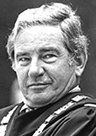
NEWCASTLE — Thomas Hedley Reynolds, known for nearly three decades of transformational leadership at two Maine educational institutions, died Tuesday, Sept. 22, at his home in Newcastle, after a long illness. He was 88 years old. His wife of 24 years, Mary Bartlett Reynolds, was with him at the time of death.
Reynolds served as president of Bates College from 1967 through 1989, and of the University of New England from 1990 to 1995. His success as commander of an armored unit in the Mediterranean theater of World War II came to symbolize Reynolds’ qualities as an academic leader: far-reaching vision, decisiveness and energetic determination.
At Bates, Reynolds presided over a regional school’s evolution into a national liberal arts college now regarded as one of the nation’s best. He led Bates to strengthen its faculty and curriculum, add such key facilities as a modern library and arts center, diversify its student body and eliminate the SAT requirement.
“He brought a renewed sense of confidence and purpose,” says John Cole, a faculty member who arrived soon after Reynolds and now holds an endowed history professorship bearing Reynolds’ name. “He enlarged this place, invigorated it, professionalized it.”
Reynolds left retirement to become the third president of the University of New England. Originally taking the position on a short-term basis, Reynolds ended up giving that growing institution five years of valuable service. “He saw something here, material in the raw that had the potentiality for greatness,” UNE trustee Neil Rolde wrote in a 1995 tribute to Reynolds in “Coastlines,” the UNE magazine.
Reynolds was born on Nov. 23, 1920, in New York, the son of Wallace and Helen (Hedley) Reynolds. He attended The Browning School in New York City and Deerfield Academy in Massachusetts, from which he graduated in 1938. In 1942 he earned a bachelor’s degree in political science at Williams College.
With America embroiled in World War II, Reynolds enlisted in the U.S. Army and was decorated for his service as a unit commander in a tank battalion that fought in the Mediterranean theater. After the war, he earned a master’s degree in 1947 and a doctorate in history in 1953, both from Columbia University.
Reynolds joined the history faculty at Middlebury College in 1949. He remained at Middlebury for 18 years, becoming dean of men in 1957 and dean of the college seven years later.
Reynolds became Bates’ fifth president in January 1967. The expansion and evolution that distinguished his tenure touched nearly every facet of the Bates experience, from student life to academics, from physical facilities to college finances.
“Throughout his presidency, his core interest was developing the quality of the faculty, and consequently the quality of the curriculum and of the undergraduate experience,” says Carl Benton Straub, a professor emeritus of religion and the Clark A. Griffith Professor Emeritus of Environmental Studies. Straub served as dean of faculty under Reynolds for 15 years.
Reynolds led Bates in diversifying its student body — academically, geographically, ethnically and racially. It was during his tenure that the college ceased to require that student applicants report their SAT scores, a move that widened the range of accepted students without affecting academic standards, as later Bates studies showed.
In addition, Reynolds’ tenure at Bates saw the construction of a new library, an arts center, a field house and the conversion of the former women’s athletic building into the Edmund S. Muskie Archives.
Reynolds took the helm of the University of New England just 12 years after that institution was born from the merger of a small liberal arts college and a school of osteopathic medicine. His tenure was marked by steady increases in student enrollment, academic prestige and financial capability. A signal Reynolds achievement was the construction of the Harold Alfond Center for Health Sciences.
Off campus, Reynolds served as a director of the Public Broadcasting Service in Washington, D.C., and as a trustee and chairman of the board of WCBB-TV in Lewiston; a member and director of the National Association of Independent Colleges and Universities; a director and president of the New England Colleges Fund; and as chair of the Governor’s Special Commission on the Status of Education in Maine. Known on campus as a private man, Reynolds was a voracious reader and an outdoorsman who enjoyed skiing, tennis and particularly sailing.
Reynolds was predeceased by his parents and by a son, David Hewson Reynolds, one of four children born during his marriage to Jean Fine Lytle. They married in 1943. In addition to his wife and Jean Lytle of Randolph, Vt., he is survived by a sister, Elizabeth Reynolds Henderson of Locust Valley, N.Y.; two sons, Thomas Scott Reynolds of West Tisbury, Mass., and John Hedley Reynolds of Stannard, Vt.; and a daughter, Tay R. Simpson, also of Randolph,Vt.
Comments are no longer available on this story