
LEWISTON — Before St. Patrick’s Church could close, its maker needed to rest.
For 102 years, the body of Monsignor Thomas Wallace lay behind an iron gate and a wall of cement in the basement of his church. But on Saturday morning, he was interred in the ground at Mt. Hope Cemetery.
It was an intimate ceremony for someone whose death in November 1907 shut down the city.
“It was huge,” said Michael Poulin, a Lewiston native who researched Wallace’s death in recent weeks. “There were 2,000 people at his funeral.”
Poulin spent hours sifting through old newspaper clippings in the Lewiston Public Library, reading accounts of a priest who had sat on the public school board for 29 years.
“I didn’t expect to get this involved,” said Poulin, a downtown attorney. “I tend not to do things halfway.”
He wrote a short biography for the interment ceremony.
Wallace was born in 1846 in Somersworth, N.H., to Irish immigrants. He was ordained at 25 and began serving in Lewiston at 30. Seven years later, he was appointed to the Lewiston School Board, Poulin wrote.
Wallace served on the board until his death.
“What did it say about Lewiston that we had a priest on the school board?” Poulin said.
At the same time that he worked for public schools, Wallace promoted parochial education, eventually using an inheritance to buy the land that would become St. Patrick’s School.
And he led the initiative to build St. Patrick’s Church. At the time, St. Joseph’s Church on Main Street drew so many parishioners, it couldn’t house them all.
When Wallace died, every school in the city closed. City Hall closed. The mills shut down, and trade was halted during the funeral’s hours.
In the months that followed, the Catholic Church honored him by making him part of his Bates Street church.
“It was a privilege for a priest who built a church in the old days, and it’s no longer the case, obviously,” said Monsignor Mark Caron, who leads Lewiston’s Prince of Peace Parish.
The tomb sat near an entrance to the downstairs hall that hosted the annual holiday fairs and the St. Patrick’s Day suppers. His body rested on a simple cement slab.
The room inside the iron gate was covered in white brick and tile.
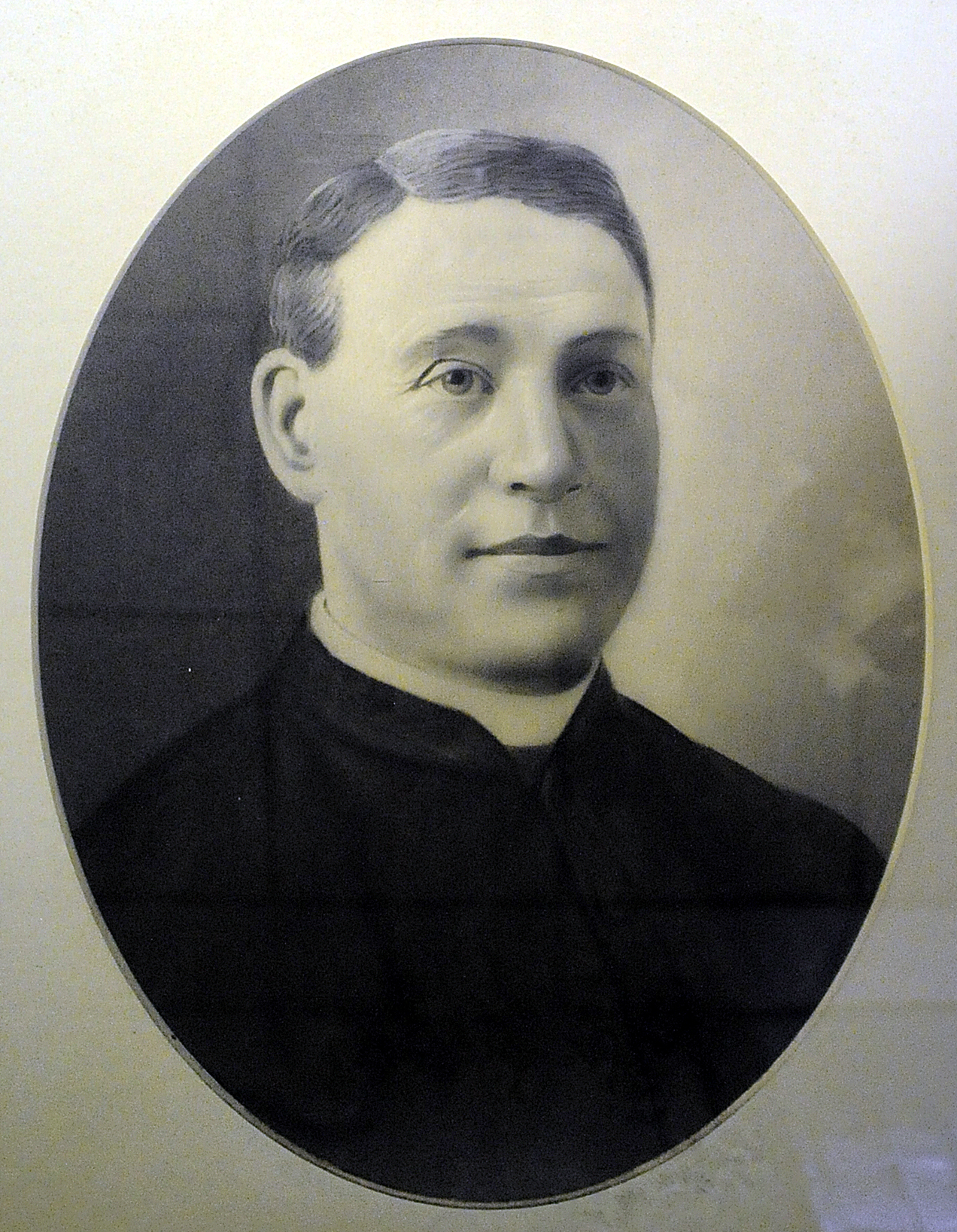
Nearby, a large black-and-white portrait of the priest adorned the wall. His face was round and ruddy. His smile was serene.
Boys and girls grew up knowing little bits about Monsignor Wallace, partly passed on in priests’ homilies about the days when the city’s Catholic community was still learning to assert itself, Poulin said.
The building that became St. Peter’s School — and now hosts a food pantry — still bears the “Wallace Building” sign in stone. At the church, due to close on Oct. 27, he will continue to be present. His name is on one of the biggest, most imposing stained-glass windows in the nave.
“At St. Patrick’s, he was everywhere,” Poulin said.
Monsignor Thomas Wallace was responsible for getting St. Patrick’s Church built in 1890. He was buried in a crypt in the church in 1907.
Monsignor Thomas Wallace’s crypt in St. Patrick’s Church is empty because church officials removed his body to prepare for the church’s closure.
Prince of Peace Parish maintenance man Jerry Tanguay enters the crypt in St. Patrick’s Church where Monsignor Thomas Wallace had been entombed.
Monsignor Thomas Wallace’s crypt in St. Patrick’s Church is empty after officials removed his body for burial in Mt. Hope Cemetery. The church is due to close on Oct. 27.


Comments are no longer available on this story