
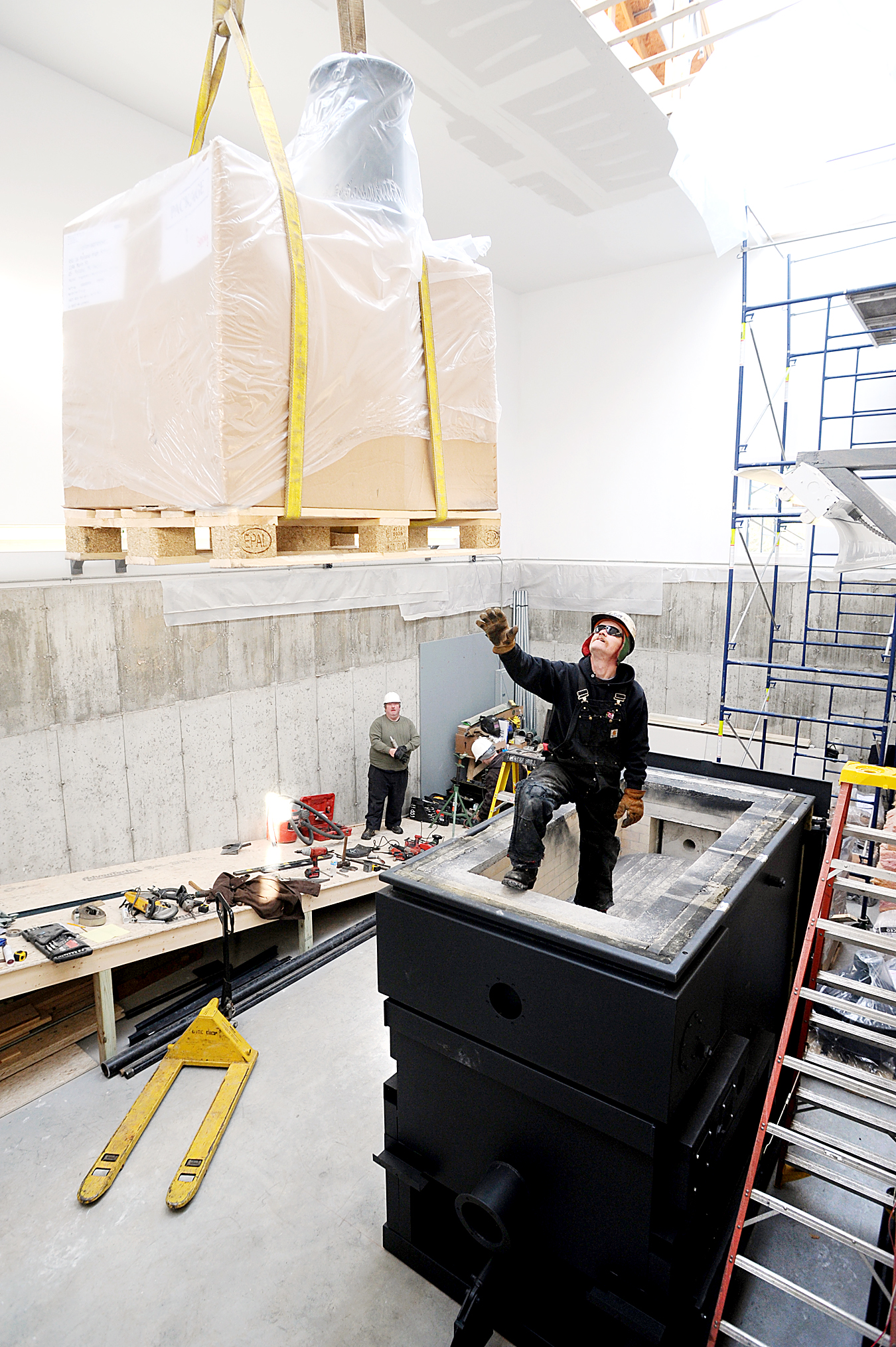
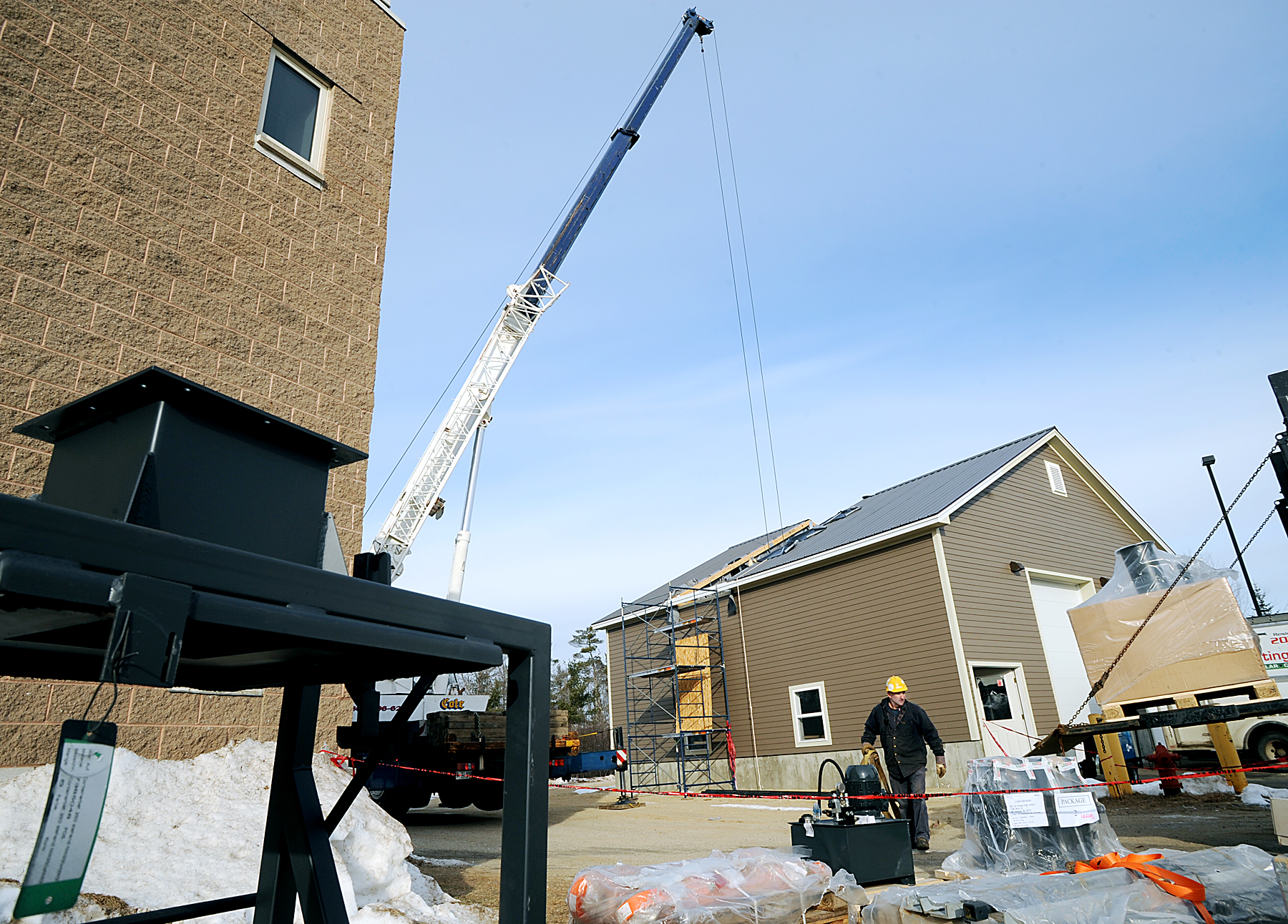
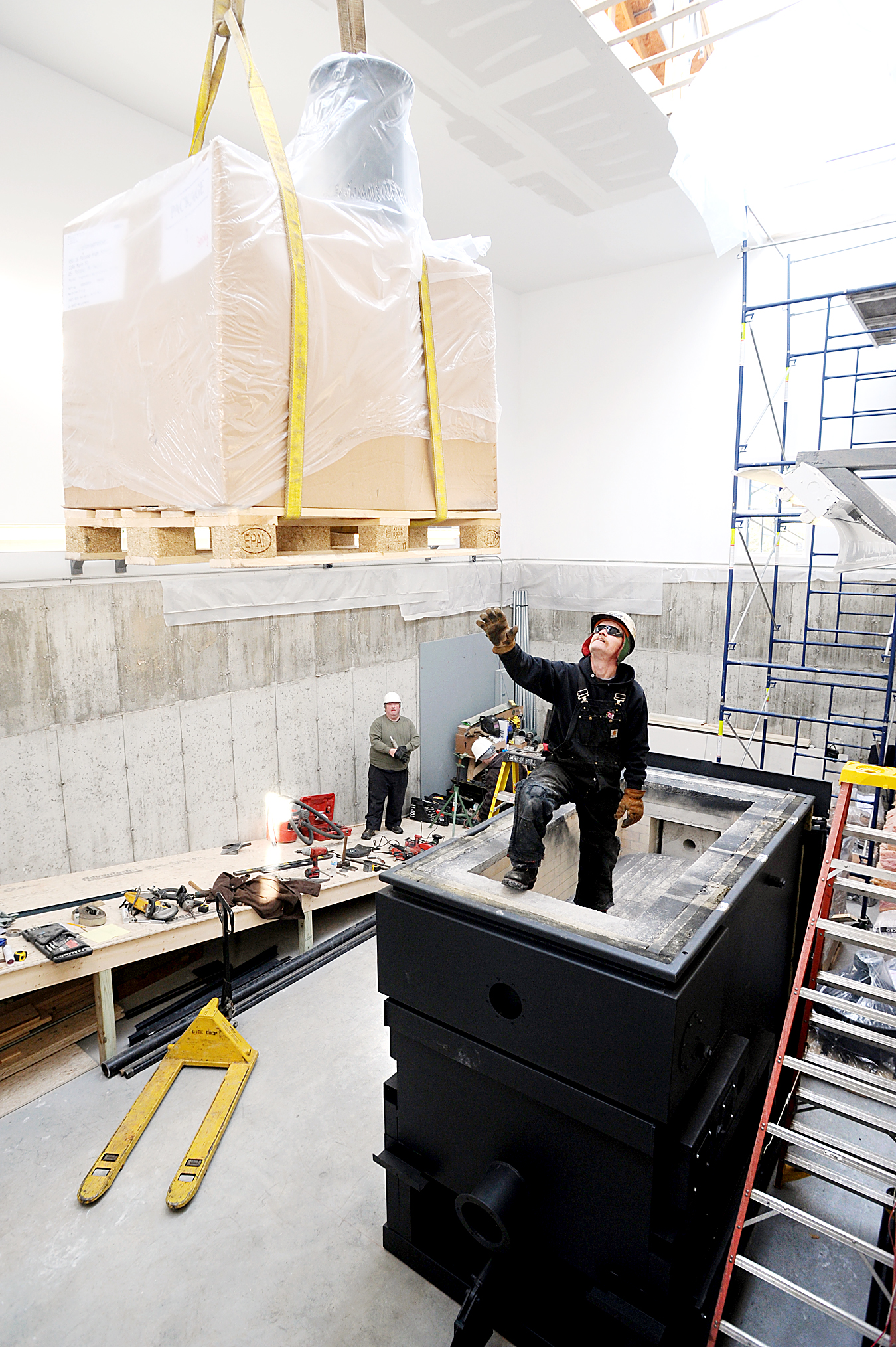
POLAND — Scattered applause helped the Cote Crane operator ease the 7-ton burner unit for the Poland middle/high school’s new biomass furnace through a freshly cut hole in the boiler building roof Thursday morning.
“It couldn’t be coming at a more opportune time,” Poland Regional High School Principal Cari Medd said. “Our No. 1 boiler let go almost a year and a half ago, and our second boiler is on its last legs.”
Standing next to Medd, shivering in the nippy air that barely cracked double digits, Bruce M. Whittier Middle School Principal Ayesha Farag-Davis offered that on days like Thursday, when the temperature in some classrooms in her wing hangs at 60, even boisterous, high-energy 13-year-olds tend to clump as close as possible to the nearest heat source.
“It’s cold in our wing — not as cold as out here, but it’s cold,” Farag-Davis said.
What should be a backup boiler isn’t up to meeting the demands placed day after day of what is ordinary January weather.
The new, wood-to-energy system will supply more than 2.3 million BTUs per hour of hot-water heat to the 134,000-square-foot school.
“This is the first boiler to hit the floor of the boiler room,” Tom Wood, senior planner for the Maine Forest Service’s wood to energy program, told the gathering. He recounted the brief history of the $11.4 million his agency received through the American Recovery and Reinvestment Act of 2009 to fund projects such as the one in Poland.
Regional School Unit 16 Business Manager Rick Kusturin learned of the grant program in November 2009, just as he was preparing to give the School Committee the bad news about the failed boiler.
Kusturin ran the numbers by the committee: It was going to cost about $60,000 to repair the failed boiler that relied on non-renewable fossil fuel, coming chiefly from foreign sources; or, if they could secure a grant, it would cost about $60,000 to acquire a new heating system that uses fuel that grows in the backyard.
The School Committee was sold on a state-of-the-art biomass system that could replace 47,000 gallons of No. 2 fuel per year at an estimated annual savings to the district of more than $125,000.
“It was a long shot” last February, Kusturin said, when the school system was offered the $636,372 grant.
“Credit is due (Superintendent) Dennis (Duquette) and Rick (Kusturin) for jumping on the opportunity,” School Committee Chairman Dave Griffiths said. “We now have a system that pushes the limits of technology, sets the standard. I look forward to the day other schools come to Poland to see this system.”
Wood noted that at least 200 jobs will be created in Maine, once all 13 biomass boiler projects that have been approved through his department’s program are operational.
“As much as 85 percent of the funds spent on oil leave the state immediately,” he said. “The chips for this boiler will come from local sources, employing Maine people in all phases of production, from stump to heat in the classroom. This project is about keeping the jobs at home. Exporting wood-cutting jobs to China is just not going to happen.”
Kusturin said it would be a few weeks before the system is up and running, with the initial load of fuel coming from Maine Wood Pellets.
“We don’t have a contract for the chips,” Kusturin said. “We haven’t chosen our regular supplier yet.”
Tony Bennett, facilities manager at the high school, said he couldn’t wait for the new system to come on line.
“I’m tickled to death the boiler is in,” Bennett said. “I’ll be more comfortable once it’s up and running. No doubt there will be some bugs, but we’ll work them through.”
Comments are no longer available on this story