
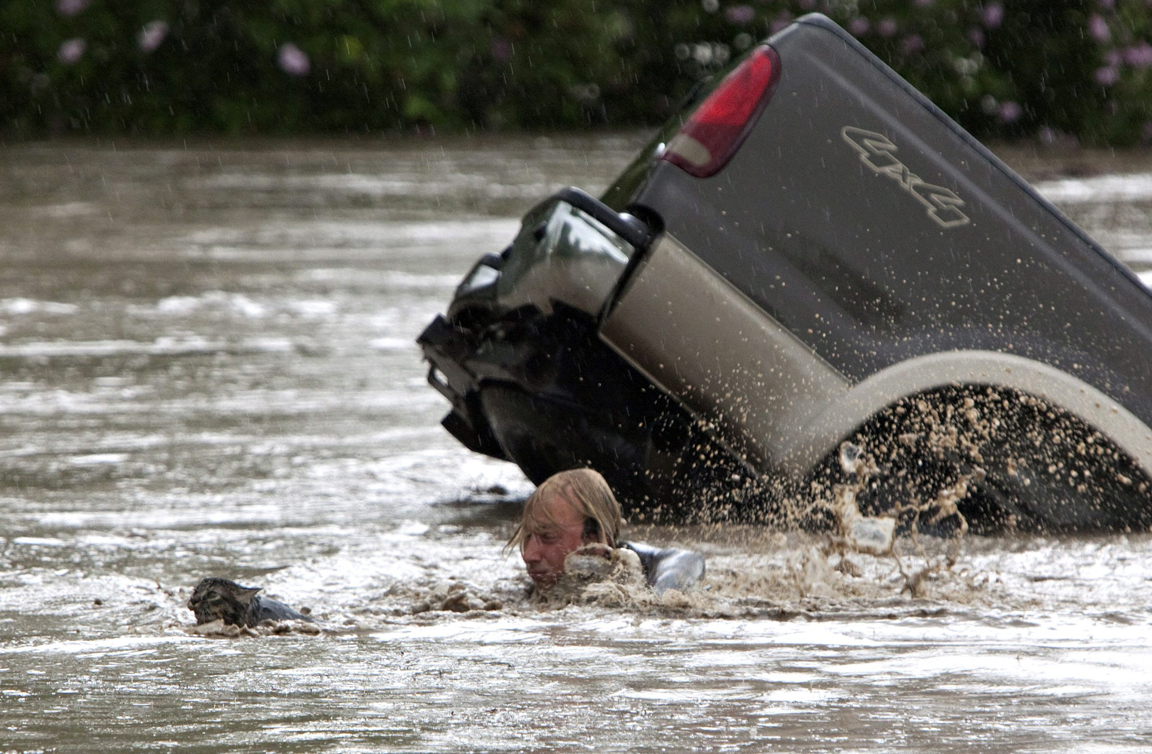
CALGARY, Alberta — Police in Calgary, home to Canada’s oil industry, ordered as many as 75,000 residents to leave their homes and closed most of the downtown business district after heavy rains flooded parts of the city and corporate headquarters lost power.
Suncor Energy Inc., Canada’s largest energy company by market value, was among businesses closing offices as workers were told to stay home and schools, bridges and roads were shut. The Bow and Elbow Rivers, which meet near the middle of Calgary, surged from their banks into neighborhoods and were expected to remain high for several days after 4 inches (10 centimeters) of rain fell over two days.
Calgary has imposed a state of emergency, with 26 communities ordered to be evacuated, according to the city’s website.
“The Bow is moving higher and faster than I have ever seen in my lifetime,” Calgary Mayor Naheed Nenshi said at a media conference posted Friday on the Calgary Police website. Nenshi said 75,000 people have been ordered evacuated. “Avoid all travel that is not absolutely necessary.”
Calgary suffered its worst flooding in about a century in June 2005 when surging waters damaged 40,000 homes and forced the evacuation of 1,500 people, according to the city website. Water on the Elbow River last night was flowing more than three times faster than during the 2005 flood, Alberta Premier Alison Redford said Friday at a press conference in Calgary.
Canadian Forces was dispatching troops, including infrastructure engineers, to Calgary to assist in the crisis, she said. Nenshi said no casualties had been reported so far in the flooding.
The Bow River was moving 1,500 cubic meters per second above the Bearspaw dam, Nenshi said in a press conference Friday. That may climb to 1,700 cubic meters per second if upstream dams protecting the city are forced to release more water, he said.
“We’re holding back as much water as we can,” TransAlta Corp., owner of dams upstream of Calgary, said on its Twitter page today. The company’s headquarters in the city was under an evacuation order, it said.
Bearspaw Dam, owned by TransAlta, was built in 1954 on the Bow River primarily to reduce flooding in Calgary, according to the company website. It’s the first of four TransAlta hydroelectric dams upstream of the city on the Bow.
Neighborhoods in the flood plain of the Bow and Elbow rivers, including those surrounding the downtown office towers, were evacuated late yesterday and early this morning, according to the city’s website. Hotels were full, with some suggesting people travel to Red Deer to find a bed.
Water on the Bow River rose to just below a bridge designed by Spanish architect Santiago Calatrava. Roads including Elbow Drive through the city’s southwest quadrant have been flooded and much of the power to the central city was off, darkening buildings and traffic lights.
Peter Butler, a tourist from Massachusetts on a vacation to the Canada’s Rocky Mountains, was planning to leave the city to escape the floods.
“I think we’re going to just fly to Vancouver, just try to get out of here,” he said from the Fairmont Palliser hotel, where staff had lit candles for lighting. “It was a little bit alarming, going to bed and knowing the waters are slowly rising.”
A low pressure system moved in off the Pacific and crossed the U.S. Pacific Northwest earlier this week, said Bernie Rayno, a senior meteorologist at AccuWeather Inc. in State College, Pa. The movement of the storm and the topography of the Canadian Rocky Mountains create “ideal conditions” for heavy rain, Rayno said.
“Some areas in the mountains got 5 inches of rain in 24 hours,” Rayno said. “Where is that water going to go? Down into the streams. Epic flooding is occurring in southern Alberta. This is as bad as it gets.” Rayno said the worst of the rain is probably over.
“We certainly are dealing with something very different than we were in 2005,” Premier Redford said at the news conference, referring to higher volumes of water flowing on the Elbow River than during flooding eight years ago. It’s too early to tell if the impact will be worse than in 2005, she said. “Everyone has the sense that this is very significant.”
Comments are no longer available on this story