
Off-the-grid joy draws visitors to western Maine.
Mountains rose on his canvas, while crickets chorused instead of car horns. From the cabin on the ridge, Tim D’Agostino turned his easels to face the mountains: Baldpate, Old Speck, Whitecap. He’d paint all day, sometimes break for a hike, and at night he read Moby Dick by an oil lamp. By morning, he showered using water from a sun-warmed skin. After he returned to New York City and was still painting with the greens and blues borrowed from the trip, he responded evasively when friends asked him where he’d stayed: Oh, you know, western Maine.
“It was all cabin, valley and mountain sky,” D’Agostino said recently of his month-long stay at Skyline Ridge in Andover. An artist and instructor at the Bronx Community College, D’Agostino, 44, came for the views as much as the lifestyle, part of a wave of people, many from cities on the East Coast, looking to unplug and unwind at off-the-grid accommodations across Oxford County.
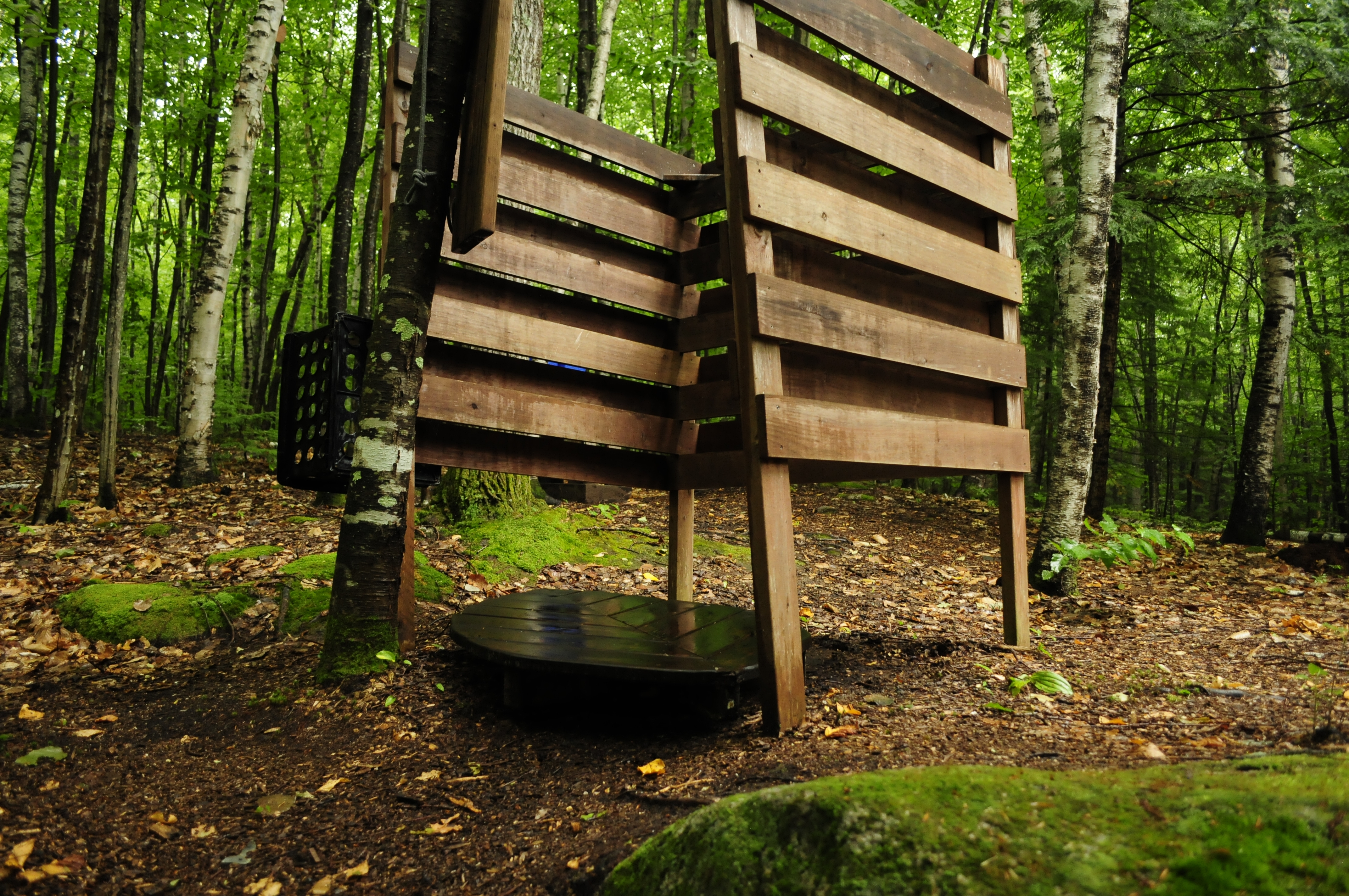
Whether you call it camping or glamping (glamorous camping) or just good business sense, a range of off-the-grid cabins, tiny houses and yurts from Brownfield to Andover have risen to meet the demand. Glamping promises the wilds of camping without some of its inconveniences, allowing lodgers to ratchet their taste for a primitive life up or down based on their sense of adventure. Attracted by the quietness, fewer neighbors and stunning views, as well as modest rental costs, lodgers say it’s about more than the novelty of cooking on a wood stove or using an outdoor gravity-fed shower. It’s about the timeless charms of a simpler life, minus the hassle.
Burnt out on New York City hustle and bustle, Keith Tiszenkel downsized to Portland a few years ago and not long after took a weekend retreat with his girlfriend at a 200-square-foot tiny house along the Crooked River in Waterford.
By day he painted chickadees and drank tea along the river, by night watched “Game of Thrones” on his laptop, charged on his car battery. A popular option for urbanites looking to unwind, when the tiny house was put up for sale this year by its owner, Tiszenkel bought it.
“I think as human beings we’re programmed to need solitude and isolation to recharge. Getting back to nature, we find ourselves again,” Tiszenkel said.
The kitchen is stocked with spices. A cooler acts as a makeshift sink. Beneath the stairs leading to a loft and mattress is a comfy couch. The tiny house is off the grid; cooking is done by propane, the shower is fed by a hand pump outside. Guests bring their own drinking water. The house includes an unheated guest cabin, with attached composting toilet; all of it goes for $100 a night in peak season.
While more tourists go to the coast or even Baxter State Park, when people visit western Maine, they do so for the purpose of getting outdoors more than any other region in the state, according to a 2013 study by the Maine Center for Economic Policy.
And what the area has to offer meshes well with out-of-staters primed to receive Maine’s message of authentic adventure, particularly for middle-aged, nature-attuned individuals and families looking to get off the beaten path, according to the Maine Tourism Association.
On a recent weekday at Skyline Ridge in Andover, 29-year-old Kevin Snow was deciding between hiking to a swimming hole or fishing. He made the trip from Lowell alone — his girlfriend balked when told there was no electricity — where he manages employees for a company.
“Here, the only thing to manage is water,” Snow said.
That morning he’d showered indoors from a gravity-fed rain barrel strapped to the roof. Because the sun hadn’t hit it, the water was ice cold. “I didn’t need coffee.”
Around the small cabin, an abundance of cast-iron pans hung from the walls, and a dog-eared gazetteer was tucked beneath some board games. In the kitchen, there was a propane-fed stove and a fridge, powered by solar panels. Owners Brenda and Lance Stickney say their clientele are split 50-50 between the cosmopolitan and the rural. Cabins go for $136 a night.
“It’s everything you need, and nothing you don’t,” Brenda said.
Jerusha Murray, who rents out her off-the-grid Stow cabin overlooking Evans Notch, said it’s not just young people flocking to the woods. Her lodgers are older, upper-middle-class “adventurers” interested in birding and exploring.
“Everything makes noise, but at the cabin you can hear a leaf disconnecting from a tree,” Murray said.
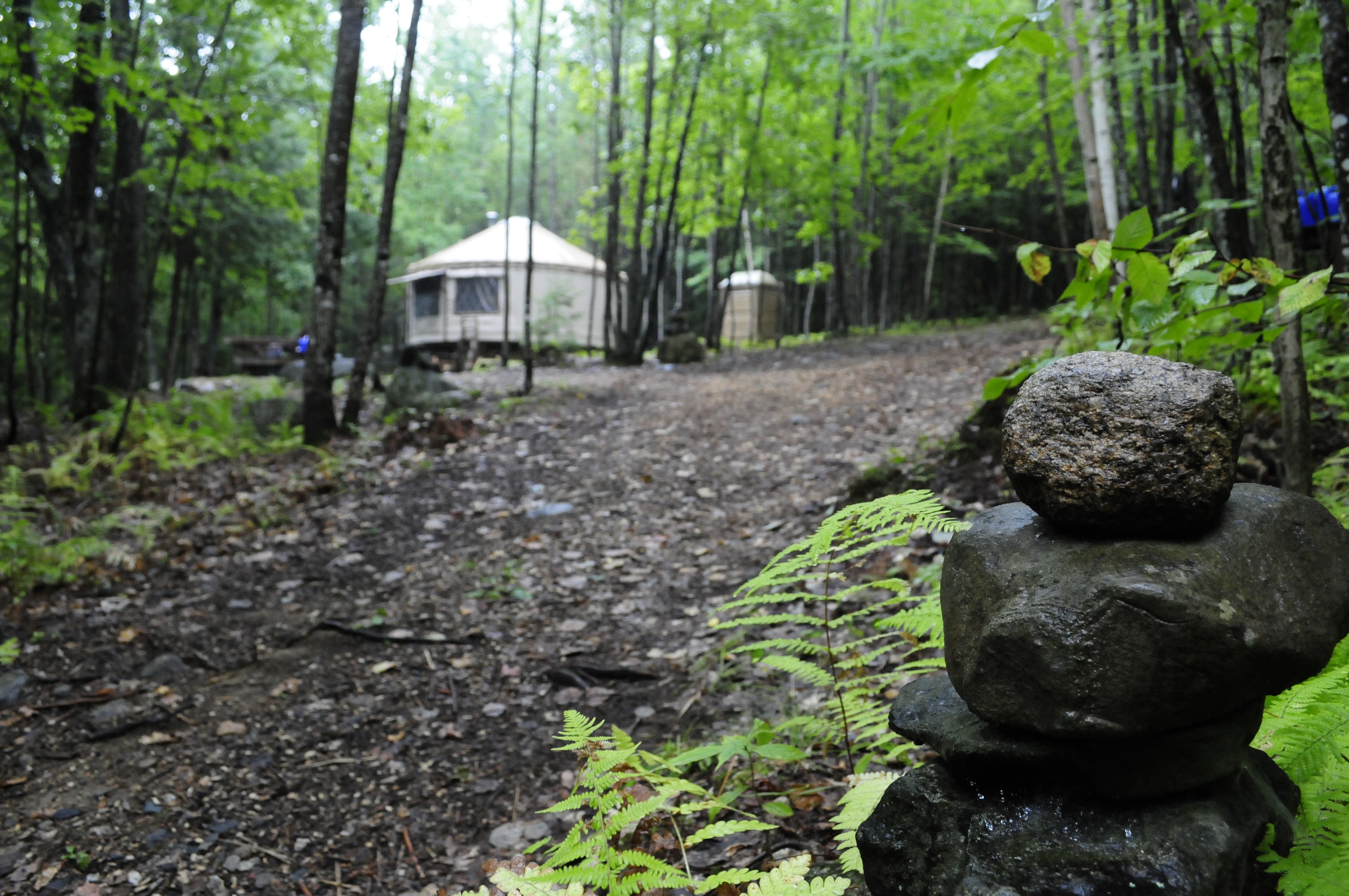
Winding an off-road, oversized golf cart along forest trails from yurt to yurt, Erika Fagan was overseeing last-minute preparations for guests at Frost Mountain Yurts in Brownfield. Erika and her husband, Patrick, run four off-the-grid yurts, popular with cross-country skiers who come from around the world to enjoy 60 acres of interconnected trails; in the summer, those same trails provide hiking and mountain biking.
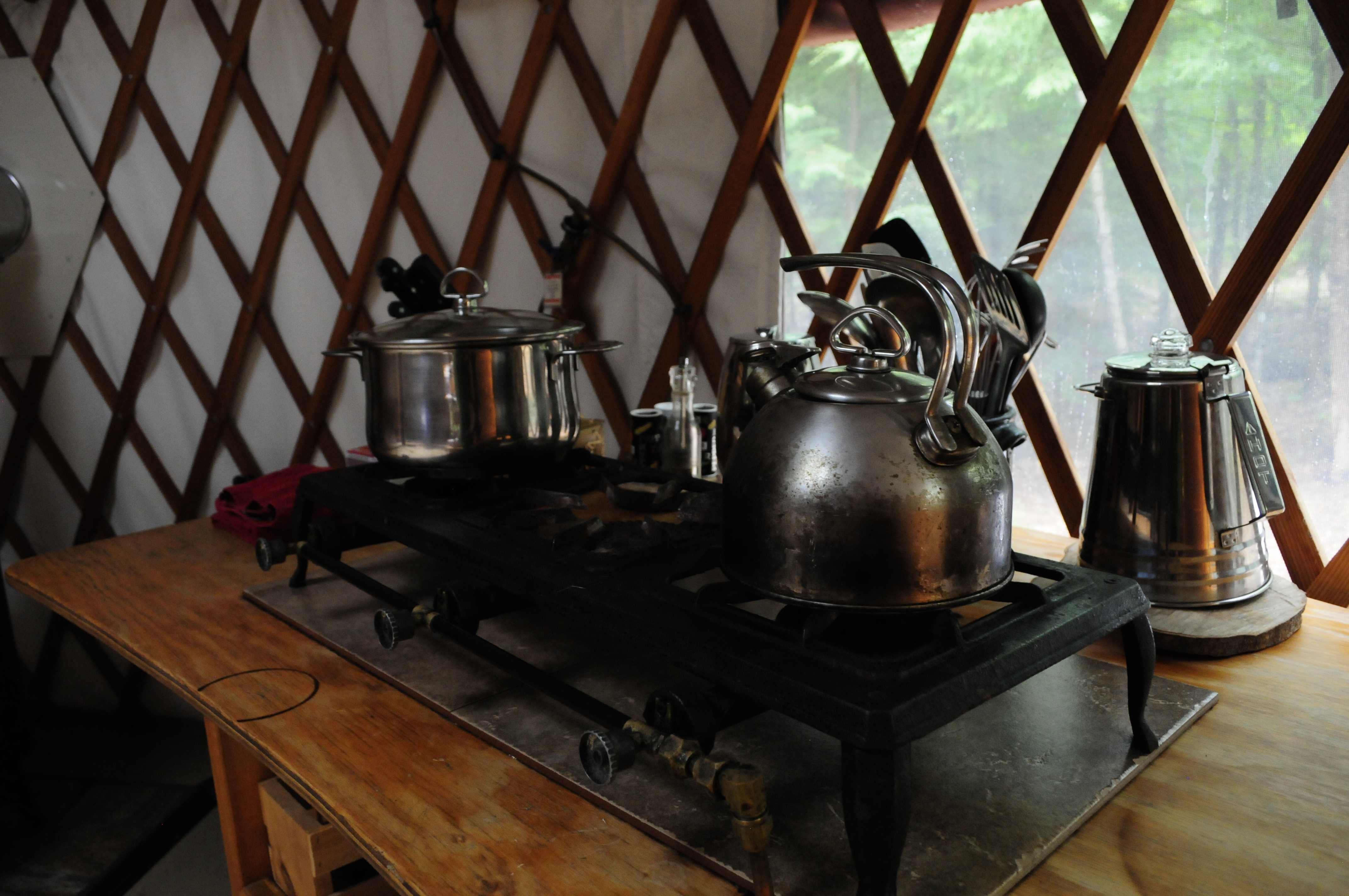
“We totally fit into glamping,” Fagan said as she stepped from the wooden porch to the yurt door. Circular tents with roots in Central Asia, the Fagans’ modern yurts have wooden lattice frames, vinyl windows — including a skylight — tables and bunks. There are propane burners for cooking, French presses for coffee, a fondue pot and plastic wine glasses. For a fee, the Fagans will even warm the yurt in advance, which are heated by stove. The decks are cleaned off so lodgers can walk barefoot without bringing dirt into the yurt.
Guests bring their own bedding, drinking water and food, which is hauled in wheelbarrows from a parking site. Rates vary, but the yurts go for as much as $140 a night in the winter; $125 in the summer. Weekends are booked a year in advance, and for some holiday weekends, they’re booked for life.
“You don’t feel as closed inside,” Erika explained, “and I think a yurt is cool.”
While some come to the off-the-grid accommodations to hike, bike or fish, others come to meditate in the mountains. At Nurture Through Nature, a yoga retreat off a quiet dirt road sloping up Pleasant Mountain in Denmark, on a recent weekday guests carrying plates of hummus, salsa, crackers and cheese were walking out onto the porch of a cabin after a morning yoga session as someone played “Rising Sun” by George Harrison on the mandolin inside the cabin.
More than a decade ago, owner Jen Deraspe quit a job teaching sports medicine at the University of Southern Maine and began leading retreats. In 2003, she raised the first cabin — “It was a barn raising. People I didn’t know just showed up, and it was magical.” — which now doubles as the yoga studio. Since then, a handful of yurts and cabins, composting toilets and even a wood-fired sauna have sprouted.
“It’s all about mindfulness, and being present in the moment,” Deraspe said. “They (guests) approach their limit of wildness. They want a table and floor, but also to edge closer to nature and get away.”
Recently, about a dozen people in spandex and head bands were sitting outside at Nurture Through Nature retreat. The conversation drifted to the repetitive neediness of Facebook, the civil war in Syria, folk music and the unexpected bonds people form when engaged in intentional silence.
“It’s not far, but it feels like a different world,” said Tara Humphries, a 21-year-old sociology student at Bates College in Lewiston.
Jen Deraspe’s sister, Mer, cooks. Solar power provides the electricity, even for Wifi, but most guests said they hadn’t checked their phones. “Other than the composting toilet, you barely notice you’re living off the grid. I don’t see why more people aren’t doing it,” Humphries said.
Betsy Mellor had driven from Wellfleet, Massachusetts, to get away from the computer and a busy life, and “invest in my mental health.” As she packed her bags to leave the yurt she had been staying in, Mellor paused to sit in an oversized chair that folded into a bed and began reading a book by a Buddhist monk. The night before, rain had pelted the yurt’s fabric, making it sound like a drum, she said. Wind swirled the trees overhead, crickets chirped, but the secluded lodgings were otherwise silent.
Her roommate, Susannah Brown of Worthington, Massachusetts, took out an iPhone and asked to have their photo taken in front of the yurt. As she carted her belongings in a wheelbarrow to her car, she was asked if she had mixed feelings about returning to a world of smartphones and computers.
“That’s the way it is,” Brown said.
‘It’s everything you need, and nothing you don’t.’






Comments are no longer available on this story