
TWINSBURG, Ohio — Titina and Elizabeth Gist, both donned their “twindividual” shirts before heading out for their first night here. The 30-year-old identical twins do everything together. They often speak in unison. And in Gainesville, Florida, where they share an apartment, they’re used to turning heads.
“In our town, we only see us,” Elizabeth said. “Everyone knows us as ‘The Twins.'”
Not here.
They drove nearly 1,000 miles to Twinsburg for the weekend because they wanted to meet other people who get what their life is like. At the annual Twins Days festival, there’s plenty of chances for that, with 1,520 sets of twins, triplets, and quadruplets coming to this small Midwestern town for the largest such gathering in the world.
The Gist twins spoke of the many charms, oddities and irritations that come with twindom, and many twins nearby nodded sympathetically. One is Twin A and one Twin B. “I’m the first one,” Elizabeth explained. Titina expanded: “And I’m more to-the-point.”
“When I think about what would happen if we weren’t together, if something happened to her, I literally start crying,” Titina said.
Singletons — code at the event for non-twins — just don’t understand.
That’s sort of the point of this weekend, twin siblings say: to celebrate and recognize the unique existence that comes with being a twin. Such as Saturday morning’s Double-Take Parade, in which costumed twins and their family members walk alongside themed floats as an old calliope plays carnival tunes. Onlookers in lawn chairs line the residential street to watch and wave. Double- and triple-wide strollers cut through the crowds.
“Even when thousands of people come to this small town, it feels like home to them,” said Kevin McManamon, a 52-year-old Twinsburg resident.
Twinsburg’s name is no coincidence. About 25 miles southeast of Cleveland, the town was named for two of its founders, identical twins Moses and Aaron Wilcox, who owned property in what was originally called Millsville. They donated six acres for a public square and cash for a public school. A historical presentation for the town’s sesquicentennial, in 1967, recounted stories about the twins communicating by “mental telepathy” and standing in for each other on dates.
The Wilcox brothers wed a pair of sisters, had an equal number of children — none twins — and later died of the same disease. They also rest in eternity together, having been buried in the same grave at the Locust Grove Cemetery near the city’s main square. On Saturday, there were red roses on each side of the twins’ gravestone and two bouquets of red flowers at its head. Twinsburg also bares homage to their image – two silhouetted male faces – on its flag.
The town of about 19,000 residents is filled with pastel-colored Colonial homes and sits among rolling green hills. Celebrating its 200th anniversary this year, Twinsburg fashioned itself the center of gravity for the nation’s twins and multiples, reveling in its founders’ quirks. Twins Days has been celebrated here since 1976, when 37 sets of twins made it to the first event. The festival now draws thousands of twins each year.
And while twin births have been increasing steadily during the past 30 years, now is perhaps the peak for twindom in the United States, partially explaining the festival’s surge.
When Twins Days hosted its first event here, the twin birthrate hovered just below 20 sets of twins for every 1,000 live births. From 1980 to 2009, the rate of twin births surged by 76 percent — accounting for 865,000 additional twins above the expected average, according to the Centers for Disease Control and Prevention. Twin births hit their peak in 2014, with twins accounting for 33.5 of every 1,000 live births in the United States. Twin births in 2015 nearly kept pace.
Rose Pacalo and Charlotte Italiano, 85-year-old twin sisters from nearby Youngstown, started coming to Twins Days a decade ago to find more like companions. When they were growing up, Pacalo said, they could easily fool teachers and switch classes. That gusto still stands, with the twins wearing matching red-sequined hats on Saturday as they rode down the parade route in a convertible.
“In our family, in the younger generation, we have four sets of twins,” Pacalo said.
Philip Malm and his identical brother, Doug, 60, met their wives, Jena and Jill, 50 — also identical twins — at Twins Days in 1991. The brothers later proposed to the women on the Twins Day stage the next year, and the two couples decided to get married at the festival in 1993. They now all live together in Moscow, Idaho.
“It’s family,” Phil said of the festivalgoers. Everyone is on the same wavelength.
The historically high population of twins has been great for researchers. Scientists from hospitals, government agencies and large companies set up shop at Twins Days each year to administer surveys, collect DNA samples and recruit study subjects.
Identical twins are of particular interest because they share the same genetic makeup, giving researchers the opportunity to determine what behaviors or health risks are a factor of their environments rather than inherited DNA.
As the rate of twin births has grown, so, too has a push within the medical community to drive down the rate because twins are typically considered to cause higher-risk pregnancies, said James Goldfarb, chief of the division of infertility at University Hospitals Cleveland Medical Center. Twins are more likely to be born preterm, be admitted to the neonatal intensive care unit and experience birth defects.
The American Society for Reproductive Medicine recently released guidelines strongly in favor of single-embryo transfer, both to reduce costs and the rate of twin and multiple births. Alan Penzias, a reproductive endocrinologist at Boston IVF and clinical professor at Harvard Medical School – and a parent of twins – said it’s likely the rate of twin births will return to near-normal levels before long.
Those at Twins Days don’t much care what the birthrate is; they just want to celebrate the phenomenon, and one another.
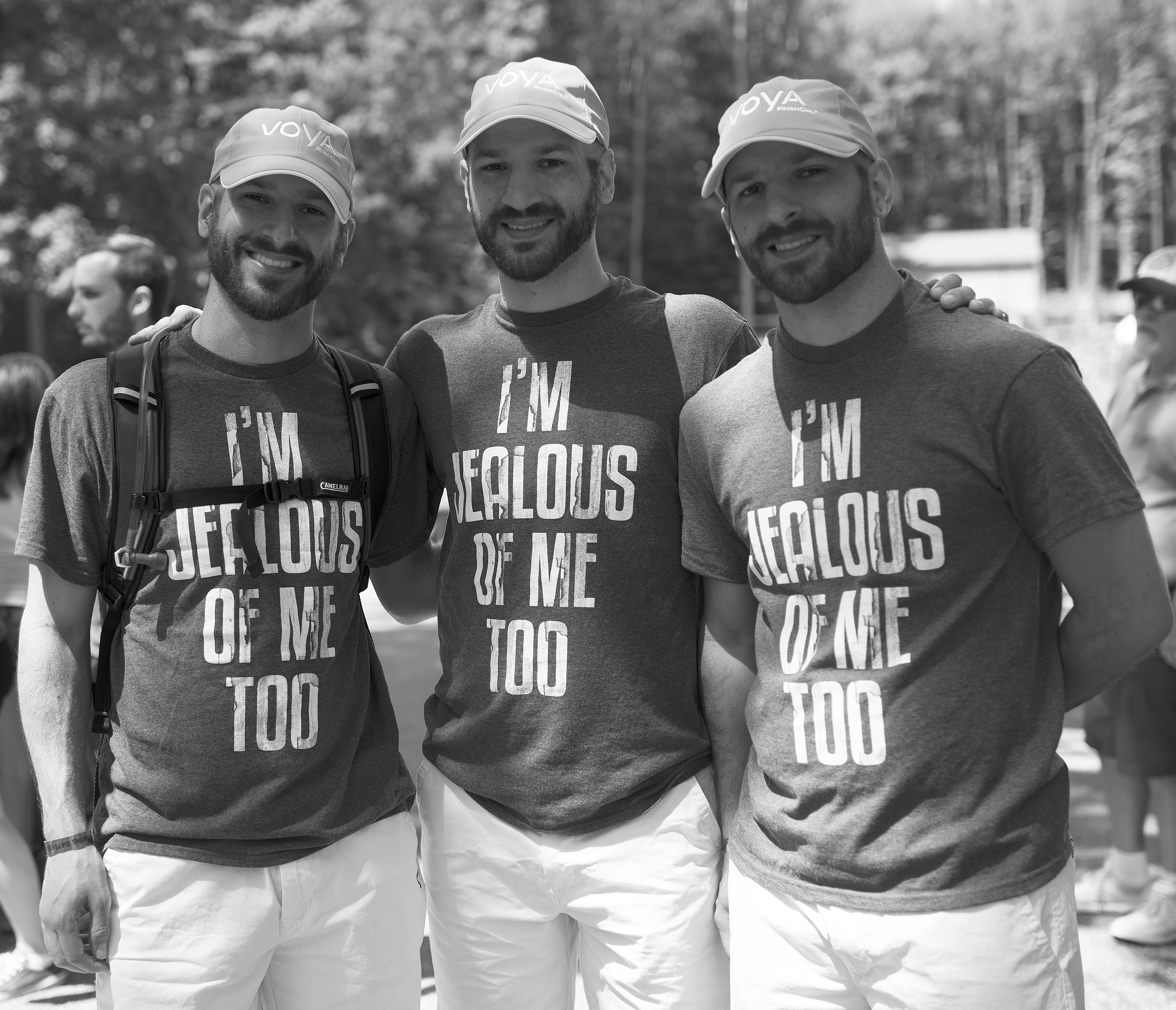
Triplets Moses, Jonas and Noah Allooh, 32, of Cleveland. MUST CREDIT: Washington Post photo by Marvin Joseph
The Washington Post