



The mountainous region of Nagorno-Karabakh, where deadly new fighting has erupted in recent days between Armenian and Azerbaijani military forces, has been in a tense limbo since a 1994 truce. The Associated Press explains what’s behind the long-unresolved conflict:
WHAT AND WHERE IS NAGORNO-KARABAKH?
Karabakh is a region within Azerbaijan that has been under the control of ethnic Armenian forces and the Armenian military since the 1994 end of a full-scale separatist war that killed about 30,000 people and displaced an estimated 1 million.
Nagorno-Karabakh proper has an area of about 1,700 square miles — about the size of the U.S. state of Delaware — but Armenian forces occupy large swaths of adjacent territory.
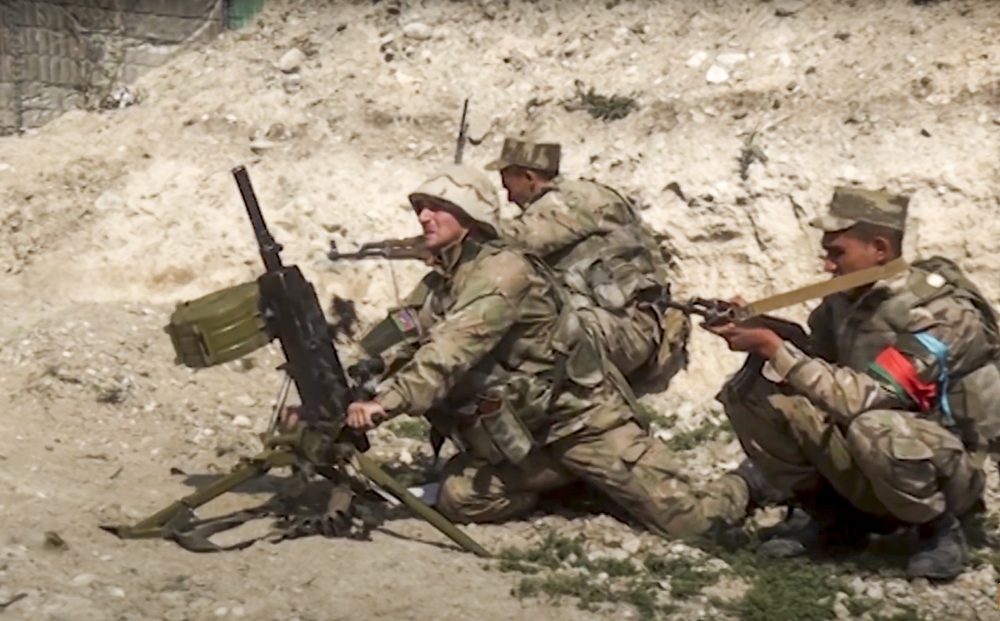
Azerbaijan’s soldiers fire from a mortar at the contact line of the self-proclaimed Republic of Nagorno-Karabakh, Azerbaijan on Sunday. Azerbaijan’s Defense Ministry via Associated Press
HOW DID THE CONFLICT START?
Long-simmering tensions between Christian Armenians and mostly Muslim Azeris began boiling over as the Soviet Union frayed in its final years. Once the USSR collapsed in 1991 and the republics became independent nations, war broke out.
A 1994 cease-fire left Armenian and Azerbaijani forces facing each other across a demilitarized zone, where clashes were frequently reported.
WHAT’S HAPPENED SINCE?
International mediation efforts to determine the region’s final status have brought little visible progress.
The conflict has been an economic blow to the Caucasus region because it has hampered trade and prompted Turkey to close its border with landlocked Armenia.
Fighting periodically breaks out around Nagorno-Karabakh’s borders, often deadly, notably in 2016 and this July. Since new fighting erupted Sunday, dozens have been killed and wounded in apparent shelling by both sides. Each country blamed the other for sparking the clashes.
WHAT’S THE BROADER IMPACT?
In addition to causing local casualties and damage, the conflict in the small, hard-to-reach region is also of concern to major regional players.
Orthodox Christian Russia is Armenia’s main economic partner and has a military base there, while Turkey has offered support to Azerbaijanis, ethnic brethren to Turks and fellow Muslims. Iran neighbors both Armenia and Azerbaijan and is calling for calm.
Meanwhile, the United States, France and Russia are meant to be guarantors of the long-stalled peace process, under the auspices of the Vienna-based Organization for Security and Cooperation in Europe.
Comments are not available on this story.
Send questions/comments to the editors.
