



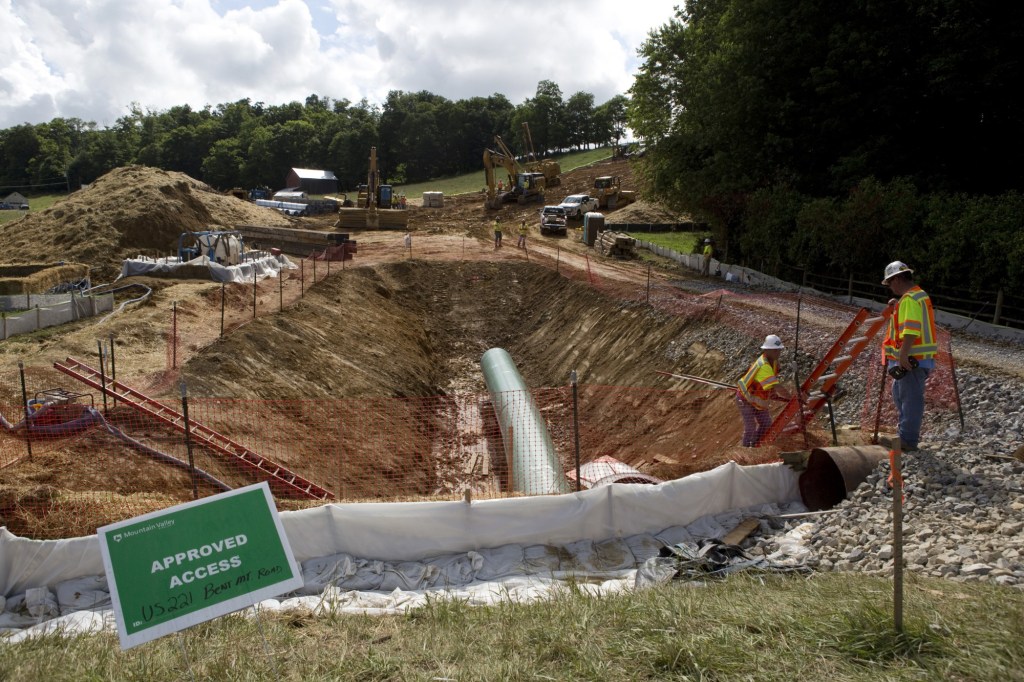
Construction crews bore beneath U.S. 221 in Roanoke County, Va., in 2018, to make a tunnel through which the Mountain Valley Pipeline will pass under the highway. The state of West Virginia announced Monday that it is appealing a ruling that blocked construction on a segment of the contentious natural gas pipeline being built through Virginia and West Virginia. Heather Rousseau/The Roanoke Times via Associated Press
CHARLESTON, W.Va. — The fate of a controversial natural gas pipeline in West Virginia may rest with the U.S. Supreme Court, as the state appealed a lower court’s ruling that temporarily blocked construction despite a congressional order clearing the way for the project.
West Virginia Attorney General Patrick Morrisey argued that the 4th Circuit Court of Appeals in Richmond, Virginia, lacked jurisdiction to block the Mountain Valley Pipeline. In a statement Monday, he said any challenges to Congress’ action must be heard by a federal appeals court in Washington, D.C.
Morrisey asked the U.S. Supreme Court to take up the case.
“The Mountain Valley Pipeline is vital to the survival of American energy independence and affects thousands of jobs in West Virginia – its completion is also critical to our national security, the urgent need is for it to be completed as soon as possible,” Morrisey said.
Congress passed legislation last month ordering all necessary permits be issued for the pipeline, which crosses rugged mountainsides in Virginia and West Virginia. Environmentalists say the construction plan will cause erosion that will ruin soil and water quality.
The legislation addressing the pipeline was part of a bipartisan bill to raise the debt ceiling. It stripped the 4th Circuit Court from jurisdiction over the case. Environmentalists have argued that Congress overstepped its authority by enacting the law, saying it violates the separation of powers outlined in the Constitution.
The appeals court issued a stay July 10 focusing on a 3-mile pipeline section that cuts through the Jefferson National Forest. On July 11, the court issued a similar stay in connection with parallel litigation alleging the pipeline would violate the Endangered Species Act. Environmentalists made similar constitutional arguments in that case.
The pipeline’s operators say the project is already substantially complete and that only 3 acres of trees need to be cleared, compared to more than 4,400 acres that have been already cleared.
The $6.6 billion, 300-mile pipeline is designed to meet growing energy demands in the South and Mid-Atlantic by transporting gas from the Marcellus and Utica fields in Pennsylvania and Ohio.
Copy the Story LinkComments are not available on this story.
Send questions/comments to the editors.
