
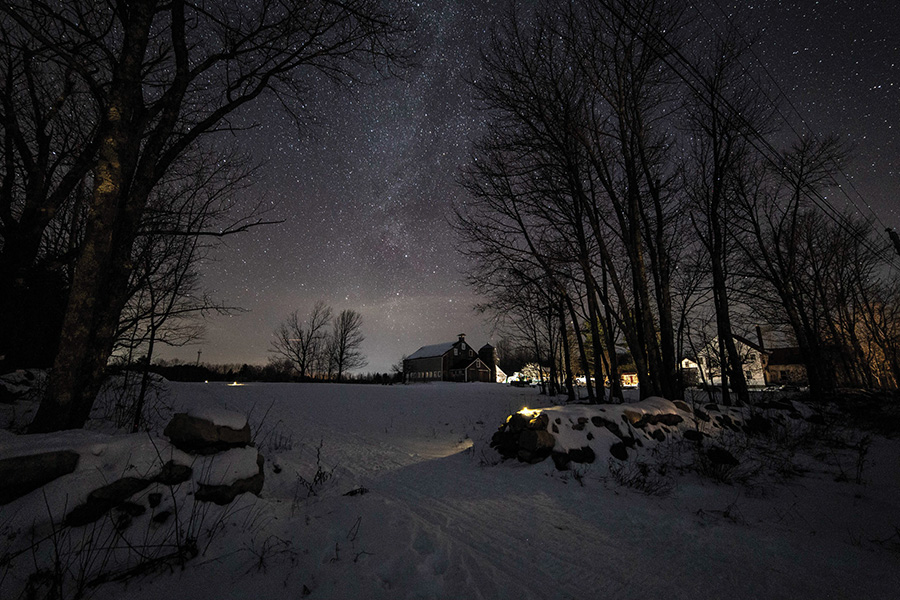
“The winter sky is just a marvelous sky to explore,” gushed astronomer John T. Meader. “It’s crisp and clear, it’s refreshing and it’s full of familiar constellations.”
Meader is the owner and operator of Northern Stars Planetarium (northernstarsplanetarium.com), a mobile planetarium program that he has been bringing around the state for over 35 years. Meader said that he’s been dialing back his schedule as he moves into his 60s, but still sees 15,000 to 18,000 kids a year enter the two different domes he tours with.
Even though most of these kids live outside of Maine’s largest cities, what they can see at night through the natural dome of the atmosphere is still affected by light pollution, which can obscure views of the Milky Way and reduce visible stars from the thousands to the hundreds. Reducing light pollution is “important for geeks like me,” Meader joked, “and for birds or sea turtles, animals that navigate by the stars, and, if you don’t care about that, it’s important for all of our health.”
Darkness is vital for our circadian rhythm. It helps us sleep, which is part of hormone production and immune function. If you’ve ever had to sleep where there’s street light coming into your room, or scrolled on a phone six inches from your face for an hour before bedtime, you know the aggravation blue and white light can cause. Screens, and increasingly, digital public lighting default to cool temperatures, which are around 5,000K, equivalent to daylight.
However, unlike other types of environmentally harmful pollution, Meader likes to emphasize how easy it is to reduce extra light, like using warmer, 3,000K temperatures for outdoor lighting, putting units on timers and/or using motion activation. He enjoys working with local land trusts and municipalities to educate residents about light pollution and empower them to make changes, and that includes the Town of Rangeley and Rangeley Lakes Heritage Trust (RLHT), who are taking the mission further.
If preserving the dark is key to preserving wild heritage, it seems natural that the Town would be taking steps toward becoming an official DSI Dark Sky Community, a certification from DarkSky International, the worldwide authority on combatting light pollution.
Maine is one of the most densely forested states in the continental U.S., so it’s not surprising that it is home to the only two designated Dark Sky Places in New England. The Appalachian Mountain Club (AMC) holds about 100,000 acres in the Hundred-Mile Wilderness, which is an International Dark Sky Park. Then there’s Katahdin Woods and Waters, just east of Baxter State Park, all 87,500 acres of which is an International Dark Sky Sanctuary.
While these places in the middle of the state are “officially” dark, Western Maine is perhaps the next best place to look upward. To become certified, the Town of Rangeley has enacted new lighting ordinances (bit.ly/towncode), like capping street lights so they only project downward, and hosts Dark Sky events, like a community Light’s Out! effort in April during International Dark Sky Week. Because Dark Sky Community certification is ongoing, partners like RLHT support community events and education, offering in-person Dark Sky tours and resources to conduct a home inventory.
So whether you’re visiting the region, here all winter season or are blessed enough to live in the Maine woods year-round, here’s what to look for when you look up in the night sky.
What to watch for this winter
As a dark sky devotee, Meader partners with the Rangeley Lakes Heritage Trust and other land trusts around the state to lead night hikes with telescopes and lasers or hold star parties around the new moon. In the winter, he makes sure he’s properly attired. Snowshoeing to the viewing spot may warm you up, but having a snowsuit, proper boots and moisture-wicking, insulated gloves or mittens will let you space out as long as possible.
Like Meader said, winter in the northern hemisphere is primetime for finding constellations. There’s Orion the Hunter, Canis Major and Minor, Taurus the Bull, the Pleiades, Gemini and more. The Milky Way is less prominent as the planet’s tilt means we are looking at its edges. You can also look for the Winter Triangle, an asterism or pattern formed by standout stars Betelgeuse, Procyon, and Sirius, which is the brightest star in our sky and part of Canis Major.
Jupiter will be high in the sky all winter long. Meader said to look for it “right above Orion, up and to his left.” Hot tip: you can spot a planet by its unwavering glow, as opposed to the “twinkle” that starlight creates. Another hot tip: the Appalachian Mountain Club recommends getting a headlamp with a red light setting to preserve your night vision. White and blue lights can take up to 30 minutes to recover from, while red light lets you see without disrupting the stars.
While a telescope is always the best stargazing tool, a decent pair of binoculars should give you a look at Jupiter’s four largest moons (out of 90 total) along with the two gray cloud bands that circle the gas giant.
Meader also said that December will be the best time to view Saturn in the western sky. Since the ring plane crossing last March, an every 13 to15 year occurrence, Meader said the the rings are now “nicely on display,” but you will still need a telescope to see them. And then there are two meteor showers to see. The biggest of the year is the Geminids, which are currently predicted to peak on December 14 with 120 to 130 meteors an hour. They appear with such regularity because they originate from a near earth asteroid. Meader said this will be a great year to catch the peak, as a third-quarter moon (a natural light polluter) will appear after midnight, making for great early evening observations. The Quadrantids start in early January. According to the American Meteor Society, the Quadrantids have potential to be the strongest shower of the year, but usually disappoint because of the short window of maximum activity (six hours) and common, dreary weather in early January, along with a full moon on January 3. Let’s all cross our fingers for perfect conditions before they wrap up around January 12.
Looking for the perfect spot to stargaze? Check out Rangeley’s Dark Sky Trail, a list of hiking destinations from the Rangeley Lakes Heritage Trust.
Wondering what the viewing conditions are? Visit clearoutside.com/forecast.
Want to be a Dark Sky hero? Go to darksky.org/get-involved and learn how to assess and adjust your home’s outdoor lighting.