

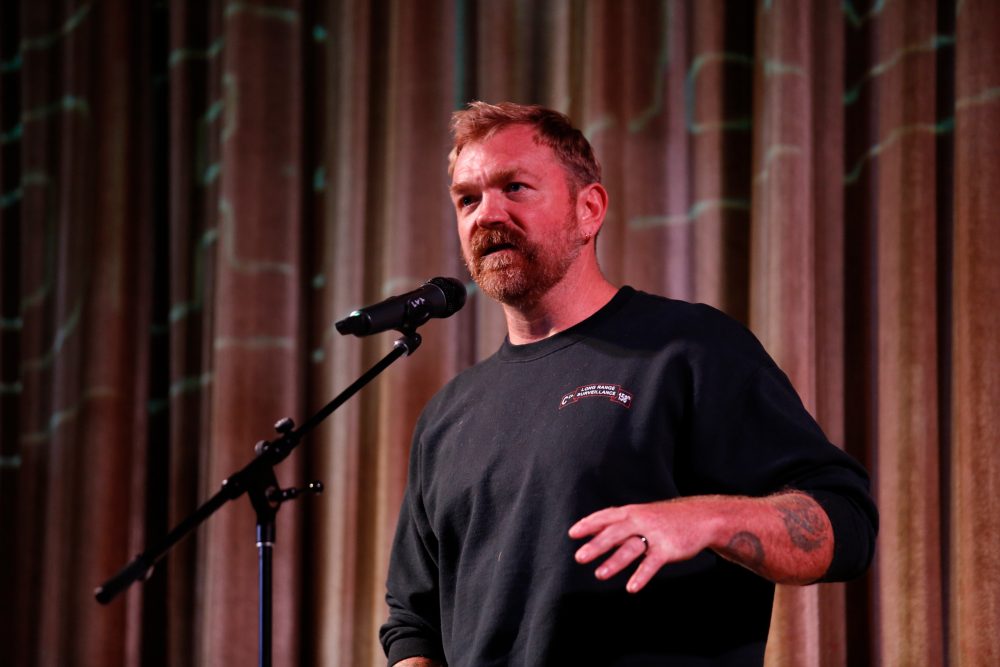
Users on two online betting platforms are placing money on the Democratic U.S. Senate primary in Maine — and most are wagering that Sullivan oysterman and veteran Graham Platner will win.
Platner is leading Gov. Janet Mills on both Polymarket and Kalshi, two sites that allow people to place bets on elections, sports and current events. The markets will be closely watched by political insiders as the June primary nears, and some experts say the sites are better predictors than polls of the likely outcome.
“When you have to put your money down and risk your own money to make a trade like this, people tend not to do that unless they’re relatively confident in what they’re thinking about who’s going to win an election,” said Koleman Strumpf, a professor of economics at Wake Forest University who studies so-called prediction markets.
“As a result, these people tend to be pretty informed and work pretty hard to know more than other people, and they typically do. These are some of the most astute forecasters of these elections.”
The Senate race in Maine is expected to be one of the most closely watched and competitive in the country next year, with the winner of the primary taking on Republican Sen. Susan Collins.
On Polymarket, which launched in 2020 and calls itself the world’s largest prediction market, close to $800,000 has been wagered on the Democratic primary. The platform allows users to buy and sell shares based on the predicted outcome of future events.
As of Tuesday, it gave Platner a 69% chance of winning, compared to 31% for Mills.
On Kalshi, more than $1.1 million has been bet, with Platner leading Mills 68% to 32%.
The polling in the race has been limited so far. An October poll from the University of New Hampshire Survey Center found 58% of Democratic primary voters planned to support Platner, compared to 24% who favored Mills.
Polymarket allows users to see who the top shareholders are in various markets, but doesn’t provide much public information about who they are or where they’re located. The top shareholder favoring Platner, who goes by “scottilicious” on the site, has linked his account to his profile on the social media site X, which allowed a Press Herald reporter to contact him.
That shareholder, who goes by David, has 121,222 shares in the pro-Platner market − currently valued at around $83,000. A professional investor in his mid-40s, David didn’t want to say where he lives but said he’s not located in Maine. The Press Herald agreed to only use David’s first name due to privacy concerns.
He first bought shares in the Maine Senate primary market in early October, before Mills got in the race, and said he was drawn in when he saw Platner “gaining a lot of grassroots support” and felt his shares at the time were underpriced.
David, who also has active bets pending on the Chilean presidential election, TIME person of the year and whether President Donald Trump will declassify UFO files, said he “doesn’t have a huge familiarity with Maine politics.”
But he said he’s been able to learn enough about the Senate race, and the context of the national political climate, to feel confident betting on Platner. Earlier this month, he told the Oracle by Polymarket, a Substack newsletter from the platform, that he was formerly a Ph.D. student in political science.
“There’s the chronological proximity to the Mamdani stuff, the charisma and this swirl of support for populist candidates and that the guy seems very charismatic — he has the endorsement of Bernie Sanders and has been doing a lot of groundwork — it’s all kind of intriguing,” David said in an interview.
He was referring to Zohran Mamdani, the New York City mayor-elect who recently surprised the nation with his victory over former Gov. Andrew Cuomo running on a progressive platform.
Prediction markets are not measuring the same thing as polls. Whereas polls show expected vote totals, the prediction market is giving a probability of who will win.
“Sometimes people misinterpret the percentages in a betting market to be the percent of the vote (the candidate) might get,” said Michael Franz, a professor of government and legal studies at Bowdoin College. “What it actually is is, do you think they’re going to win?”
Like polls, the markets are also affected by events that could impact the outcome, such as a poor debate performance or negative news story, but they’re more likely to capture real-time impacts.
In late October when Platner’s campaign was hit with a barrage of challenges including the resurfacing of old Reddit posts that showed him making inflammatory comments, the revelation he had a tattoo of a Nazi symbol and key staff resignations, he took a hit on the markets.
Mills overtook him on both Polymarket and Kalshi — at one point leading 68% to 26% on Polymarket. Platner has since rebounded to take the lead.
“I think the markets reflect the sense that, at the moment, he seems to be capturing the interest of Democratic primary voters, and there’s a very strong belief that he’s a safe bet at the moment,” Franz said.
Both Kalshi and Polymarket have drawn legal scrutiny, with some state authorities accusing the platforms of unregulated sports betting or gambling. Polymarket only received authority from federal officials in late November to operate in the U.S., though Strumpf, the Wake Forest economics professor, said that didn’t necessarily stop U.S.-based operators from using it previously.
“I think a lot of (users) are in the U.S. because if you are sort of technically savvy … it’s not hard to trade on the sites if you are here,” he said.
However, as David’s example shows, it’s not necessarily Mainers putting their money where their mouths are on these sites. Prediction market users wagering on elections often include people who have experience in online betting or financial forecasting, Strumpf said.
“If I’m investing in Tesla stock, for example, and I do an investigation on Tesla, they’re doing that same kind of thing for elections,” he said. “I will say, I’m continually amazed at how smart people on the site are in terms of the kind of information and things they dig up.”
As the election nears, activity around the Maine Senate race — and other races — is only expected to grow on Polymarket and Kalshi. While the markets can be a good forecaster of results, experts also caution that they’re not perfect.
The accuracy is only as good as the information being used by those placing the bets, which often includes polls that may come with their own flaws. And the results can always change with new developments in the race.
“But I’ll still say the markets, I think, are the best forecast we have,” Strumpf said. “They can’t tell us the future, in part because things happen between now and the election, but I would say if I could only have one forecast … I would definitely pick these markets.”

We invite you to add your comments. We encourage a thoughtful exchange of ideas and information on this website. By joining the conversation, you are agreeing to our commenting policy and terms of use. More information is found on our FAQs. You can update your screen name on the member's center.
Comments are managed by our staff during regular business hours Monday through Friday as well as limited hours on Saturday and Sunday. Comments held for moderation outside of those hours may take longer to approve.
Join the Conversation
Please sign into your Sun Journal account to participate in conversations below. If you do not have an account, you can register or subscribe. Questions? Please see our FAQs.