


In the photo, the hammer is down, blown from its moorings and toppled without dignity.
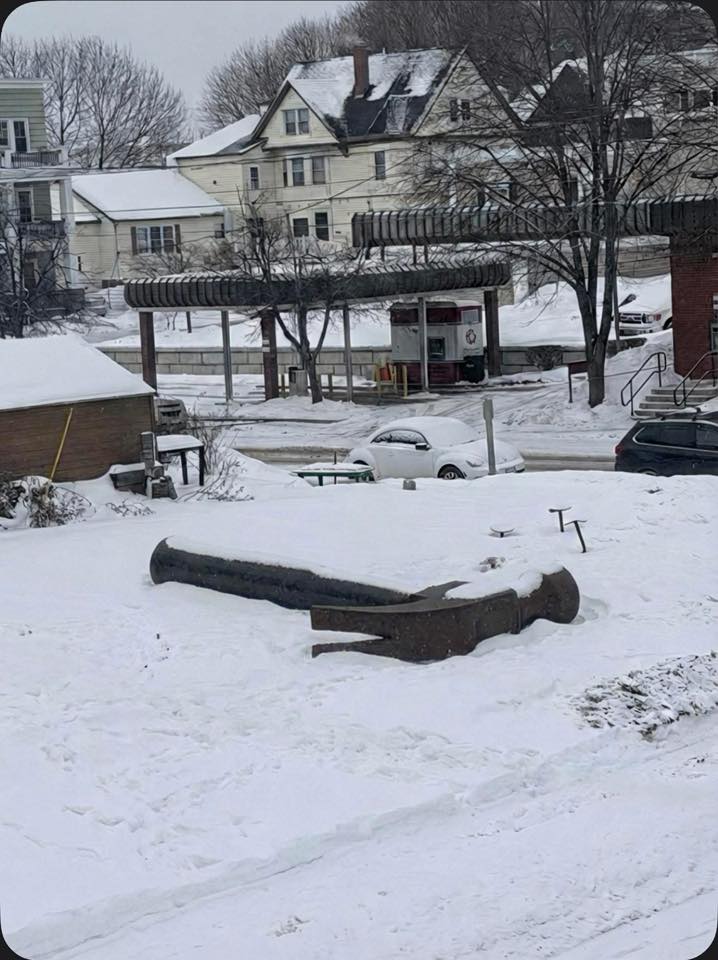
It lies forlorn on the cold Pine Street ground, its cheeks covered with snow as if nature itself was trying to bury the shame of it.
The 15-foot-tall artwork by William Josiah Glover Jr. titled “Nailed It” was erected at Pine and Howe streets in Lewiston in November 2022 by the city.
Where it once stood tall and proud, the giant hammer is now a pitiful sight; an avatar of defeat that perhaps hints of things to come for the city that erected it as part of a community art effort.
When the image of the downed hammer began circulating on Facebook over the weekend, reaction was immediate.
Some reacted with mirth. How ironic, they offered, that such a grand symbol of carpentry had been so shoddily erected. Yuk, yuk, yuk …
Others wondered fretfully what might have happened if a child had been playing beneath that hammer when it blew over.
Others got political, taking the opportunity to declare the fallen hammer the perfect symbol of what this city has become. The waste, they fumed. The frivolousness.
Only a few paused to question what they were looking at in the first place. For most, Lewiston’s quasi-famous hammer was down and that was that. Photos don’t lie, after all.
But of course, that’s just the thing. In the age of ubiquitous AI, photos DO lie. They lie plenty.
By now, most of us know that the picture of Lewiston’s fallen hammer was a hoax. A sham. Another example of AI trickery that looked good enough to believe without question.
“It’s worrying how fast and easy it was for people to believe that this really happened,” says Lewiston Mayor Carl Sheline. “This was fairly innocuous as rumors go, but it’s concerning to think that this could’ve been something that caused people to make decisions that would’ve changed their day, their week, or even their life.”
Sheline attempted to set the record straight on Sunday by posting a photo of the hammer still standing on its anchors, the spires of the great Saints Peter and Paul Basilica in the background.
“Even with windchill at 1 degree,” Sheline wrote on Facebook, “our hammer stands strong!”
What followed was a clear sign of the dubious times.
Having seen the original photo of hammer down for the count, some commenters simply refused to let go of the lie.
“You’re a little late,” one man scolded the mayor. “It fell down yesterday.”
Several others chimed in, insisting that they knew for certain that the hammer had fallen because they had seen that picture with their own eyes.
No matter how many people pointed out that the original photo was nothing but an AI manipulation, the lie persisted. As far as I can tell, there are STILL people who believe that either the wind or roving bands of vandals knocked over a 15-foot hammer.
Which would be downright hilarious if the matter wasn’t full of such foreboding. Because we all know how easily reality can be manipulated these days and by people who aren’t particularly skilled in the computer arts.
And sometimes, it goes beyond simple titters.
Last month, U.S. Sen. Dick Durbin of Illinois introduced a photo on the Senate floor depicting a federal agent poised to shoot a kneeling protester in the back of the head. Some saw it as an AI fake at once — one of the federal agents was headless in the photo, after all — and yet even days later, the bogus photo was still being widely circulated and accepted as truth.
Durbin’s AI photo was presented as evidence in an official government proceeding and by now millions of copies are adrift in cyberspace, tricking thousands into fresh rages every day.
Other media was caught using AI-enhanced photos of Alex Pretti, the man who was shot and killed by those federal agents in Minneapolis. They had enhanced his photo, apparently, to make him look cleaner. Neater. More sympathetic.
We see over and over how a single image can move masses of people to great emotion. So what to do in an age where AI technology is so accessible that an average 6 year old with a tablet can create fakes every bit as good as the pros?
Not, mind you, that we even need that 6-year-old to alter our reality.
Although evidence is in short supply in the matter of Lewiston’s fallen hammer, there are strong indications that the fake photo was posted, not by some giggling mastermind in his mom’s basement, but by a bot.
By an AI bot, to be specific. Just a chunk of computer code crafted to convince the rest of us that this is a living human being showing us this stunning photo of a toppled statue.
There are millions of these bots crawling all over the internet, after all, masquerading as people to push products or change the temperament of the masses.
And here I pause to fully understand how paranoid and deranged these words sound as they fly from my fingers. We’re in strange times, people. We’re in an age where we have to doubt even those things we see with our own eyes. We have to hope that others, some of whom have the attention spans of a goldfish, will do the same.
In this age of rage, it is sometimes just a matter of one seeing what one wants to see. If a particular image bolsters your own political message, how hard are you going to question it? Why be skeptical of a photo that says exactly what you want it to say?
“When all you have is a hammer,” as the saying goes, “everything looks like a nail.”
Strange, strange times. In Lewiston, the flap over the hammer will be sputtered about for a while and then forgotten. It was there just long enough to demonstrate how easily people can be fooled.
Mayor Sheline admits that when he first saw the photo of the downed hammer, his first instinct was to call Public Works to address the matter. But then he paused and looked into it, finding clear evidence that the photo was a fake.
The way I see it, there are two types of people: those who have been fooled by an AI photo and those who haven’t been fooled … yet.
The whole technology is becoming easier to use and it’s in the hands of more and more people every day. We have only begun to experience the trickery.
“Unfortunately,” says the mayor, “with AI, every day has the potential to be April Fools’ Day.”

We invite you to add your comments. We encourage a thoughtful exchange of ideas and information on this website. By joining the conversation, you are agreeing to our commenting policy and terms of use. More information is found on our FAQs. You can modify your screen name here.
Comments are managed by our staff during regular business hours Monday through Friday as well as limited hours on Saturday and Sunday. Comments held for moderation outside of those hours may take longer to approve.
Join the Conversation
Please sign into your Sun Journal account to participate in conversations below. If you do not have an account, you can register or subscribe. Questions? Please see our FAQs.