


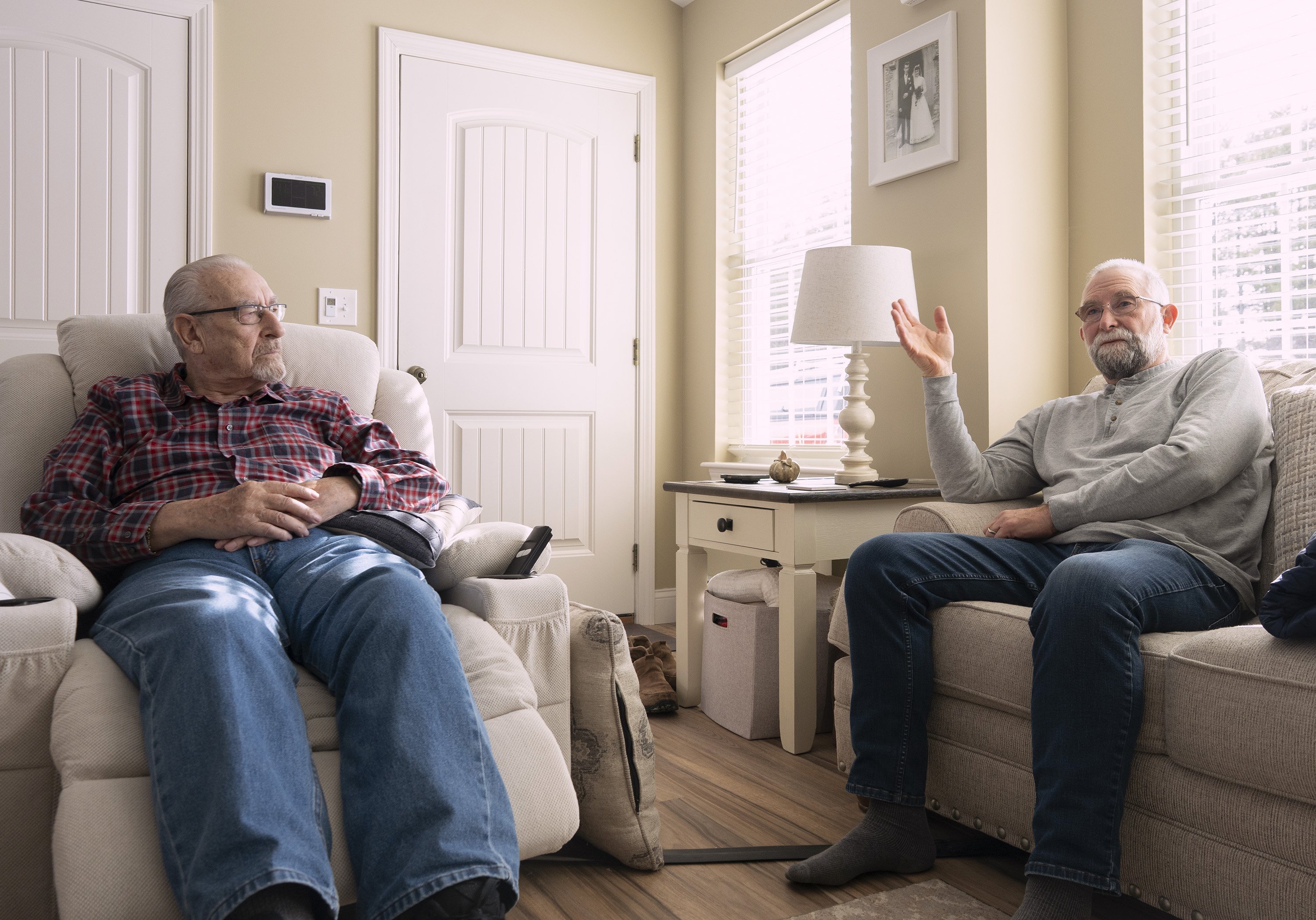
ARUNDEL — At first glance, it might appear that Ken Bartow and Trevor Armstrong have little in common.
Bartow, 70, grew up in upstate New York and ran a construction company in the Oxford Hills region of Maine for decades. Armstrong, 86, is from England, where he was a truck driver — or lorry driver, as he is quick to clarify — before retiring.
They became fast friends in the fall through a new program that matches volunteers with people with Alzheimer’s disease, dementia or other memory issues.
Bartow, a volunteer, was paired with Armstrong, who has memory issues, through the Respite Care Companion Program. The Southern Maine Agency on Aging, which serves York and Cumberland counties, launched the effort in August after the agency saw a need to better support people living with dementia and the people who care for them.
Now, the two men spend three hours together every Wednesday, often driving around York County in search of new spots to stop for coffee and a bite to eat. They never run out of things to talk about.
“Sometimes we have to stop talking because we’re talking at the same time,” Bartow said recently during his weekly visit.
In Maine, nearly 30,000 people aged 65 and older have Alzheimer’s, the most common form of dementia, according to the Alzheimer’s Association. More than 66,000 family caregivers provide support to people living with dementia in the state, according to the organization.
“There are hundreds of individuals across our region who are caring for a loved one with dementia. In many cases, it’s a 24/7 job,” said Megan Walton, CEO of the Southern Maine Agency on Aging.
The idea behind the Respite Care Companion Program is simple but the impact is huge, organizers say. The volunteers, some who have cared for loved ones with dementia, give caregivers a chance to run errands, go to appointments or just relax. Trevor Armstrong’s wife, Lesley Armstrong, uses the time to volunteer with another local program.
Programs similar to the agency’s initiative are growing in popularity across the country. They offer support to older residents in a variety of ways, from daily check-ins to weekly visits and rides to appointments. The programs often help older people remain independent and in their own homes.
To launch the initiative, the Southern Maine Agency on Aging used a $150,000 grant from Community Care Corps, which funds programs that provide voluntary nonmedical assistance to family caregivers, older adults and adults with disabilities to maintain independence in the community, said Lona Kapler, the program coordinator.
So far, 10 volunteers have signed up and Kapler has a long list of people waiting to be matched with a companion.
She said the benefits of the program are evident for everyone involved, especially the clients.
“They don’t get out much and are isolated,” she said. “Sometimes the caregivers are the only people they see.”
HELP FROM VOLUNTEERS
Walton said programs like these are possible because of the hours volunteers — most of them older Mainers themselves — put in each week. Last year, 1,574 volunteers across the state’s network of agencies on aging logged more than 117,000 hours.
The willingness to volunteer in the community reflects the values and culture of Maine, Walton said.
“We want to ensure that our neighbors know we’re here to support them,” she said. “People really care and want to make a difference.”
After Bartow sold his company and moved to Biddeford, he had plenty of time to give back. He and his wife volunteer with Meals on Wheels and he also gives older people rides to appointments.
When Bartow heard about the respite care companion program, he said he jumped at the chance to be involved. His wife had been the primary caregiver for her parents for 10 years and he helped care for his own father and grandmother as they aged.
He said those experiences gave him an understanding of the responsibilities caregivers shoulder — and the need to have a break. Bartow said he can relate to Trevor Armstrong’s wife.
“I can’t really understand what Trevor’s going through,” he said, “but (I can) sympathize with it.”
Sara Paige, program director for Community Care Corps, said respite care programs are needed, especially in rural areas where they’re less prevalent.
“When a volunteer can come in and give a caregiver a few hours out of their week to decompress or do things they need to do,” Paige said, “it helps reduce caregiver stress and burden.”
Kapler said enlisting more volunteers will allow the agency to expand the program to meet demand.
NEW FRIENDS
Trevor and Lesley Armstrong moved to Arundel from England three years ago. They‘ve been married for 65 years and live in a small, brightly lit house next door to their son. Trevor Armstrong has memory issues that make it unsafe for him to be alone, his wife said.
He goes twice a week to a day program for adults with memory impairments at the Sam L. Cohen Center in Biddeford, where he said he plays games, does puzzles and talks to other people.
While the couple enjoys Maine and being near their son, it has been hard to make new friends, Lesley Armstrong, 83, said. When her husband spends time with Bartow, she volunteers at the Cohen Center, which has given her a chance to get to know other people.
“Because of not ever having worked here, we’ve not really made any friends,” she said. “We’ve been quite lonely.”
The companion visits are a highlight of the week, Trevor Armstrong said during a recent morning with Bartow.
Trevor Armstrong was keen to try American McDonald’s (he’s not a fan) and KFC (“It’s passable,” he said.). Bartow made that happen.
“It’s given me a better insight of American life,” he said. “I’ve been to places where I would never go with my son. We always end up somewhere to eat.”
As they prepared to leave for a drive, Bartow told him that he found a cafe in Limington that they’d never tried before. Bartow assured his friend that the cafe had “jam” doughnuts on the menu, using Armstrong’s name for jelly doughnuts.
“He’s got the lingo now because I call it a jam doughnut,” Armstrong said.
Bartow said he has come to think of his Wednesdays not as volunteer work, but as simply time well spent with a friend.
“I would never have a friend like Trevor if it hadn’t been for this,” he said. “I’m richer because of it.”

We invite you to add your comments. We encourage a thoughtful exchange of ideas and information on this website. By joining the conversation, you are agreeing to our commenting policy and terms of use. More information is found on our FAQs. You can update your screen name on the member's center.
Comments are managed by our staff during regular business hours Monday through Friday as well as limited hours on Saturday and Sunday. Comments held for moderation outside of those hours may take longer to approve.
Join the Conversation
Please sign into your Sun Journal account to participate in conversations below. If you do not have an account, you can register or subscribe. Questions? Please see our FAQs.