


EDITOR’S NOTE: This story discusses suicide and may not be appropriate for all readers.
Seven weeks after state troopers initiated the “yellow flag” procedure to restrict a Somerset County sheriff’s deputy from possessing dangerous weapons, the deputy was sitting in a courtroom asking a judge to lift the order against him.
Stephen “Dan” Armiger said at the Oct. 10 hearing he wanted his right to carry guns restored, not only so he could hunt with his daughter, but because he also needs his job back.
He testified in detail about the treatment he had received since the August night state troopers were called to his Detroit home in response to his drunken statements threatening harm to himself and his fiancée’s ex-boyfriend. Family members spoke of his change in demeanor since then and expressed their support. A leading advocate for the mental health of Maine law enforcement officers said he had little concern about Armiger.
“I’m not a danger to myself or others,” Armiger said at the end of his testimony, according to the official court audio recording.
When the hourslong hearing at the Skowhegan District Court ended, Judge Julia G. Pitney was not convinced.
Pitney issued a weapons restriction order for 90 days, through Jan. 7. Without the ability to carry a gun, Armiger, who had been on administrative leave, could not do his job.
Then, in November, Armiger succeeded in getting Pitney to shorten her order so it expired Dec. 5. With the order lifted, Armiger could return to work.
But Somerset County Sheriff Dale Lancaster said this week that Armiger remained on unpaid, administrative leave. Lancaster declined to comment further because internal administrative procedures were ongoing.
Police use of Maine’s yellow flag law is not meant to be a punishment, but rather a safety measure. And in Armiger’s case, it was exactly that, immediately setting him on a path to seek help for issues that law enforcement experts say have long been stigmatized within the profession. But it put the deputy out of a job, at least temporarily, and what must happen next in a case like his remains unclear.
Armiger, who joined the Somerset County Sheriff’s Office hired in 2017, Lancaster said, did not respond to requests for an interview.
YELLOW FLAG
It is not known whether an active Maine law enforcement officer has been subject to yellow flag restrictions before, as records containing specific details of each case are scattered across agencies and courthouses.
The Office of the Maine Attorney General keeps the state’s centralized list of the more than 1,200 weapons restriction orders that have been issued since the law went into effect, but it only offers a brief synopsis for each one.
Almost none of those descriptions, including what appears to be Armiger’s case, lists the occupation of the person subject to the order. One lists the person as a retired police officer.

But Kenneth Quick, an adjunct professor at the John Jay College of Criminal Justice in New York City, said it is not unheard of for a police officer to have access to work firearms restricted.
Quick, a retired New York City Police Department inspector who ended his career overseeing the employee relations bureau, was unfamiliar with Maine’s yellow flag law and the specifics of Armiger’s case.
He said most law enforcement agencies have policies to determine if an officer should not carry a work-issued gun, in situations, for example, involving domestic violence or substance abuse. Agencies have to balance doing what is best for not only the officer, but the public at large.
“No matter what we do,” Quick said, “that’s going to be a painful process, but a necessary one.”
Much of Armiger’s case, since it began with the yellow flag law rather than an internal decision, has played out in largely public court filings and proceedings.
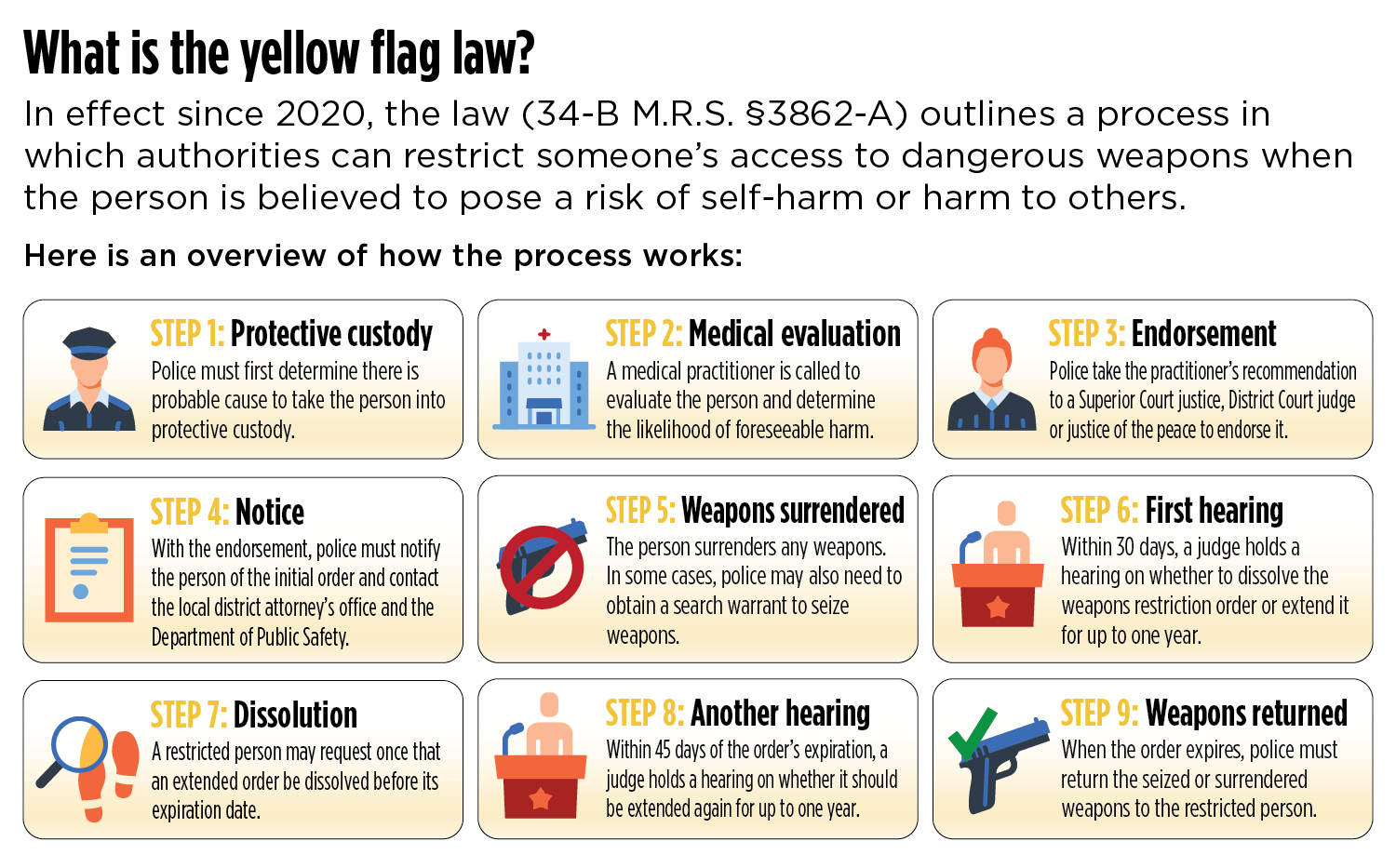
The law, passed in 2019 as a bipartisan compromise, allows law enforcement to intervene when someone is believed to pose a risk to themselves or others. In November, voters approved a red flag law, which will create an additional process for a family member to petition the court directly.
The yellow flag law requires a medical provider to complete a mental health assessment before police can ask a judge to restrict the person’s access to dangerous weapons, through what is technically known as an extreme risk protection order.
Armiger, 41, is not facing any criminal charges.
The Maine State Police were called to Armiger’s residence just before 2 a.m. on Aug. 18. Sheriff’s deputies had responded initially but requested another agency handle the call due to Armiger’s employment.
Armiger made concerning comments that night that were enough for the troopers to use the yellow flag law.
Among them, Trooper Bryce Scott wrote in an affidavit, Armiger had told one of the deputies he would not be upset if the deputy killed him with one of the guns in the house. Earlier that evening, Armiger had also made a comment in a phone call to his fiancée about wanting to hurt and kill her ex-boyfriend, the troopers learned.
And while troopers were at the house investigating, Armiger said a shootout on the job years earlier had left him “chasing the high.” He said, too, that he wished the suspect had succeeded in shooting him.
Armiger later testified in court he had consumed 30 beers that night — an admittedly large quantity of alcohol — because he was stressed. His memory of the night was blurry, he said; he did not recall making many of the statements troopers documented.
THE HEARING
At the October hearing, Armiger’s court-appointed attorney, Jonathan Handelman, asked Pitney to dissolve the weapons restriction order.
A hearing on whether to extend or dissolve an order is usually held within 30 days of a judicial officer signing off on the initial weapons restriction order. Armiger’s hearing was delayed several weeks because he was in a treatment program, court records show.
Within days of when the state police initiated the yellow flag procedure, Armiger was admitted to a monthlong program in Havre de Grace, Maryland, according to court testimony and records.
The Harbor of Grace National Law Enforcement and First Responder Wellness Center says it offers a variety of care tailored specifically to first responders. It is one of the only centers in the country approved by the National Fraternal Order of Police.
The Armiger who returned was different, those closest to him said in court.
The cynical, standoffish, stereotypical cop who went to the center came back soft, positive, spiritual, they said.
“I really believe, with the right accountability, that Dan is not a risk to society, and he’s not a risk to himself,” said Stanley “Rusty” Bell, Armiger’s soon-to-be father-in-law.
Bell, Clinton’s police chief, is no stranger to the yellow flag law. A 2024 Portland Press Herald/Maine Sunday Telegram investigation highlighted his department as one of the most frequent users of the law, although the analysis found no clear reason why.
Bell said in court he believes law enforcement needs to be held to higher standards, but he has never seen anyone drop everything to seek help like Armiger did.
“If he didn’t change his life,” Bell said in a recent telephone call, “I’d be a pretty big critic.”

In his closing argument, Handelman, who declined an interview, highlighted Armiger’s early signs of improvement and support network.
He also downplayed the threats Armiger made that August night, pointing to testimony from troopers and Armiger’s fiancée that indicated nobody else was seriously considered to actually be at risk.
The worst that happened, Handelman said, was that Armiger’s fiancée got upset with him and left the house, Armiger punched a hole in the wall and he went to bed. And when Armiger was woken up by police, he was “perhaps too chatty.”
“And yet,” Handelman said, “that was enough to get him to seek treatment that he never would’ve sought beforehand. This was like a cathartic event.”
‘THE STAKES ARE HIGHER’
Assistant District Attorney Michael Madigan acknowledged the steps Armiger took to seek help.
But Madigan, a Kennebec County prosecutor, zeroed in on Armiger’s comments to the troopers about his experience of being in a shootout and argued the problem was deeper than just drinking.
Armiger was among several officers involved in a December 2019 chase and shooting that began with a shoplifting incident in Waterville and continued 15 miles to Canaan. The gunfight left a Waterville police officer and the suspect, Richard Murray-Burns, injured.
Armiger testified that the feeling of surviving the incident gave him an unmatched adrenaline rush. But he insisted, despite what he said to the troopers, he would not wish to experience it again.
A one-hour evaluation with a counselor was all he needed to return to work after the shooting, Armiger said.
He also testified that the shootout, at the time, had led to problems with drinking, but he thought he had since dealt with that.
“For whatever reason, it caught up with me that night,” he said.
Madigan said Armiger’s seemingly positive comments to the troopers about the shootout six years later were his chief concern, especially because Armiger’s job requires him to carry a gun.
Pitney, the judge, agreed Armiger needed more time with treatment.
“The stakes are higher for you, in some respects, because your job does require you to carry a firearm on a daily basis,” Pitney said at the October hearing.
Returning to court in mid-November, Handelman asked Pitney to end the order early, pointing to Armiger’s progress, as well as the financial implications of Armiger being out of work for any longer. Armiger was on unpaid administrative leave and his paid sick time would run out in early December, Handelman said. Madigan said the state was agreeing not to seek an extension of the order past January.
At first unsure if she could, Pitney ultimately agreed to amend the order’s end to Dec. 5, commending Armiger on his progress with treatment and support.
Pitney noted Armiger’s financial need to return to work was not among the factors she considered.
RETURN TO WORK
Armiger testified that if the weapons restriction order was lifted, he would need to complete a fit-for-duty evaluation to return to work. It is not clear if that has happened.
At the October hearing, Sgt. Ryan Close of the Franklin County Sheriff’s Office testified he has seen dozens of Maine police officers go to the national wellness center in the last five years.
The vast majority were able to return to their work and their lives without a problem, so long as they continued their plans for continued treatment, he testified.
“When they get healthy, they have a higher emotional intelligence,” Close said in a recent interview at his office in Farmington, during which he declined to further discuss Armiger’s case specifically. “They have a greater sense of empathy. They have a greater connection to the people that we’re dealing with.”
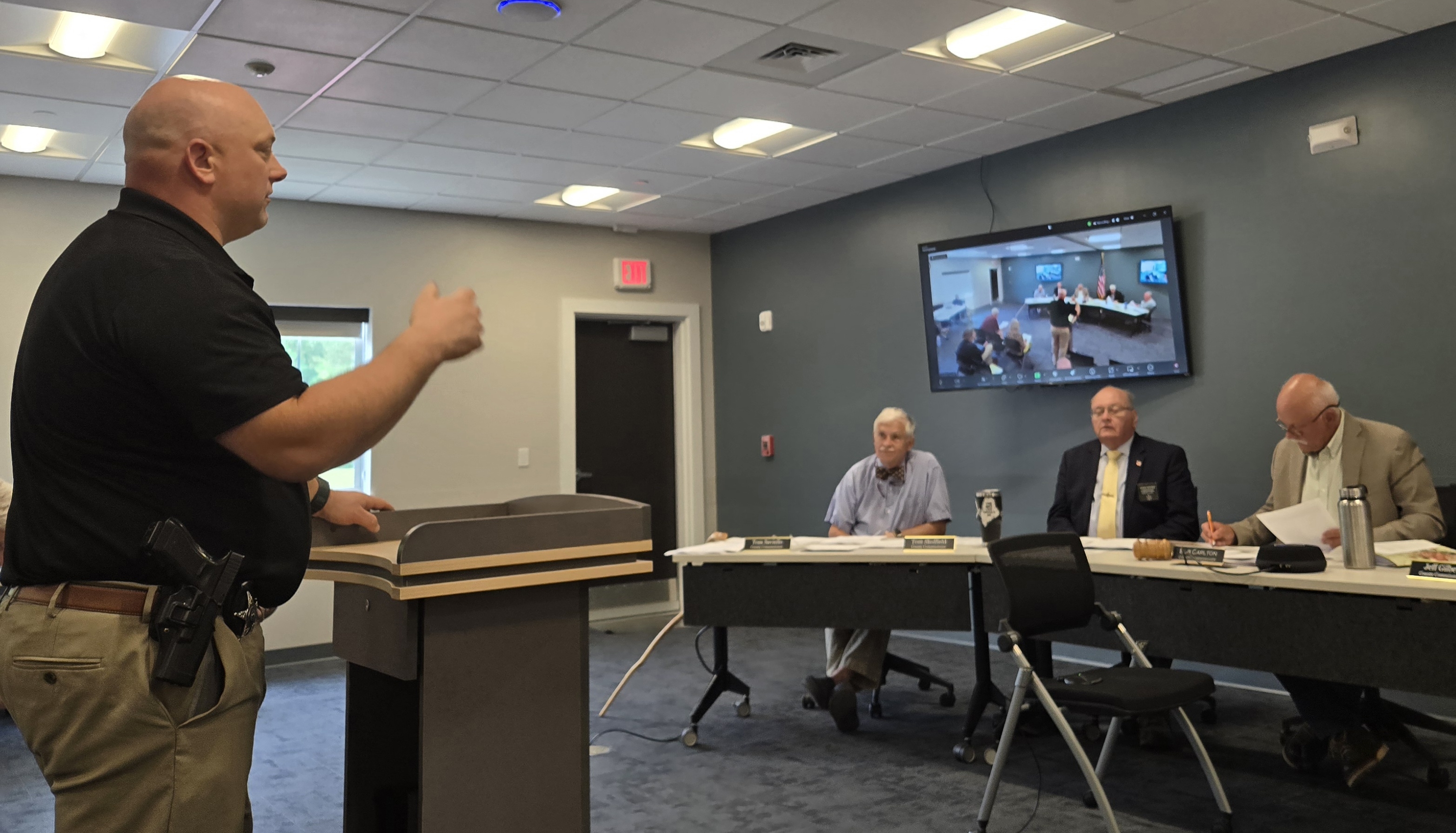
When law enforcement officers across Maine have substance use problems, Close said his phone often rings.
Close, an officer of 17 years, said he has received treatment himself and isn’t afraid to talk about it.
Close leads a team of Franklin County first responders who provide peer support after critical incidents. He worked with a University of Maine researcher to analyze trends among the 26 active and former Maine law enforcement and corrections officers who died by suicide between 2015 and 2022. And he served on a Legislature-created stakeholder group that this year delivered 13 recommendations aimed at addressing a high-attrition rate and a slew of mental health issues law enforcement officers are statistically more likely to develop.
One goal of his county’s peer support model is to help first responders process incidents — fatal crashes, police shootings, children’s deaths — in group debriefs before problems start to emerge. Members of Close’s team also work closely with mental health practitioners across the state and connect first responders with providers who understand their professions.
“Statistically speaking, if you do nothing but go to critical incidents,” Close said, “you’re going to have an issue.”
Quick, the retired NYPD inspector, said even as agencies try to encourage officers to feel comfortable asking for help, officers may be hesitant to seek help because of real-life concerns.
Those range from missing out on overtime and promotions to their perceived reputation among coworkers.
Quick said when an officer returns from some kind of mental health crisis, an agency should have a plan that includes increased monitoring and input from mental health professionals.
But there has to be a plan to get back to normal.
“Otherwise, we reaffirm this stigma that the police department is going to hold this against you and you’re never going to get over it,” Quick said. “And guess what? Now, officers will never come forward and ask for help.”
IF YOU NEED HELP
IF YOU or someone you know is in immediate danger, dial 911.
FOR ASSISTANCE during a mental health crisis, call or text 888-568-1112. To call the Suicide and Crisis Lifeline, call 988 or chat online at 988lifeline.org.
FOR MORE SUPPORT, call the NAMI Maine Help Line at 800-464-5767 or email [email protected].
OTHER Maine resources for mental health, substance use disorder and other issues can be found by calling 211.
