


Before artist Charlie Hewitt’s “Hopeful” sign became a familiar sight on buildings and bumper stickers around the state, it first adorned the side of the 350,000-square-foot, saw-toothed Bates Mill No. 5.
In some ways, Mill No. 5 has become a visual metaphor for Lewiston’s reputation as a city primed for revitalization but unable to shake offghosts of the past.
While other, less overwhelming buildings in the Bates Mill complex have seen successful redevelopment, Mill No. 5 has remained the city’s most prominent vacancy. And what was once considered Lewiston’s best hope for redevelopment it is set to expire next month.
However, as the Lewiston-Auburn area becomes a more sought-after region for new housing, city officials are looking to build on momentum they’ve seen elsewhere at places like the Continental Mill, and are hoping the reuse of more historic buildings can drive a downtown renaissance.
The Sun Journal spoke with city staff and developers about when residents might see some new life at buildings like the former Pamco mill, the Professional Building and others along Lisbon Street, plus one across the river in Auburn.
BATES MILL NO. 5
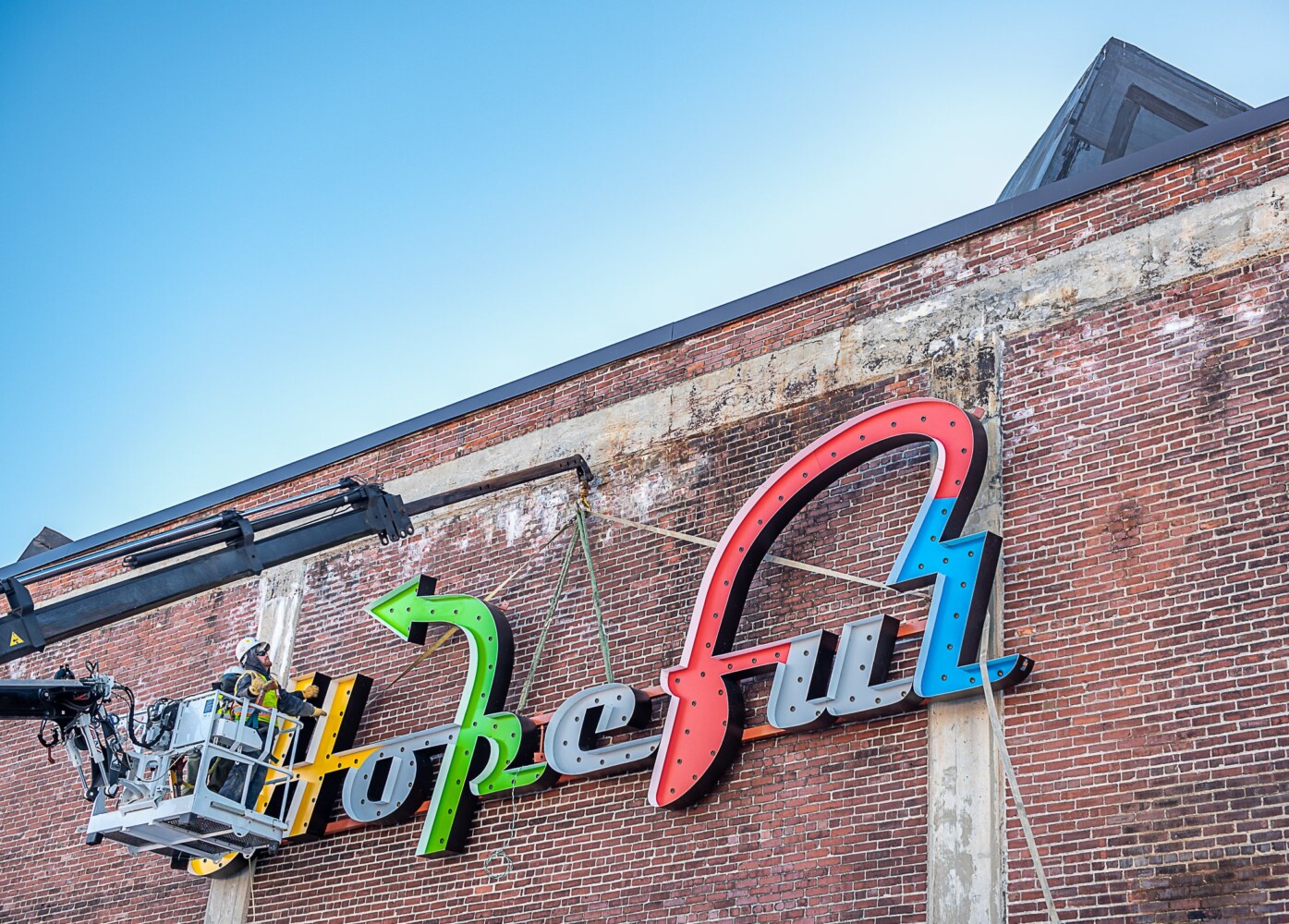
If you ask Tom Platz, who has led the successful redevelopment of much of the Bates Mill complex, the idea of a downtown is being redefined, and it’s made redeveloping Mill No. 5 even more challenging.
He said while there are some signs that the pandemic-era shift to remote work is changing, downtowns everywhere continue to see fewer people working, eating lunch and spending time in downtown buildings, which has had a ripple effect.
“The toughest thing in the last four years has been the abandonment of the downtown by businesses,” he said, adding that Lewiston has likely lost more than 2,000 people working downtown during that time. “Everyone wants a vibrant downtown, but you as a worker or as an owner have to be willing to work downtown and not from your bedroom.”
The shift away from downtowns came just as Platz and city officials agreed on what was dubbed a “final” five-year option agreement for Platz to purchase the building, should a viable redevelopment move forward. That agreement expires at the end of February and both Platz and city administration say they are still working closely.
“Their plans and tenant commitments for mixed-use redevelopment were coming together in 2019 and the pandemic really disrupted that effort, so they’ve had to regroup and are working hard at finding a viable anchor tenant for at least one-third of the building’s 356,000 square feet,” City Administrator Bryan Kaenrath said.
At the Bates Mill complex, Platz said the days of attracting anchor tenants — businesses who can take up large swaths of a building and convince other businesses that the property is viable — are gone. But he’s seen some success recently in attracting owners of smaller businesses who believe in downtowns.
He said that’s been the toughest part of Mill No. 5: The size of the building necessitates at least one large anchor tenant. Platz said he continues to have talks with several companies about the prospect of reusing the building, and still believes it can be done.
“There’s really nothing like it in the state of Maine,” he said.
As for the coming deadline, Platz said he hopes the city would consider renewing it given the time and money that he’s put in, but he said he also wouldn’t stand in the way of other interested parties with viable proposals.
“I welcome anybody to come in who has a good plan for it,” he said. “Whether I have an option or not, if someone else came up with an idea, I’d work with them and try to get them in there. I think it’s important for the downtown.”
The looming expiration of the agreement will also likely renew a perennial debate over what to do with the building, including calls for it to be demolished. However, Platz said he’s not concerned because Mill No. 5 is part of a protected historic mill district and the costs to demolish would be extraordinary.
Kaenrath said that as the option agreement approaches its end, the city’s options “remain unchanged: continue working with an interested and invested developer, seek proposals from other parties, or, at significant public cost, consider demolition of a historic structure.”
Asked about Mill No. 5, Mayor Carl Sheline called it “the most iconic building in Maine” and said it’s worth saving.
“Like Lewiston, this building has stood the test of time and is a rugged symbol of who we are. We are not tearing it down on my watch,” he said.
But, he also said he’s “fairly certain pyramids have been built in less time,” and that the redevelopment effort needs to be a bigger priority in 2026.
PAMCO MILL
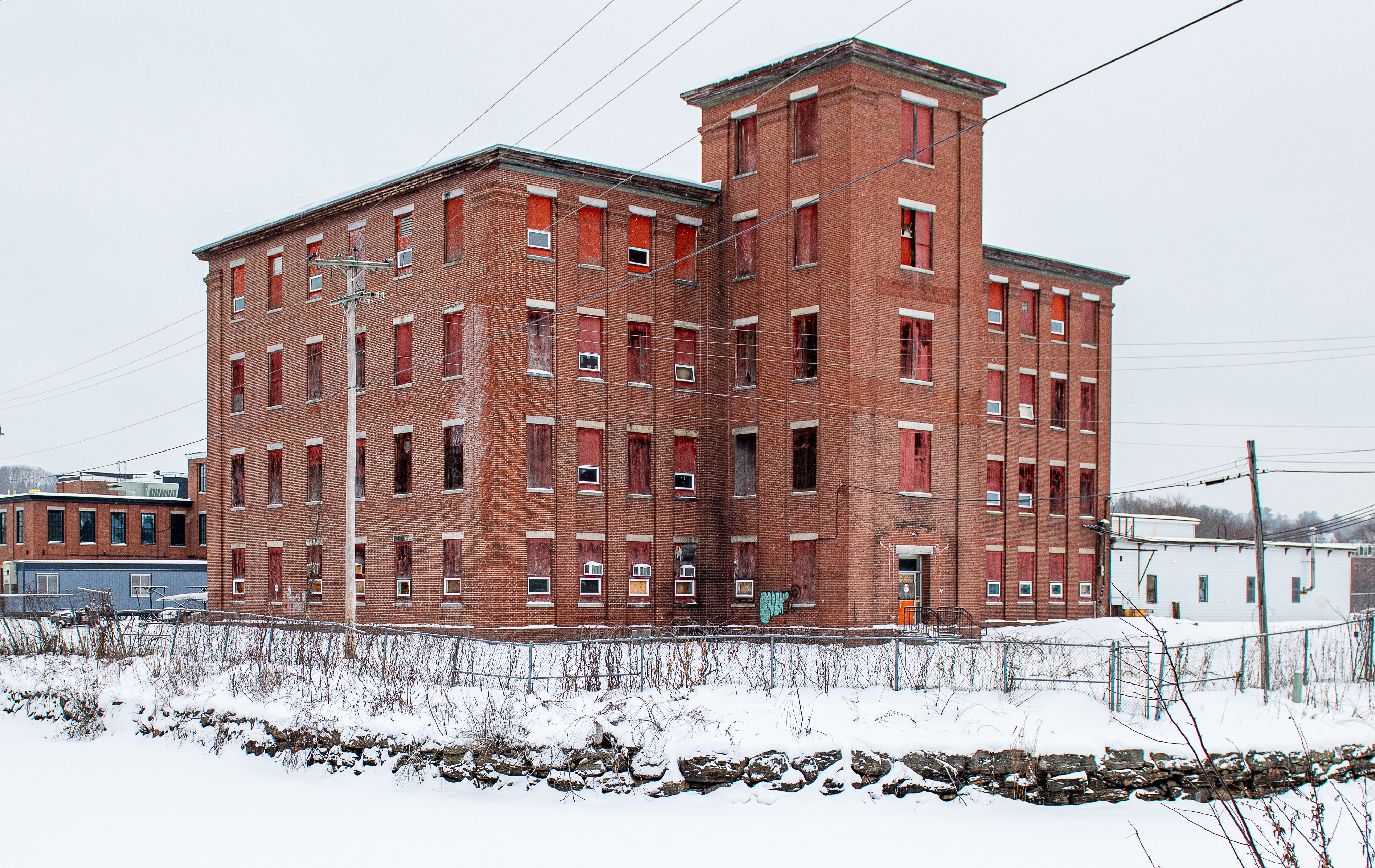
At the city’s riverfront, Platz is also behind a redevelopment of the former Pamco Mill on Beech Street that appears to be a sure thing.
Platz is hoping to ride the coattails and momentum from nearby development, like the new Maine MILL museum next door that’s slated to open in June, and the coming Continental Mill project that will put 377 apartments on the riverfront. The city also has plans to overhaul Simard-Payne Memorial Park.
Platz called the Maine MILL opening “one of the most significant things happening in this town in a long time.”
At the Pamco building, there are multiple avenues for redevelopment, Platz said, with options for a small office building, condominiums, or a small hotel on the table. He said while there is no solid timeline yet, he’s hoping the redevelopment would occur within the next three years.
City officials said projects like the Maine MILL and Continental Mill, as well as the new St. Dominic Regional High School coming downtown “signal confidence in downtown’s future.”
“Together, these projects not only bring new businesses, housing, and amenities, but also reinforce the foundation for a vibrant, connected, and resilient downtown that will continue to attract more businesses, residents, visitors, and entrepreneurs alike,” Kaenrath said.
Platz said he applauds businesses that have decided to commit to being downtown.
The idea that downtowns need people to thrive was part of what drove a massive backlash recently against a proposed AI data center at Bates Mill No. 3. While the building’s owner and city staff were attracted by the prospect of filling another vacant building, the environmental concerns related to generative AI use and the lack of job generation ultimately doomed the project.
PROFESSIONAL BUILDING & LISBON STREET
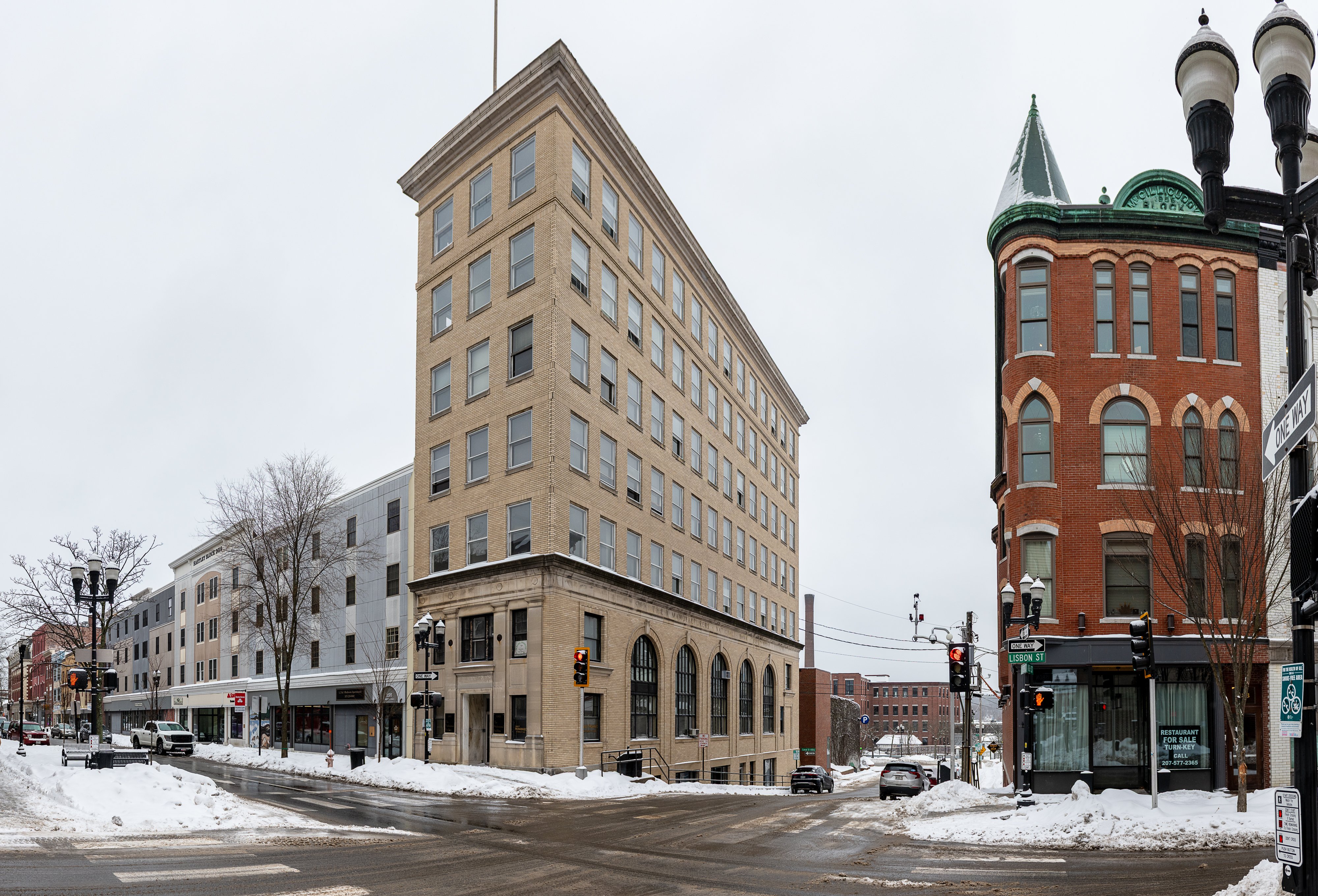
One of the city’s most unique buildings — both on the inside and out — has been in redevelopment talks since 2022. But it could be closer to reality.
According to city staff, a plan from developer Jason Hutchins to turn the Professional Building at 145 Lisbon St. from offices into 17 one-bedroom apartments is heading toward construction this year.
Nate Libby, director of economic and community development, said Hutchins is “wrapping up” a few remaining items with the Planning and Code Enforcement office, and securing final commitments for financing and historic preservation tax credit qualification.
City officials approved a tax-increment financing deal for the seven-story building in 2022 that will likely be on an upcoming council agenda for updating.
The building, with its architecture adapted from Italian Renaissance, features wrought-iron staircase railings, mahogany doors and marble throughout, and is on the National Register of Historic Buildings.
Because it is considered a “high-rise” structure, officials have said it requires additional life safety measures that add more than $500,000 to a project that was estimated to cost $4.8 million three years ago.
Sheline said that while the reuse of historic buildings can be difficult, especially following the pandemic, the “incredible architecture” on display in Lewiston is part of what makes the city great.
“Our storied buildings have been rehabbed one by one and their redevelopment has contributed to the character of our city,” he said.
Due to the presence of several vacant buildings and storefronts along downtown Lisbon Street, officials have been trying to get creative. The city has attempted to boost event programming like the Lewiston Live busking festival to bring more people downtown, and it has pursued temporary public art in vacant storefront windows.
Sheline said the city needs to be in more regular communication with vacant building owners “to see what their plans are and how we can support them.”
He pointed to two buildings sitting side by side at 136-140 Lisbon St. as a prime example.
“Those two buildings have been vacant since I moved to Lewiston,” he said. “They sit on a very visible corner and we really need to pull out all the stops to get them redeveloped.”

According to city property records, 136 Lisbon St. last sold in 2022 for $125,000 and is owned by A S Lisbon, LLC.
Asked about the properties, Kaenrath said city staff recently met the developer at a workshop regarding a “new business opportunity grant” offered by the city.
Kaenrath said the buildings are being used for warehousing/storage but the owner has visions for a variety of first-floor commercial uses, including a way “to preserve and repurpose the beautiful historic bank vault,” with residential uses on the upper floors.
‘THE BARN’ IN AUBURN

Across the river in Auburn, the most prominent vacant building has remained the same for decades. According to city staff, it continues to be top of mind.
The former shoe factory at 67 Minot Ave., known as “The Barn,” was once eyed for a Chinese medical tourism facility, but that project never got off the ground and the building has continued to deteriorate.
In September of last year, Auburn took action to secure the building after staff said its condition posed a threat to public. People continue to break in and vandalize the building or use it for shelter, staff said.
At the time, a representative for the building’s owner, Miracle Enterprises LLC, told officials that an employee who had been the point of contact for the city is no longer working for them, which caused a communication breakdown. The Hong Kong-based owner told Auburn that she would still like to see it redeveloped.
Eric Cousens, director of public services, said the city has “continued conversations” with the owner and the city attorney regarding the building, but that there were no other updates to share.

We invite you to add your comments. We encourage a thoughtful exchange of ideas and information on this website. By joining the conversation, you are agreeing to our commenting policy and terms of use. More information is found on our FAQs. You can update your screen name on the member's center.
Comments are managed by our staff during regular business hours Monday through Friday as well as limited hours on Saturday and Sunday. Comments held for moderation outside of those hours may take longer to approve.
Join the Conversation
Please sign into your Sun Journal account to participate in conversations below. If you do not have an account, you can register or subscribe. Questions? Please see our FAQs.