

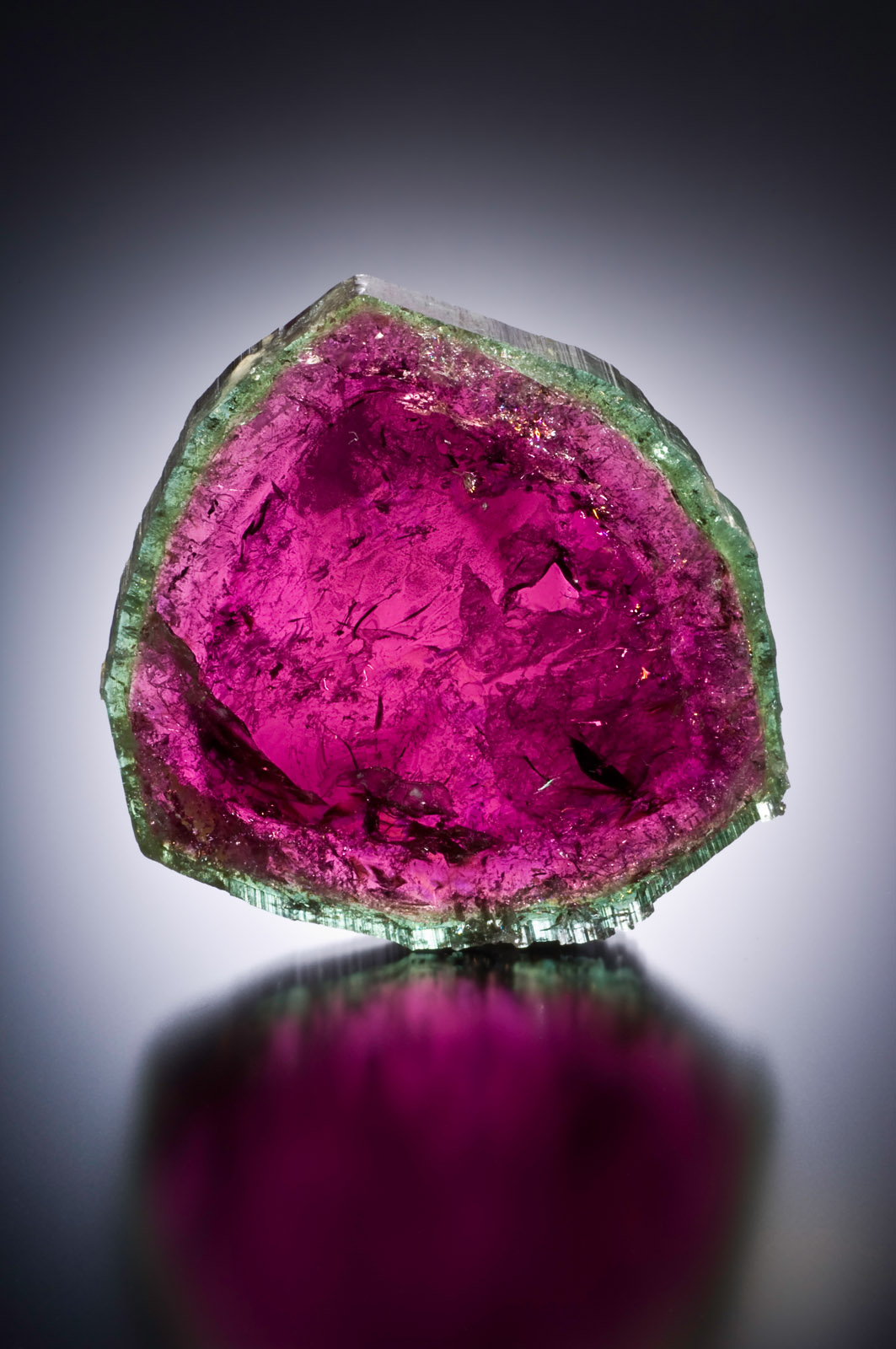
In 1820, Elijah Hamlin and Ezekiel Holmes, both students with an interest in mineralogy, were descending Mount Mica in Paris late in the autumn when a flash of green caught Hamlin’s attention near the roots of an uprooted tree, so the story goes. The crystal they recovered was later identified as tourmaline by Yale professor Benjamin Silliman after specimens were sent for examination.
That story, told by Augustus Choate Hamlin, son of Elijah Hamlin, in his 1895 book, “History of Mount Mica,” documents the earliest known discovery of tourmaline in Maine.
For more than 200 years, tourmaline has been mined in western Maine, gaining international attention through rare discoveries such as Newry’s 1972 “Big Find,” which produced world-class watermelon tourmaline and helped cement the region’s reputation among mineral collectors and museums worldwide.
The mineral, discovered by Hamlin and Holmes the same year Maine achieved statehood, was designated Maine’s official state mineral in 1971, a recognition rooted in its long mining history and exceptional quality found in Oxford County pegmatites.
Hamlin’s book is widely regarded as the primary historical source for Maine’s earliest tourmaline discoveries and has informed nearly all subsequent retellings of the Mount Mica story. Tourmaline mining continued intermittently through the 19th and 20th centuries, with Mount Mica remaining active into the modern era.
Mount Mica is between Mount Mica and Thayer roads in the Paris Hill neighborhood.
Tourmaline is a complex mineral group known for its wide range of colors, including green, pink, red, blue and multicolored crystals. While tourmaline occurs worldwide, Maine specimens are valued for their clarity, saturated color and frequent occurrence in well-formed crystals.
Watermelon tourmaline is among the most recognizable Maine varieties. These crystals feature a pink or red core surrounded by a green outer layer, creating a cross-section resembling a slice of watermelon.
The term “watermelon tourmaline” is widely attributed to early Maine mineralogist George Robley Howe, a Norway native who played a significant role in documenting and promoting the state’s gem discoveries in the late 1800s and early 1900s. Howe’s work helped bring national attention to Maine’s minerals, particularly those from the Mount Mica region near Paris.
Although watermelon tourmaline is found in other countries, mineral experts note that some of the finest examples have come from Maine, particularly Oxford County.
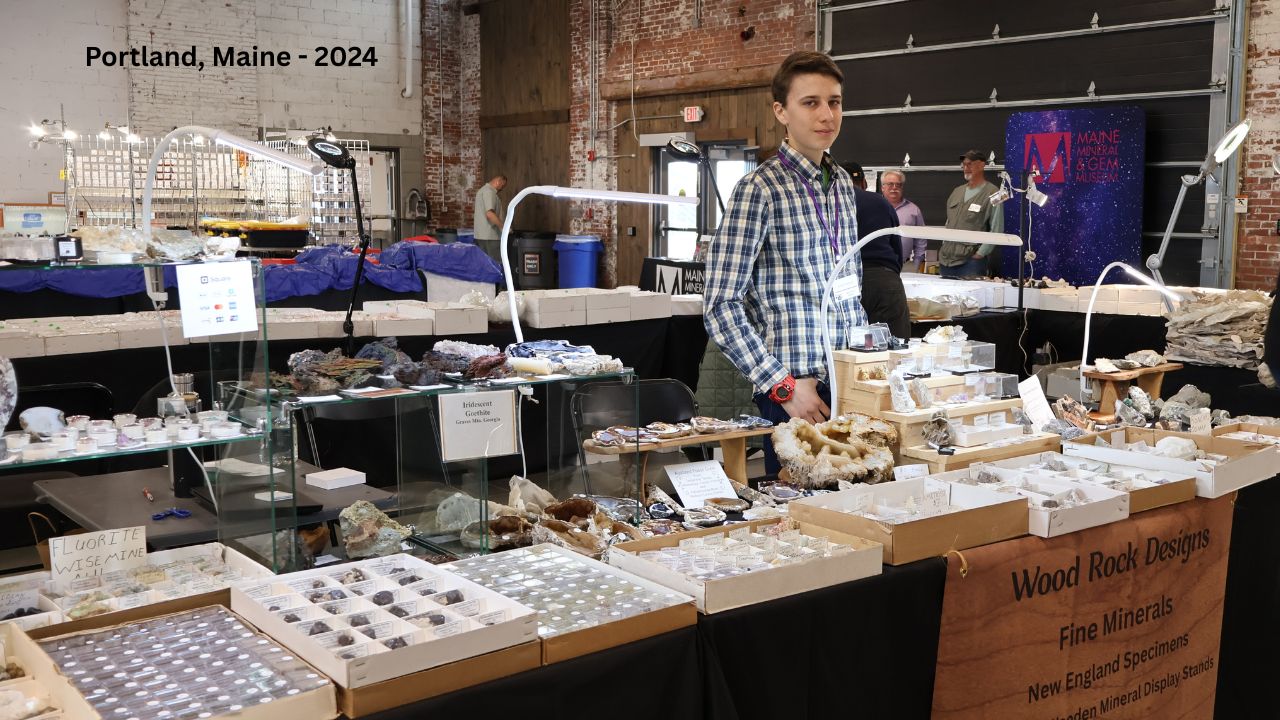
Young local mineral dealer Jonah Palumbo, who specializes in New England specimens, said quality matters more than size when evaluating watermelon tourmaline.
“A high-quality watermelon tourmaline needs five things: color, luster, freedom from major flaws, clear distinction between core and rind, and overall balance,” Palumbo said. “Many collectors would rather have a significantly smaller piece of higher quality than a much larger one that lacks those characteristics.”
Palumbo said unusual visual features, including internal inclusions, can add interest to a specimen but do not necessarily determine value.
“Sometimes there are inclusions that can appear wiry,” he said. “They can be caused by impurities, trapped fluid during cooling or gases. Even when you’re looking at the crystal closely, it can be hard to tell exactly what caused it.”
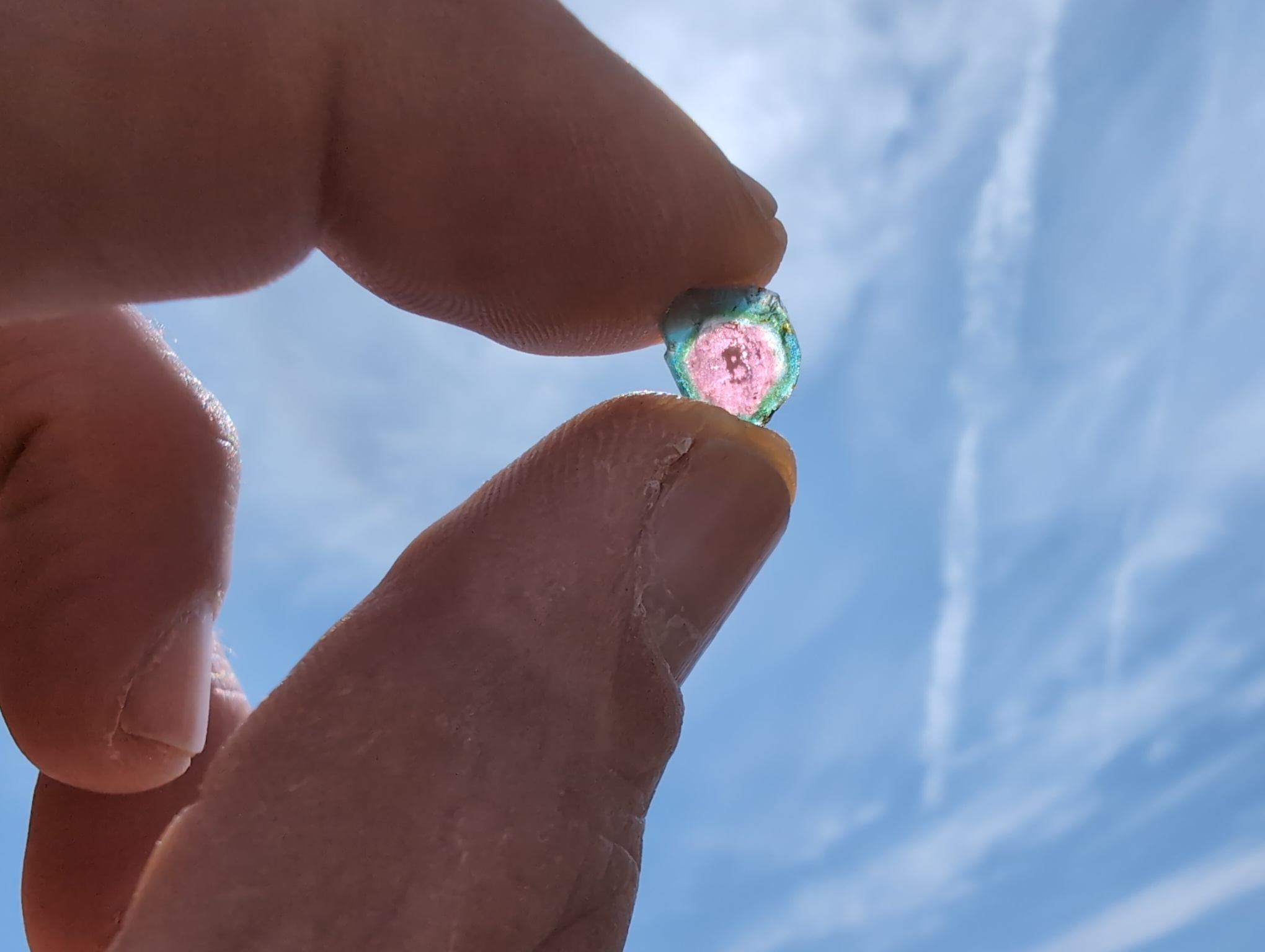
One watermelon tourmaline slice acquired from Palumbo features a distinct internal inclusion resembling the letter “B,” an unusual visual. Palumbo said that while such letter-like inclusions are rare, they fall within the range of natural irregularities seen in tourmaline formed under complex geological conditions.
Palumbo said clear labeling and known origin are especially important for collectors seeking Maine material.
“If a specimen isn’t labeled or comes from an unknown source, it’s wise to be cautious if Maine origin matters to you,” he said.
HISTORY OF QUALITY
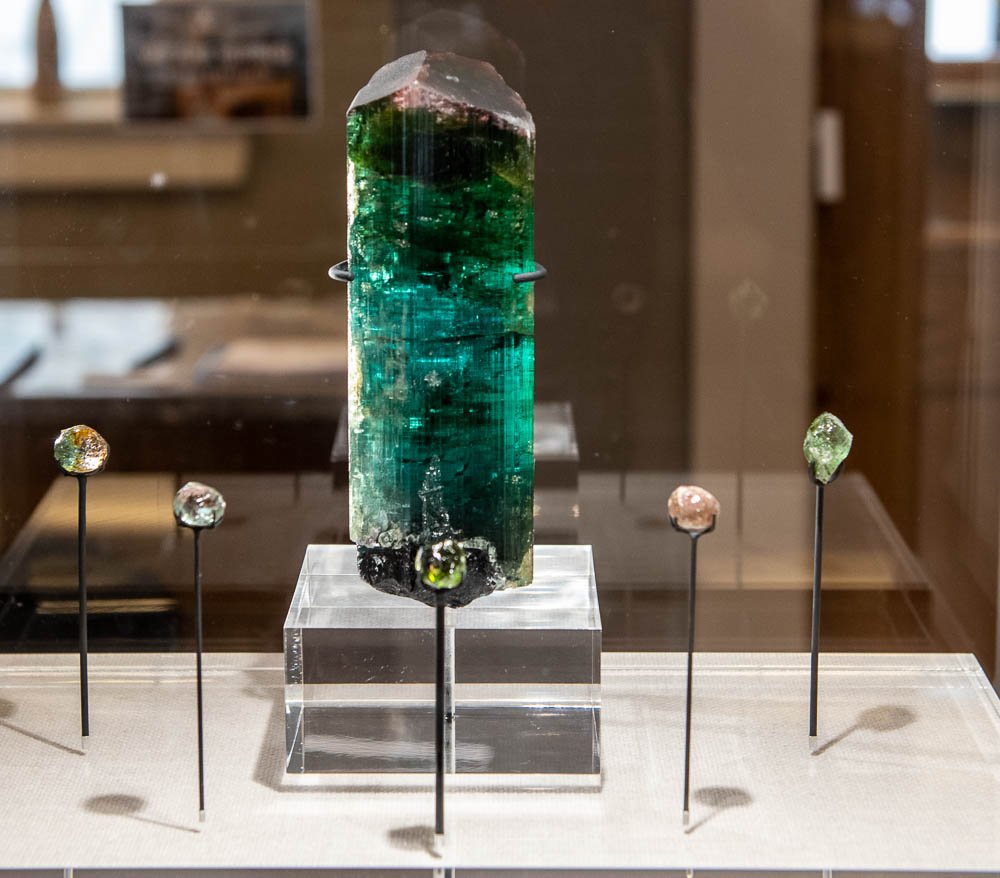
The “Big Find” refers to a series of exceptionally rich gem pockets opened in Newry beginning in October 1972. Unlike earlier Maine discoveries, which often produced limited quantities or lower-grade material, the “Big Find” yielded an unprecedented volume of gem-quality tourmaline, including large, well-formed crystals and extensive watermelon tourmaline with strong color and clarity.
The discovery occurred at what is commonly known as the Dunton Gem Quarry, also referred to as the Dunton Mine, on Plumbago Mountain in Newry in Oxford County. The site had been worked intermittently since the late 19th century.
Initial exploration by George Hartman, Dale Sweatt and James Young led to the formation of the Plumbago Mining Corp. Frank Perham was hired to assist with mining operations.
Daily mining logs document large pockets filled with interlocked tourmaline crystals, including extensive watermelon material. At one point, miners recorded uncovering a 6-foot pocket filled with watermelon tourmaline.
More than a metric ton of tourmaline was eventually recovered from the site, with estimates exceeding 3.5 million carats of gem material produced during the mining period.
Palumbo said the discovery marked a turning point for Maine’s mineral community.
“At the time of the discovery, the Maine mineral scene was pretty quiet, and it sparked a lot of excitement,” he said. “The Big Find was one of the largest tourmaline discoveries in North America and helped put Maine on the world stage.”
Perham is widely regarded as one of Maine’s most influential modern mineral figures. Born in 1934 and raised in West Paris, Perham grew up in a family closely connected to Maine’s mineral trade and spent decades working across western Maine’s pegmatites. He later studied geology at Bates College in Lewiston and became known for his technical skill and his ability to recognize productive mineral zones.
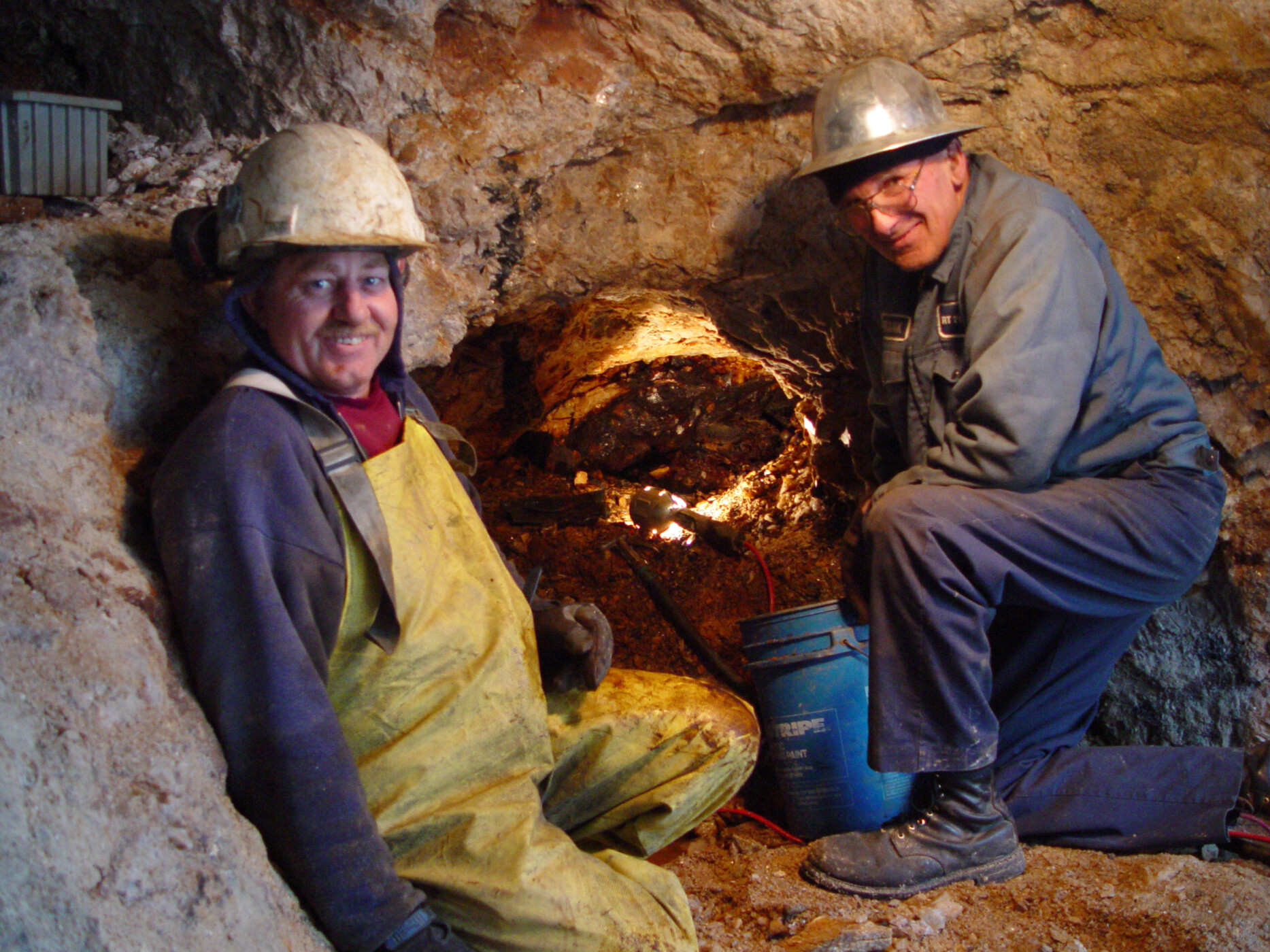
Perham played a central role in the 1972 Plumbago Mountain discovery, and his firsthand accounts of the mining operations have become essential historical records. His detailed descriptions of pocket development, crystal recovery and field conditions are frequently cited in educational, museum and collector references documenting the discovery.
According to Perham’s biography, “Frank C. Perham: Adventures in Maine Pegmatite Mining” by Karen Weber, which is sold at the Maine Mineral and Gem Museum in Bethel, his work was often a family effort. During mining operations, specimens were sometimes hauled using a small red wagon belonging to one of his children, an improvised solution that later became part of Perham family lore. The wagon is preserved today as part of museum interpretation connected to his life and work.
Perham’s contributions extended well beyond mining. He documented techniques, preserved significant specimens and worked closely with collectors, researchers and museums to interpret Maine’s mineral history for a wider audience. His writings and preserved materials remain central reference points for understanding the scale and significance of the “Big Find.”
In recent years, a park called Frank C. Perham Mineral Park in Greenwood was established by Jeff Morrison as a memorial space dedicated to preserving his legacy and educating the public about Maine’s mineral heritage. Morrison, who works the Havey Quarry in Poland, Maine, co-owns the park with Larry Stifler, founder of the Maine Mineral & Gem Museum, though the park is personally owned by Stifler and is not affiliated with the museum. Morrison also mines at several other locations. The park emphasizes hands-on learning, historical context, and the connection between Maine’s landscape and its mineral resources.
EDITOR’S NOTE: This story is part one of two looking at the history and cultural importance of tourmaline in Maine.

We invite you to add your comments. We encourage a thoughtful exchange of ideas and information on this website. By joining the conversation, you are agreeing to our commenting policy and terms of use. More information is found on our FAQs. You can update your screen name on the member's center.
Comments are managed by our staff during regular business hours Monday through Friday as well as limited hours on Saturday and Sunday. Comments held for moderation outside of those hours may take longer to approve.
Join the Conversation
Please sign into your Sun Journal account to participate in conversations below. If you do not have an account, you can register or subscribe. Questions? Please see our FAQs.