


Snow had been falling for nearly two hours last Sunday when a private jet bound for France pulled into position on the runway at the Bangor International Airport.
On board were two crew members and four passengers from the Houston area reportedly headed to Europe on a business trip. The Bombardier CL 600 stopped to refuel in Bangor, a common move for small planes before crossing the Atlantic Ocean.
Airport officials said the plane went through a deicing process before it was directed to runway 33. Visibility had dropped to three-quarters of a mile and about 4 inches of snow blanketed the ground. But other planes were still landing and departing.
An air traffic controller told the pilot he was cleared for takeoff just after 7:40 p.m., then the channel briefly went quiet, according to archived air traffic recordings.
“All traffic is stopped on the field,” the air traffic controller said moments later, his voice wavering slightly. “All traffic is stopped on the field.”
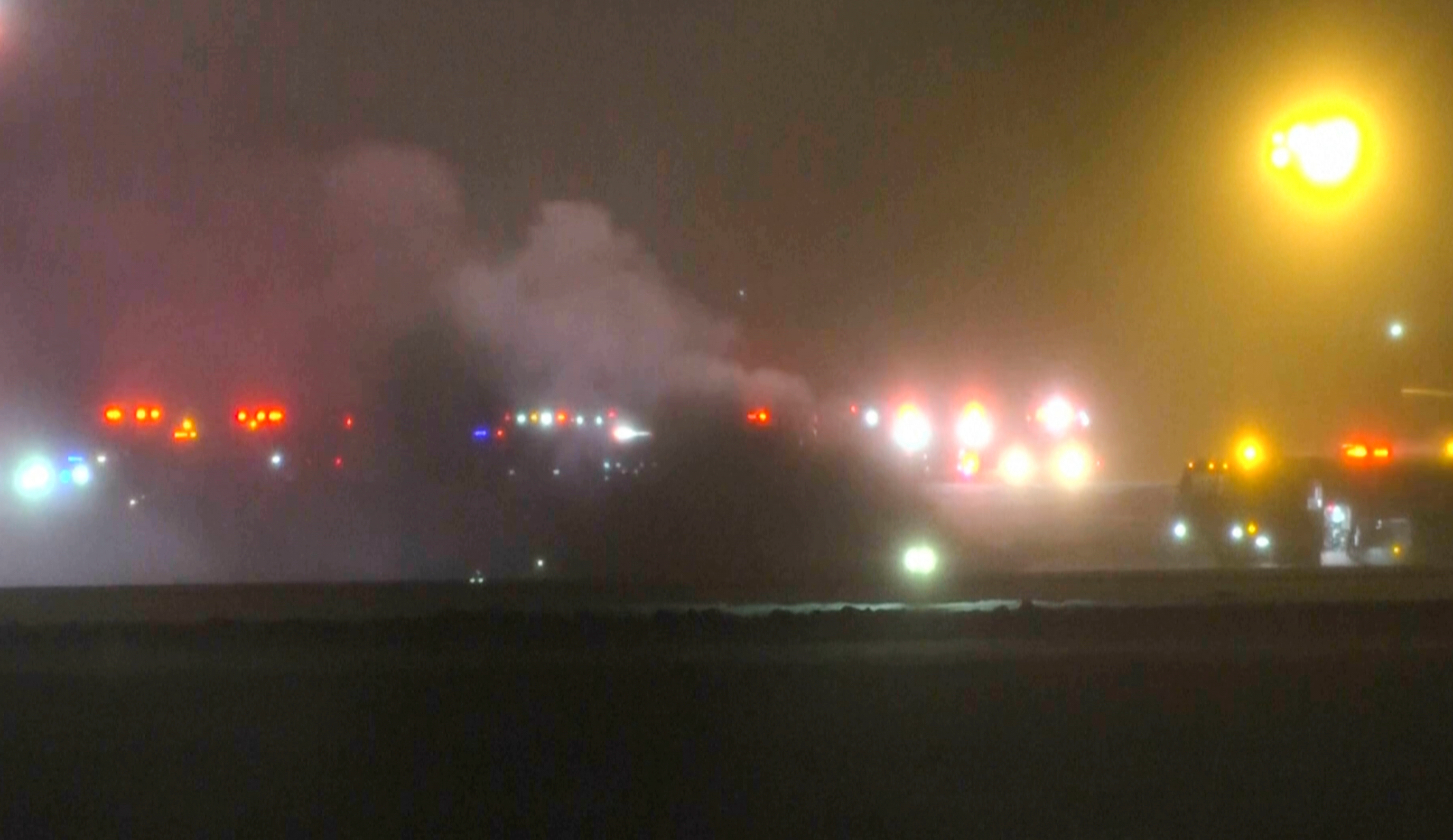
First responders rushed to the airport, where they found the jet upside down and on fire near the runway, determined no one on board survived and secured the scene for federal investigators.
But the investigation into the deadliest passenger plane crash in Maine in more than 40 years was delayed by the storm.
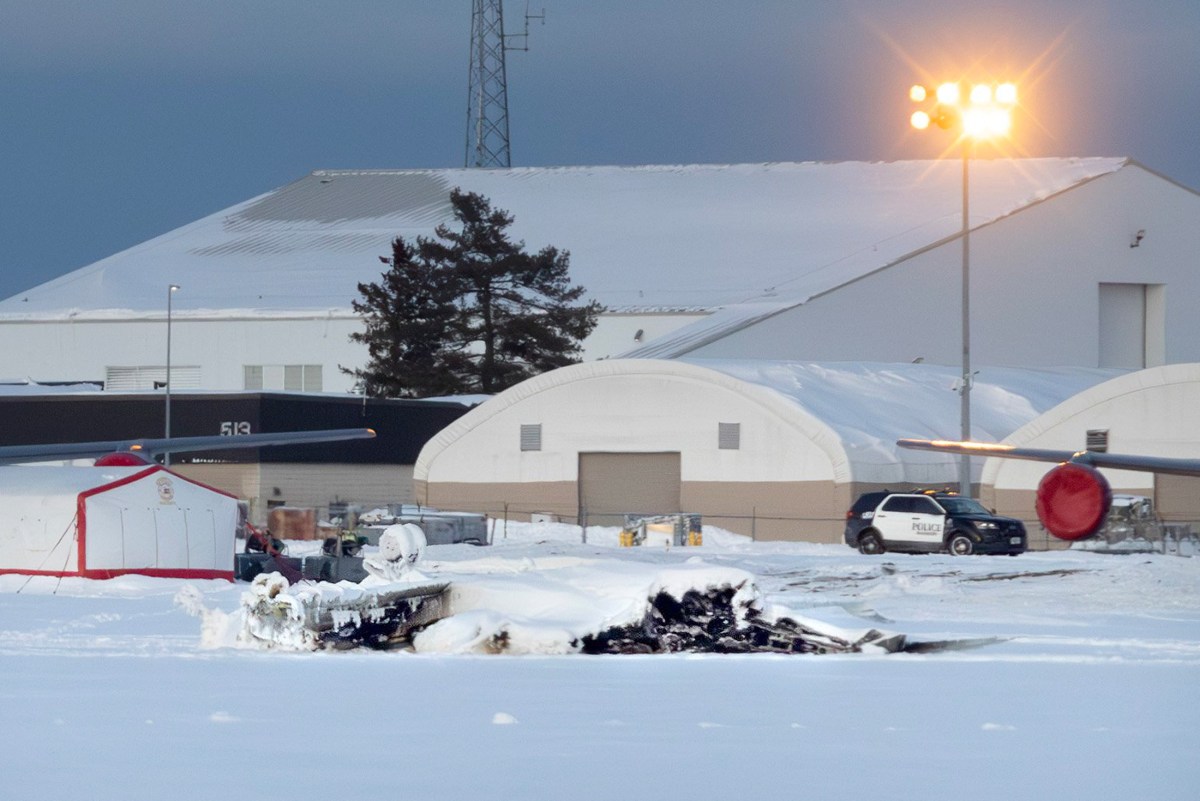
For days, the wreckage sat buried in a foot of snow. So did the remains of those on board.
THE INVESTIGATORS
It took a day and a half for the first investigators from the National Transportation Safety Board to arrive at the airport. All told, the NTSB sent seven investigators, spokesperson Sarah Sulick said. At least one of them arrived in town Monday, she said, though they did not reach the wreckage right away.
Airport spokesperson Aimee Thibodeau said federal investigators hadn’t reached the runway by Tuesday morning, about 38 and a half hours after the crash. Officials would not say what time the crew got to the scene.
The team included members from the board’s eastern and central regions, plus “specialist divisions based in our headquarters in Washington, D.C.,” Sulick said, adding that it’s relatively common for investigators from one region to be deployed to another.
Steven Marks, an aviation attorney, criticized the NTSB’s response time, arguing that delays could undermine the quality of available evidence, especially with regard to sensitive documents like maintenance records.
“That’s highly unusual,” said Marks, who has represented families of victims in several high-profile crashes over a decades-long career. “Typically, what happens (is) within 12 to 24 hours, the NTSB shows up at a crash scene. The local responders are requested to secure the area.”
Sulick said “every crash is distinct,” but investigators are usually able to arrive on scene within 48 hours. She added that certain parts of an investigation — like pulling data, planning interviews and reviewing records — can be done before crews reach the crash site.
“We get there as fast and as safely as we can,” Sulick said. “Just because they’re not on scene doesn’t mean they’re not doing investigative work.”
The storm prompted more than 11,400 flight cancellations across the country, the most caused by any one event since the pandemic, the Associated Press reported. Meanwhile, the snow slowed traffic on roads throughout the state and prompted officials to lower the speed limit on the Maine Turnpike.
Former NTSB investigator Jeff Guzzetti said the delay makes sense given the heavy snowfall and travel issues crews had to navigate.
“The NTSB is at the mercy of the roads, the airlines, the weather,” he said. “In fact, it surprises me that it only took (38) hours to get there.”
THE STORM
The storm dropped more than 15 inches of snow over the airport by the time it ended, according to the National Weather Service. Fire suppression efforts added a layer of ice to the wreckage.
Guzzetti said the buildup of snow and ice was unlikely to impact federal crews’ ability to assess the aircraft, as some of the most valuable information comes from inside the plane.
“It’s like shoveling out your driveway. It takes time to shovel out around the wreckage. But, frankly, the bulk of the detailed examination occurs after the wreckage has been salvaged,” Guzzetti said.
He noted that this model of plane, the CL 600, has had issues with ice buildup on its wings, which have factored into previous crashes.
Several experts have pointed to the deicing problem as a potential factor in Bangor. A report on the case by the Aircraft Owners and Pilots Association suggests that there may have been too much time between deicing and the jet’s attempted takeoff, which could have allowed new ice to form. Airport officials have refused to say how much time passed between deicing and takeoff.
Guzzetti said it would be impossible to tell whether ice still on the wrecked jet was there when it attempted take off or formed after it crashed. But flight simulators and other digital models can show whether the plane behaved in a way consistent with built-up ice, based on information captured by the flight data recorder, he said.
“The NTSB has Ph.D. aerodynamicists and very smart people,” Guzzetti said. “And they can tell whether or not a wing stalled.”
On Wednesday, the NTSB said it had sent the cockpit voice recorder and flight data recorder — sometimes called the “black box” — to its headquarters in Washington, Sulick said. The wreckage was brought to a secure facility run by the National Guard overnight Wednesday into Thursday, airport officials said.
Those who died in the crash were removed on Wednesday, before the plane was carried away, said Lindsey Chasteen, a spokesperson for the Office of the Chief Medical Examiner.
Chasteen attributed the delay to “weather conditions, debris and safety considerations, and the nature of the accident.”
Though the NTSB asked local officials to secure the crash while its investigators began to arrive, that guidance did not include any instructions on how to handle the remains on board, Sulick said.
“Victim recovery is not something that the NTSB does or even has a say in,” she said on a Friday call. “It’s my understanding that the timeline for that was affected by the weather.”
By Saturday afternoon, officials still had not released the names of the people who died.
THE PEOPLE ON BOARD
In the days after the crash — while the wreckage and remains sat waiting to be recovered — families of those on board began to publicly confirm their identities to local media in Texas.
The first was Tara Arnold, an attorney from Houston who started Beyond, a luxury travel company with her husband, Kurt Arnold.
The Arnolds said on the Beyond website that the business was born out of their passion for travel and love for Turks and Caicos, where they acquired 18 acres for exclusive estates. The company also has a $41 million glass-walled mansion in Telluride, Colorado.
Tara Arnold, a mother of two who was on the board of the St. Paul’s Methodist Church Foundation and involved in other community organizations, was on the plane with others connected to Beyond.
Nick Mastrascusa, an award-winning chef and sommelier, was Beyond’s executive vice president of hospitality. Before joining the company, he was an executive chef at Discovery Land’s Kūki’o Golf and Beach Club on the Big Island of Hawaii, according to the Beyond website.
Mastrascusa had three children, was an avid outdoorsman and was known for his “kindness, dedication, generosity and friendship,” according to a GoFundMe set up for his family.
Shawna Collins, a 53-year-old mother and grandmother, was the luxury event designer and experience curator for Beyond. She was known for bringing an “attention to detail not offered by others in the industry,” according to the company website.
On Instagram, Collins frequently posted photos and videos from her events, including elaborate Halloween and birthday parties. Last year, she planned birthday parties for Arnold’s children.
Collins was a longtime employee of Lakewood Church in Houston, run by Joel Osteen Ministries, according to the Associated Press. She oversaw the customer service department, said church spokesperson Donald Iloff Jr.
“Everybody loved her,” he told the AP. “She just had that kind of personality.”
The youngest passenger on the plane was 34-year-old sommelier Shelby Kuyawa, the Daily Mail reported, citing an anonymous source close to the passengers. She had 15 years of experience in luxury hotels, resorts and private clubs, according to the Beyond website.
Kuyawa’s love of hospitality went back to her childhood living in Europe and Asia, where she was exposed to different cuisines, cultures and traditions, according to her Beyond biography.
In the cockpit sat Jacob Hosmer, a pilot and flight instructor whom family members have identified to Houston media as one of the two crew members on board. Hosmer was certified to fly more than a half-dozen models of aircraft, according to FAA records. In 2024, he was certified as an instructor for single and multiengine planes.
Hosmer had been working as a pilot since at least 2010, according to his LinkedIn profile. In May, he took a job as the team captain at Arnold & Itkin.
The second member of the crew has not been identified.
Attempts to reach family members of the passengers and crew were unsuccessful.
The state medical examiner’s office said Friday that it had positively identified two who had been on board and notified the Bangor Police Department, but that it would not be releasing any names. Bangor police have not publicly identified anyone.
THE RESPONSE
This incident was the second fatal non-military crash in the airport’s history. The first was less than six months ago, when a Cessna A185F bounced on the runway while attempting to land, striking a light and cartwheeling across the ground. The pilot, a 74-year-old Italian man, was the sole occupant.
It was also the deadliest in Maine since 1985, when a Bar Harbor Airlines flight crashed in Auburn, killing eight people, according to a review of NTSB investigations. Among those killed was a 13-year-old Manchester girl, Samantha Smith, who had previously traveled to the Soviet Union to advocate for peace as fears of nuclear war loomed.
The CL 600 crashed about 7:45 p.m. Sunday, shooting a pillar of smoke into the sky. Emergency crews were on the scene within minutes.
A spokesperson for the Bangor Police Department declined to share details of the response timeline, including when the earliest first responders arrived at the airport. He cited a need to keep certain details confidential as the investigation remains ongoing.
The NTSB’s investigation will take months and a final report including probable cause may take as long as two years — though a preliminary report is expected this month.
Among the first on the scene were firefighters with the 101st Air Refueling Wing of the Air National Guard, whose base is on the airport grounds, Thibodeau and several responding fire chiefs said. The station is only a few hundred yards from the runway.
A spokesperson for the Air National Guard referred questions about its dispatching timeline and protocols to the NTSB, which declined to comment on the guard’s operations.
Bangor Fire Chief Geoffrey Low said Air National Guard crews are required to be “anywhere on the airfield” within three minutes of their alarm going off.
“We’ve never seen them take three minutes to get anywhere. It’s usually considerably less than that,” Low said. “If anything, it was probably two minutes or less for them to get to that incident.”
Low declined to share specific timelines and dispatching details, also citing the NTSB’s investigation, but a handful of other departments dispatched that night gave some insight into their roles. In all, more than a dozen agencies played a role immediately after the crash.
Two troopers with the Maine State Police, who were stationed nearby, responded immediately, but they were only on the scene for about a half-hour, as Bangor police said they did not need any further help, said Shannon Moss, spokesperson for the state police.
About 8 p.m., the Bangor Fire Department began requesting additional personnel and equipment from others nearby, several local fire chiefs said.
Some, like a crew from Brewer, were directed to cover the city while the local department handled the airport fire, according to Deputy Chief Erik Tourtillotte. Others went directly to the crash.
The Glenburn Fire Department first heard of the incident about 8:03 p.m., when it got a call requesting tanker trucks and an ambulance. Chief Jordan McLaughlin said two of his department’s tankers shuttled water from a staging area to the fiery crash. The ambulance was discharged within an hour, but the tankers cleared the scene a little after 1 a.m., he said.
Joshua Lilley, chief of the Hudson Fire Department, said a high level of mutual aid is common for large-scale emergencies. His team brought an ATV with snow tracks, carrying equipment to the wreckage during “the heaviest of the storm,” he said.
“We were requested at just before 11 o’clock that night” and stayed until about 2:30 a.m., Lilley said. “Nobody can do an incident of that magnitude by themselves.”
The fire was out by Monday morning. Icicles hung from the plane’s overturned landing gear, waiting to be cleared once federal officials arrived.


Comments are not available on this story. Read more about why we allow commenting on some stories and not on others.
We believe it's important to offer commenting on certain stories as a benefit to our readers. At its best, our comments sections can be a productive platform for readers to engage with our journalism, offer thoughts on coverage and issues, and drive conversation in a respectful, solutions-based way. It's a form of open discourse that can be useful to our community, public officials, journalists and others.
We do not enable comments on everything — exceptions include most crime stories, and coverage involving personal tragedy or sensitive issues that invite personal attacks instead of thoughtful discussion.
You can read more here about our commenting policy and terms of use. More information is also found on our FAQs.
Show less