


Getting change from a nearby TD Bank is one of Sophia Poole’s regular duties as an assistant manager at Rosemont Market & Bakery on Brighton Avenue in Portland.
So she was surprised last December when she returned to the neighborhood grocery store with a coin order containing quarters, dimes and nickels — but no pennies.
“They said we couldn’t get pennies. They didn’t have any,” Poole recalled Wednesday.
Fluctuating penny availability is a challenge some retailers and others are facing since the U.S. Mint stopped making the copper-coated, mostly zinc coins in November.
The impacts have been tempered so far, especially since people increasingly use credit or debit cards and mobile payment options. Cash transaction accounted for only 14% of all consumer payments in 2024, according to Federal Reserve Bank Services.
But that’s still a significant portion of any customer base. As a result, many who must make change, including Rosemont’s six locations in southern Maine, have adopted a rounding practice recommended by the National Council of State Legislators and the U.S. Department of the Treasury.
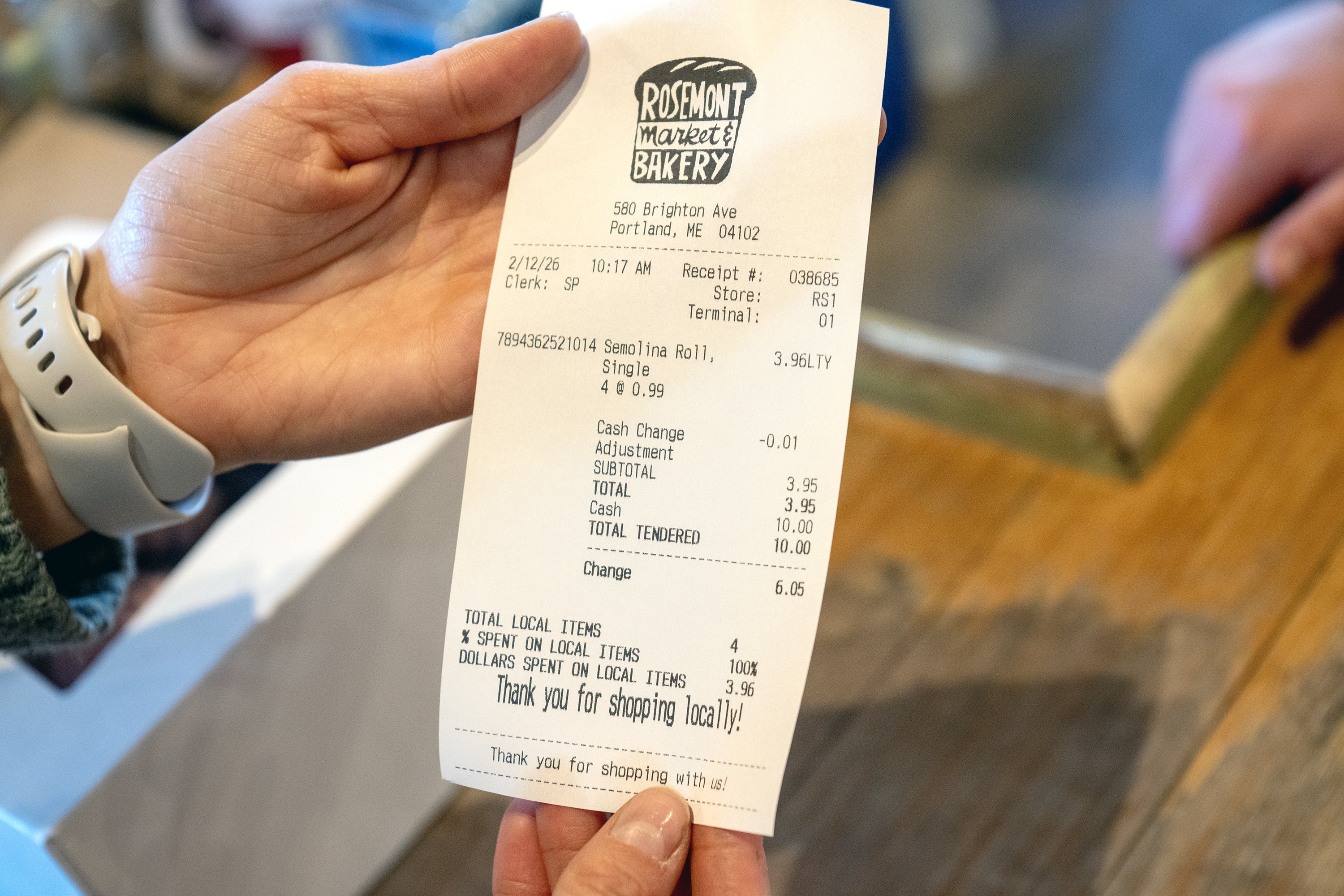
“If the final digit of the total transaction amount (including taxes) is 1, 2, 6, or 7 cents, the amount is rounded down to the nearest multiple of 5,” the national council recommended in November. “If the final digit is 3, 4, 8, or 9 cents, the amount is rounded up.”
Rounding would not apply to payments made via electronic methods, checks, gift cards or other non-cash instruments, the council advised.
“Retailers should continue accepting pennies and providing penny change for cash transactions while the coin remains in circulation,” the Treasury Department advised. “The penny will remain legal tender, meaning it retains its status as an acceptable form of payment.”
SAVING MILLIONS ON PENNIES
To justify the phase-out, the Treasury Department said it was spending 3.69 cents to make each penny and would save $56 million in annual production costs on a coin that now has “very low purchasing power.”
Still, there are 114 billion to 250 billion pennies in circulation, according to the Treasury Department and the American Bankers Association.
The crew at Rosemont Market got eight rolls of pennies Wednesday. But they keep a penny jar on the counter just in case, and the company was grateful when its point-of-sales provider upgraded its software to automatically round change on cash purchases.
“It’s been kind of chaotic,” said Ben Davis, Rosemont’s director of finance. “We can’t serve our customers if we can’t make exact change. About 15% to 20% of our customers use cash. It’s a small portion of our sales, but it’s important.”
Rosemont’s POS provider is ECRS, a retail automation company based in Boone, North Carolina, that has clients in all 50 states, Canada and the Caribbean.
ECRS had helped Canadian clients deal with rounding issues after Canada stopped making pennies in 2012, said company spokesperson Ryan Reynolds.
“We immediately had a software fix in place to provide a solution for our U.S. customers,” Reynolds said. “It was a relief for many of our customers.”
Curtis Picard, president and CEO of the Retail Association of Maine, said penny availability hasn’t been a significant problem for his members, though he shared the recommended rounding policy with them.
“Some retailers have been rounding purchases for a while,” Picard said, noting that many already kept “leave a penny, take a penny” stashes near cash registers to help reduce change.
“It ends up working out,” he said.
Hannaford supermarkets, a member of the association and the state’s largest retail chain, said it is monitoring penny availability closely and will “make adjustments” as needed, including following all federal, state and local guidance.
“Due to the limited availability of pennies impacting businesses nationwide, we are encouraging our customers to pay with exact change whenever possible as a precautionary measure,” Hannaford said in an emailed statement.
The statement didn’t answer whether the company had begun rounding change on cash transactions.
FAIR WARNING TO CUSTOMERS
The city of Auburn warned residents on Facebook last month that it would begin rounding change for cash payments on taxes and other fees when its current penny supply runs out.
“In December, Androscoggin Bank notified us that it could no longer fulfill penny change orders,” city finance director Kelsey Earle said Friday via email. “We have not yet implemented rounding, but we announced the upcoming change to keep customers informed.”
Androscoggin Bank, with 13 locations across southern Maine, continues to place orders for pennies from the federal supply, but they often go unfilled, said bank President Neil Kiely.
“Androscoggin Bank, like many others, is unable to consistently provide pennies to our clients due to an intermittent supply from the Federal Reserve Bank of Boston,” Kiely said Friday via email.
In the meantime, Auburn’s municipal offices will provide exact change when pennies are available, the city’s Facebook post stated. When pennies are unavailable, city staff will use the recommended rounding policy.
Comments on the city’s post were mixed.
One person asked why the city didn’t change the cost of services to eliminate the need for rounding — something a city official responded was impossible for fees set by the state. Another noted that Canada got rid of pennies “years ago and it’s not that difficult.”

Rosemont customers seemed largely unfazed by the rounding practice or eventual penny phase-out.
“I think it’s kind of silly,” said Maureen Costello, 71, of Portland. “We all have pennies. What are we supposed to do with them?”
Costello said she uses cash as a way to control spending. When her budgeted amount of money runs out, that’s it. She purchased a few pastries Wednesday morning, on her way to visit her father, and paid exactly $6.33, pennies included.
Al Bean, 70, of Standish, bought cookies to bring home and share with his wife. He paid with a credit card. His tally was exactly $14.
“Businesses need to start adjusting their prices so they don’t need to round up or round down for cash purchases,” Bean said.
Davis, Rosemont’s finance director, and Picard, head of the retail association, both said there was no pressing demand or anticipated move in the industry to adjust pricing to reduce or eliminate the use of pennies.
BANKS RESPOND TO SLOW DOWN
The American Bankers Association said there isn’t a penny shortage in the traditional sense.
“There are plenty of pennies out there, but circulation is slowing down,” the association said in a statement first published in October and updated in January.
“Many people stash pennies in jars or drawers, and without new ones being minted, banks and retailers are relying solely on recycled coins,” the association stated. “This has created localized supply issues.”
The association has advised its members to monitor coin circulation closely, work with government agencies to manage the penny supply and support customers as they adjust operations to accommodate reduced penny availability.
TD Bank representatives couldn’t be reached for an interview via phone numbers or online portals on its website for media inquiries.

Saco & Biddeford Savings Institution, a mutual savings bank with eight locations in southern Maine, has seen no reduction in penny availability, in part because it has changed the way it processes the coins.
“There is currently no (penny) shortage at any of our branches,” said Brian Ballute, chief financial officer, in an emailed statement. “We’re handling every transaction to the exact cent, and we’re thoughtfully monitoring conditions so we can respond responsibly as things change.”
Before penny production stopped, the bank shipped $50 bags of the coins to be rolled by an outside firm, said Sarah Gonneville, retail operations manager. Now, the bank is rolling them in house to preserve local availability and keep the pennies in rotation as long as possible.
The bank currently isn’t limiting how many pennies a customer can have, but it is reviewing requests on a case-by-case basis. Larger amounts might be divided over a few weeks.
“We want to ensure our business customers have the pennies they need to serve their customers,” said bank spokesperson Chelsea Miller.

We invite you to add your comments. We encourage a thoughtful exchange of ideas and information on this website. By joining the conversation, you are agreeing to our commenting policy and terms of use. More information is found on our FAQs. You can update your screen name on the member's center.
Comments are managed by our staff during regular business hours Monday through Friday as well as limited hours on Saturday and Sunday. Comments held for moderation outside of those hours may take longer to approve.
Join the Conversation
Please sign into your Sun Journal account to participate in conversations below. If you do not have an account, you can register or subscribe. Questions? Please see our FAQs.