


LEWISTON — Snowmobiling is big business in Maine, generating hundreds of millions of dollars a year. Beyond the snowfall, the industry depends entirely on the goodwill of landowners along the state’s vast trail network, and the work of the thousands of volunteers who take care of those trails.
Experts across Maine say both of those are increasingly at risk. Tensions between landowners and riders who don’t always follow the rules has put that relationship at a “boiling point,” according to Cpl. Kris MacCabe, who handles landowner relations as a state game warden.
At the same time, the volunteers who have held the trail network together for decades are getting older, with not enough members from the next generation willing to take on the same task.
“Our trail system is built by volunteers,” said Al Swett, past president and current operations director for the Maine Snowmobile Association. “The trouble with that is they’re an aging workforce.”
Those factors, along with rising costs for trail maintenance and shifting priorities for the logging companies, which, for a long time, owned most of Maine’s forestland, are putting the state’s 14,000 miles of trails, from Rangeley to Caribou and Portland to the Canadian border, in danger of being fragmented.
A FRAGILE RELATIONSHIP
The size of the Maine trail network stands out in New England, with the state boasting far more miles than Vermont (4,500), New Hampshire (7,000) and Massachusetts (2,200). You have to go to Minnesota, with its 22,000 miles of trails, to find a system larger than Maine’s.
Maine is also an outlier in that 95% of the trails are on private property, rather than land controlled by the state or federal government, which means that keeping trails open depends on keeping landowners happy.
MacCabe, one of two landowner relations corporals with the Warden Service, is charged with working with landowners on a variety of issues, including handling complaints. He said the relationship between snowmobilers and landowners is increasingly fragile.
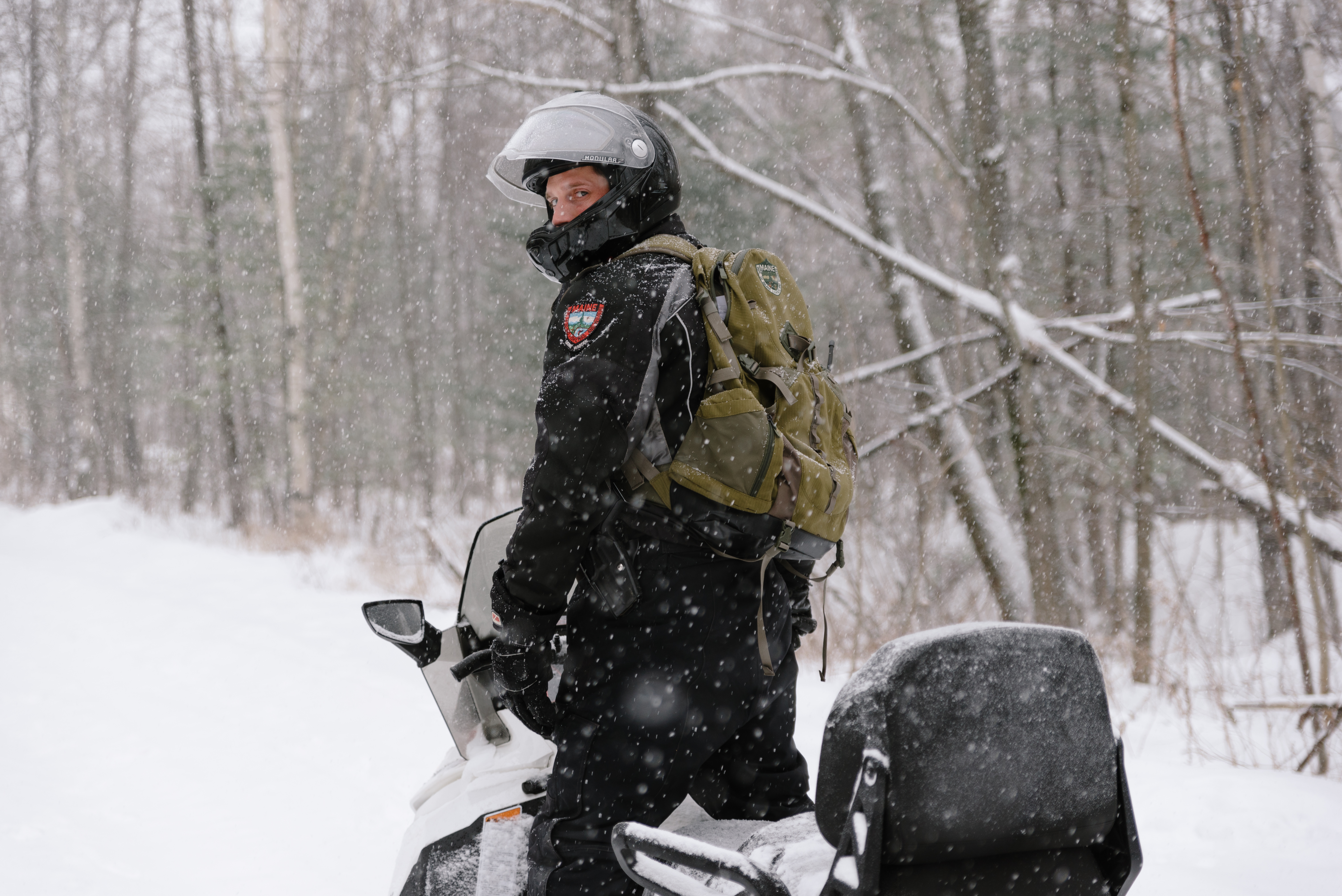
“It is a complex issue,” MacCabe said. “Their relationship is, it’s not all fun and games … it’s tense.”
Maine’s implied permission law gives hunters, anglers and recreators access to the private land unless it is posted or marked, while the state’s Recreational Use Statute protects landowners from liability if someone is injured while using their land, with some exceptions.
However, the state says landowner permission should be obtained each year — a responsibility that falls on the state’s 280-plus snowmobile clubs that maintain and groom the trails.
Every year, more and more landowners are cutting off access to their land to the public for a variety of reasons, which is their right.
LANDOWNERSHIP CHANGES
Making the situation even more challenging are the changes in who owns Maine’s nearly 18 million acres of forestland, which makes up 90% of the state.
For decades, large corporations — timber companies and paper mills like Diamond International, International Paper and Boise Cascade — owned vast tracts of land in Maine. Beginning in the 1980s, a changing global economy and rising land values drastically altered the face of landownership, with the large companies selling forestland and opening up the property to development for the first time.
The 1988 sale of nearly 1 million acres of Maine forest by Diamond International created widespread concern, and garnered the attention of conservation groups, regional governors and national media. It was the largest land sale in the region since 1960, according to Boston-based LandVest Inc.

Today, landownership is increasingly fragmented. Data from the Northern Forest Center shows that more than one-third of the land in Maine, Vermont, New Hampshire and New York is owned by nonindustrial private landowners, 20% of which are real estate investment trusts and timber investment management organizations.
In 1995, a majority of the land was owned by paper and lumber companies. By 2022, it was just 7%.
“The trend of changing landownership represents a drastic change that affects communities, the economy, and access to the land,” Julie Renaud Evans, program director at the Northern Forest Center, said in 2023.
As large plots of land are broken up, more landowners are involved: For example, a farm in Lewiston or Westbrook that was there for 50 or 100 years is sold and developed. Now, rather than dealing with one landowner, snowmobile clubs looking to secure a trail route must deal with several.
“That’s where the change really has happened in the disconnection,” MacCabe said, “because it only takes one landowner to change hands that doesn’t want the trail system that shuts it all down.”
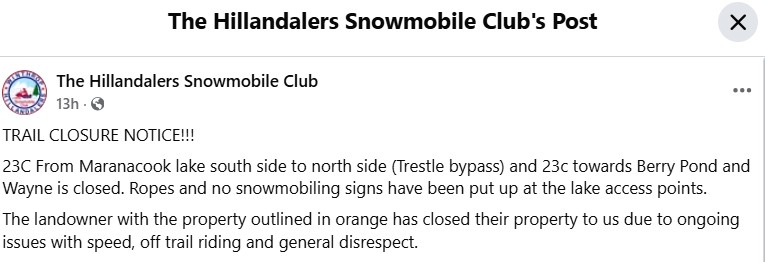
Landowners in Maine have a long tradition of allowing recreators and hunters to use their property. Some use the snowmobile trails themselves, but there’s no financial or other benefit to them, other than helping the community. All they say they want in return is to be treated with respect.
Brothers Tim and Greg Morin and longtime friend Eric Spear have been riding snowmobiles most of their lives. They are part of the Hillside Family Riders Snowmobile Club in Lewiston, which maintains 40 miles of trails in and around the city, because they love riding.
They consider themselves mainstream riders who follow the rules and have spent countless hours over the years maintaining the trails, grooming in the middle of the night and keeping the peace with local landowners.
But all it takes is one rider who rides recklessly, loud, or commits the worst offense: riding off trail without permission. That’s what leads many landowners to shut down trails.
That’s what happened a few years ago, when one person ignored the rules, leading a landowner to shut off one-third of the trails, including access to Sabattus.
“Somebody broke through the snow fence, got into some barbed wire, got out of their track and threw it in the hay field,” Tim Morin said. Come spring, the farmer picked up the wire which entangled his equipment and decided he’d had enough.
“He was gracious enough to let us use his land for all these years,” Spear said, “and that was the straw that broke the camel’s back.”
“We lost a whole side of Lewiston,” Greg Morin, the club’s trailmaster, said.

It took five years for Spear to convince the farmer and other landowners to allow the club access to just a part of the original land and create a rerouted trail.
Access to trails controlled by logging operations can change with little notice, too. Sometimes, companies shift the types of timber being cut.
Swett said a key trail in northern Maine was shut down all last season in just such a scenario. A local club spent between $20,000 and $30,000 readying the trail for the season.
“A week before, the landowner came in and said, ‘We changed our mind. We got to have that for the winter,'” Swett said. “So, all last year, we couldn’t use that route.”
At other times, companies are put off by riders who disregard trail closure signs and put themselves at risk in active logging operations, or those who cut through fields where millions of dollars of spruce has been planted, damaging the crop.
MacCabe said by the time he hears about situations like that, it’s usually too late and the damage has been done.
He cited a logging operation underway last year on a trail in Rangeley. “It was closed. We had signed it. They had some people come through and they flipped the operators off and took off,” MacCabe said. “So, we went there the next two days, and we wrote 75 summons in two days.”
In 2024, the Landowner Relations unit recorded 593 calls from landowners upset about the use of their land for a variety of reasons. Of that total, snowmobile trespass calls were second only to hunter trespass calls. In 2025 the number of snowmobile complaints was down, but as MacCabe pointed out, there was less snow and fewer riders last year.

VOLUNTEERS MAKE IT ALL HAPPEN
Part of the cost of maintaining the trail system in Maine comes from snowmobile registration fees. But those cover less than half the actual cost. The rest — about $3 million a year — is borne by the snowmobile clubs and businesses who hold fundraisers or donate.
The Maine Snowmobile Association estimates 90% of the trails are maintained by volunteers, with only a few clubs able to pay groomers.
Swett said it’s hard to attract younger generations to maintain and groom the trails. “Most of those guys are 65 to 75 years old. They go out and do the hard work … build the bridges, do the trimming. And the ladies get in their side-by-side and they go out and do all the signage. … It’s just amazing what these guys do.”
But each year there are fewer volunteers.
At the Hillside club, John Bigelow, Ben Beaucage and Melissa Bourgoin have stepped forward to help.
Bourgoin, who lives in Greene but volunteers in Lewiston, likes the camaraderie at the club and believes in giving back. But she also loves the experience.
“It’s beautiful outside at night on the trails after dark,” she said. “It’s quiet, it’s peaceful, and it’s rewarding to see what you’ve created by going through a trail that is beat up, and when you’re done with it, it’s just smooth and flat.”
It’s not all fun and games. There is a four-hour video, study material and a 150-question test to take to become a certified groomer.
“You have to know the mechanics,” Bourgoin said. “You need to know the environment. You have to understand the weather, and how the snow reacts during different temperatures, and what it’s doing as it’s going through the blades and then the pan of the machine.”
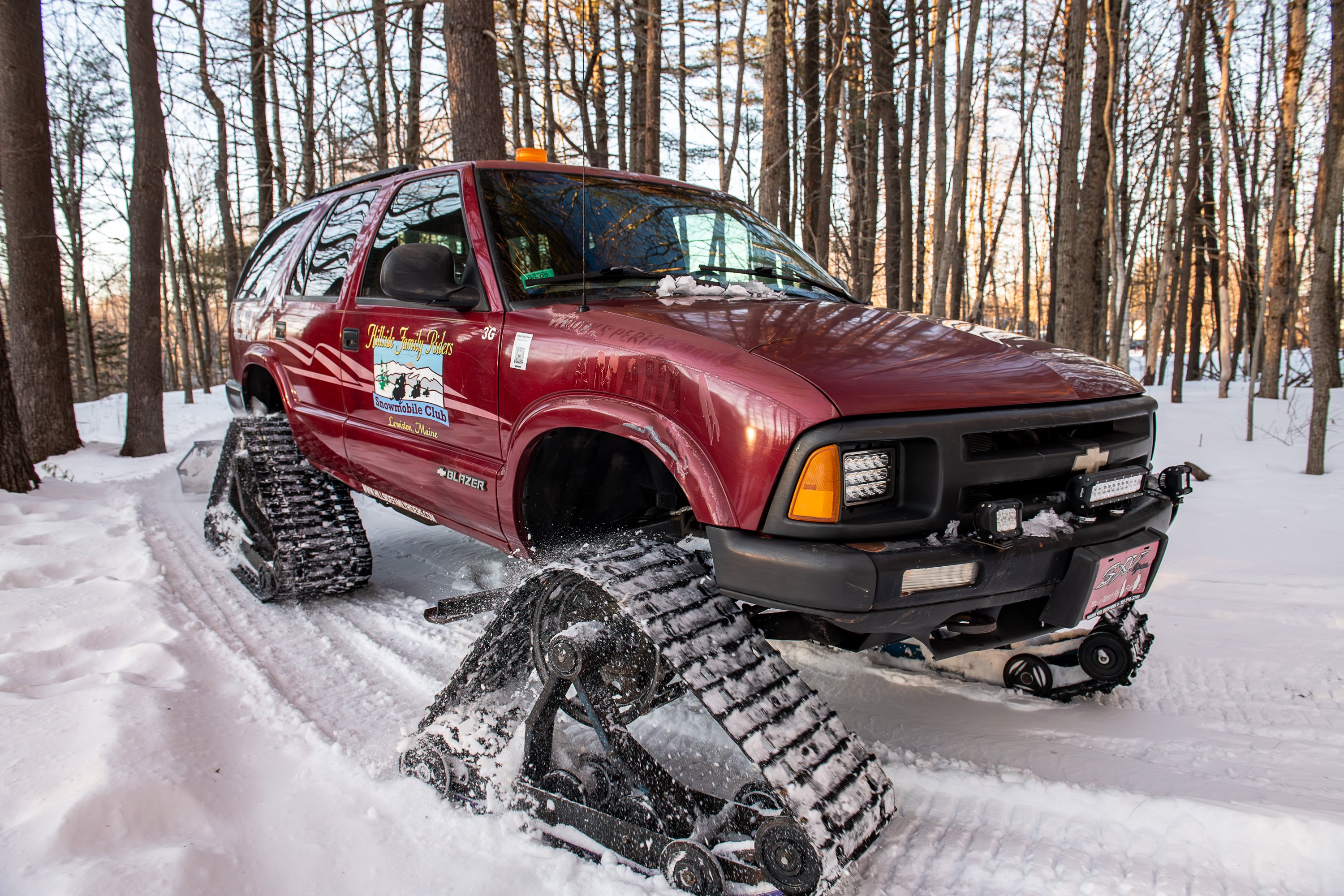
Rising costs have made maintaining the trail system more challenging for the clubs. Finding more revenue likely means increasing fees and getting more people to join clubs.
Registration fees are $56 a season for residents. Nonresidents have a choice of $75 for a three-day pass, $100 for a 10-day, and $120 for the full season.
Neighboring states charge additional fees and higher rates for nonresidents or incentivize riders to join a snowmobile club. Maine does neither.
“I don’t feel the in-staters should be paying more than what we’re paying,” Greg Morin said. “I feel the imbalance is in the out-of-state registration. The in-state people are the people that are taking care of the trail system, so they’d like a little bit of recognition.”
Joe Higgins supervises the snowmobile program within the Maine Department of Agriculture, Conservation and Forestry, which includes overseeing the registration funds and how they are spent.
“There needs to be more funding,” he said. “This is a huge economic train for the state of Maine, generating approximately $650 million a year. And, in order to keep that going, we’ve got to invest in that infrastructure of our trail system. “
The Legislature has weighed in. Recent legislation established a group to explore opportunities to work with commercial landowners to maintain public access to privately owned land. Other legislation addressed landowner rights.
A bill before the Legislature, LD 1547, would require that 40% of sales tax collected on snowmobiles be mostly redirected into trail maintenance and to help pay for groomers and other capital expenses.
LD 1762 proposes a Trails for the Future Fund to create easements for recreational trails.
Higgins said they have had numerous meetings and committees to discuss the issues, but so far there’s no immediate resolution in sight.
“I explain the shortfall that we’re running into, the lack of volunteerism that used to be there years ago,” he said. “This whole system is on the backs, literally on the backs, of the private landowner and the volunteers out there making it happen.”

We invite you to add your comments. We encourage a thoughtful exchange of ideas and information on this website. By joining the conversation, you are agreeing to our commenting policy and terms of use. More information is found on our FAQs. You can update your screen name on the member's center.
Comments are managed by our staff during regular business hours Monday through Friday as well as limited hours on Saturday and Sunday. Comments held for moderation outside of those hours may take longer to approve.
Join the Conversation
Please sign into your Sun Journal account to participate in conversations below. If you do not have an account, you can register or subscribe. Questions? Please see our FAQs.