


David Jones had a mission: neutralize Bobby Charles.
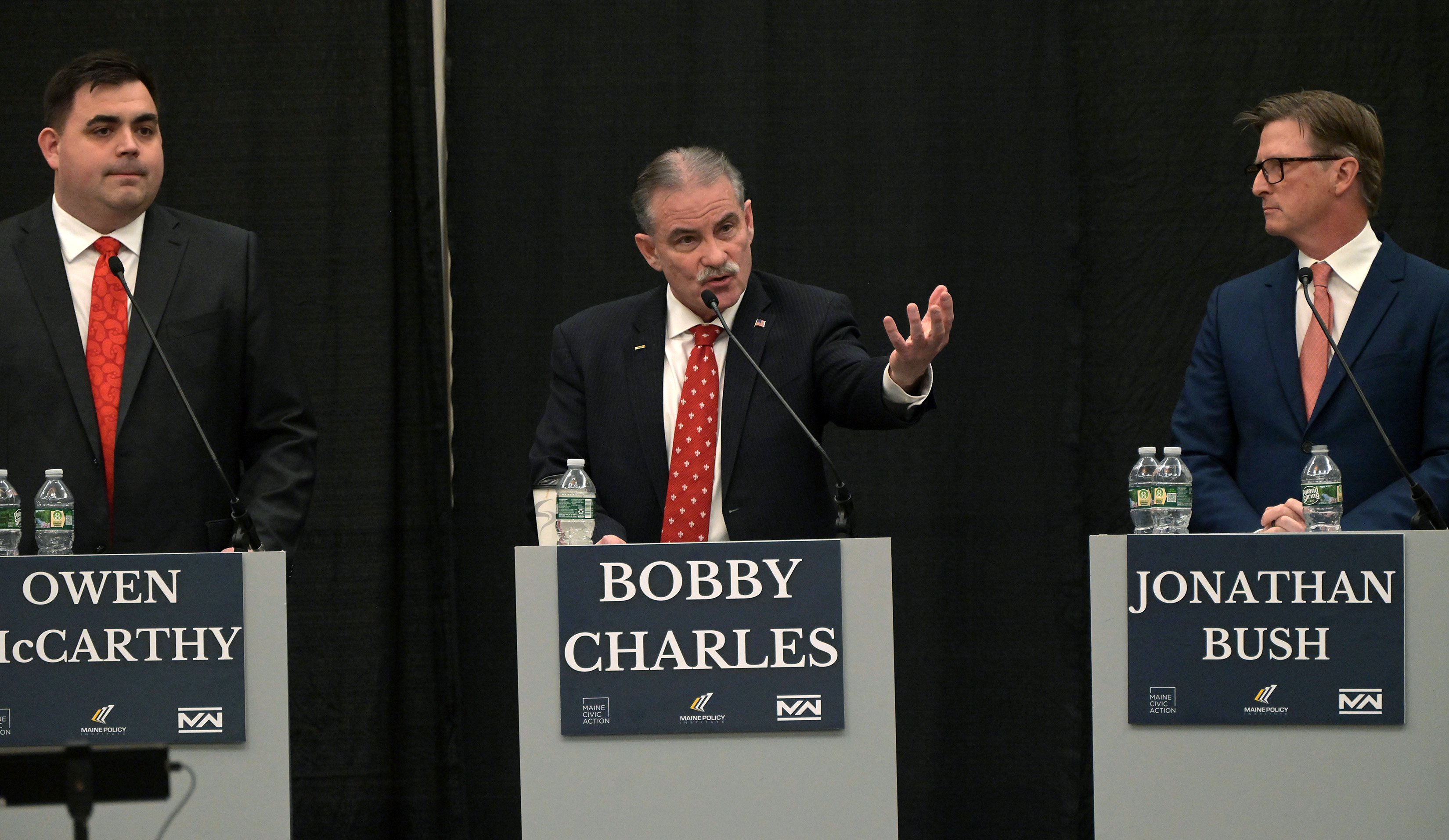
At a March Republican gubernatorial debate in Bangor, Jones, a businessman and real estate broker, spent his entire closing statement attacking Charles. He called his opponent a “swamp rat” from Washington, D.C., who had inflated his career, made unrealistic promises to voters and lied on the campaign trail.
The crowd booed and some turned their backs to the stage. Charles seized on the moment.
“So this is what it looks like to be the front-runner — by double digits!” he said to a round of applause.
In a crowded Republican field for governor, Charles has pitched himself as hard on crime and fraud — an attorney, litigator and manager who has tackled the issues at the federal level.
If you believe the early polls, his tough talk has propelled him to the top of the crowded pack. If he wins the Republican nomination, he will go on to vie for the chance to succeed Democratic Gov. Janet Mills, who is term-limited and running for U.S. Senate.
Charles grew up in Maine, but spent his career in the nation’s capital and never expected to run for the state’s highest office when he moved back in 2022. But he was alarmed by reports of drug trafficking, he said, and felt called to do something.
“If you’re a doctor, and you walk by a lot of people that have broken legs, and you know how to set a leg, you have a moral obligation to set that leg,” Charles said.
A University of New Hampshire Survey Center poll released last month had Charles ahead of eight other Republican candidates with 28% of primary voters selecting him as their first choice. Former Senate Majority Leader Garrett Mason was second, with 12%.
And a Pan Atlantic Research poll released earlier this month had 26% of primary voters likely supporting him, followed by 11% for Mason.
But as promising as those results were, Charles’ lead seems tenuous. Both polls noted high numbers of voters who were not familiar with or were undecided on the candidates in the Republican field.
In fundraising, Charles trails Jonathan Bush, who has raised $1.3 million, according to the latest campaign finance reports, from January. Charles raised roughly half that.
With less than three months to go until the June 9 primary, Charles will have to find a way to keep the momentum going and fight off competition that includes Mason — who has already benefited from ads run by a conservative political action group that has spent $2 million on the race so far — and Bush, a member of one of America’s most prominent political families. (Bush is a cousin of former President George W. Bush.)
Charles says he’s the best candidate for the job based on his experience in the federal government, but he’s never held elected office — and he will have to convince voters that he understands Maine.
“I am Maine to the core, and anybody who has ever known me and knows me now, knows that,” he said. “A lot of Maine kids, and I was one, went away in their 20s, did things, served and then came home again. All of my time away was service to the nation.”
SOCIAL MEDIA BOOSTS CAMPAIGN
Part of Charles’ early status as a front-runner may be because of when he entered the race. He announced his run a year ago, months before some of his opponents. He’s spent that time capturing the attention of diehard Republicans with grabby and provocative statements on social media.
A recent Facebook post, in its entirety, read, in large bold letters on a bright red background, “Simple but important: Maine is NOT Somalia,” an apparent reference to allegations of social services fraud by Somali-American-owned health care providers in the state.
Rep. Joshua Morris, R-Turner, who is serving his fourth term in the Maine House and whose district includes Leeds, where Charles lives, said he didn’t know much about Charles before his run for governor. But in recent months, he’s met him a few times at local political events.
Morris, who is not endorsing any of the candidates in the race, said he thinks Charles is out to an early lead because he has spoken well to the issues many Republican primary voters care about, such as fraud and wasteful spending.
“I think people feel he’s a fighter and that he’s been willing to put himself out there on these issues that are very much top of mind,” Morris said.
Charles has pledged to cut taxes, reduce the size of government and improve schools — typical conservative priorities.
But his forceful communication style has earned him no shortage of coverage in the conservative Maine Wire, an online publication of the Maine Policy Institute and a key right-wing megaphone in the state. Charles has also appeared on the conservative TV network Real America’s Voice.
The media attention has likely made more voters aware of him, said Rob Glover, an associate professor of political science at the University of Maine.
“For voters whose information environment is shaped by those channels, he’s been a highly visible and familiar candidate,” Glover said.
His blunt style has also led to public spats with other candidates. In February, Democrat Troy Jackson, the former president of the Maine Senate, made the rare move of challenging Charles to an early one-on-one debate.
Jackson had called Charles’ statements racist, particularly his criticism of state Rep. Deqa Dhalac, D-South Portland, whom Charles accused of being more loyal to Somalia — where Dhalac immigrated from more than 30 years ago — than America. Democrats, and one Republican lawmaker, criticized Charles at the time, saying he was engaging in a smear campaign to get attention.
When the two men met for the debate at the Hilton Garden Inn in Auburn, the scene was messy enough that Jackson lamented that such an event is “not what gubernatorial candidates probably should do.”
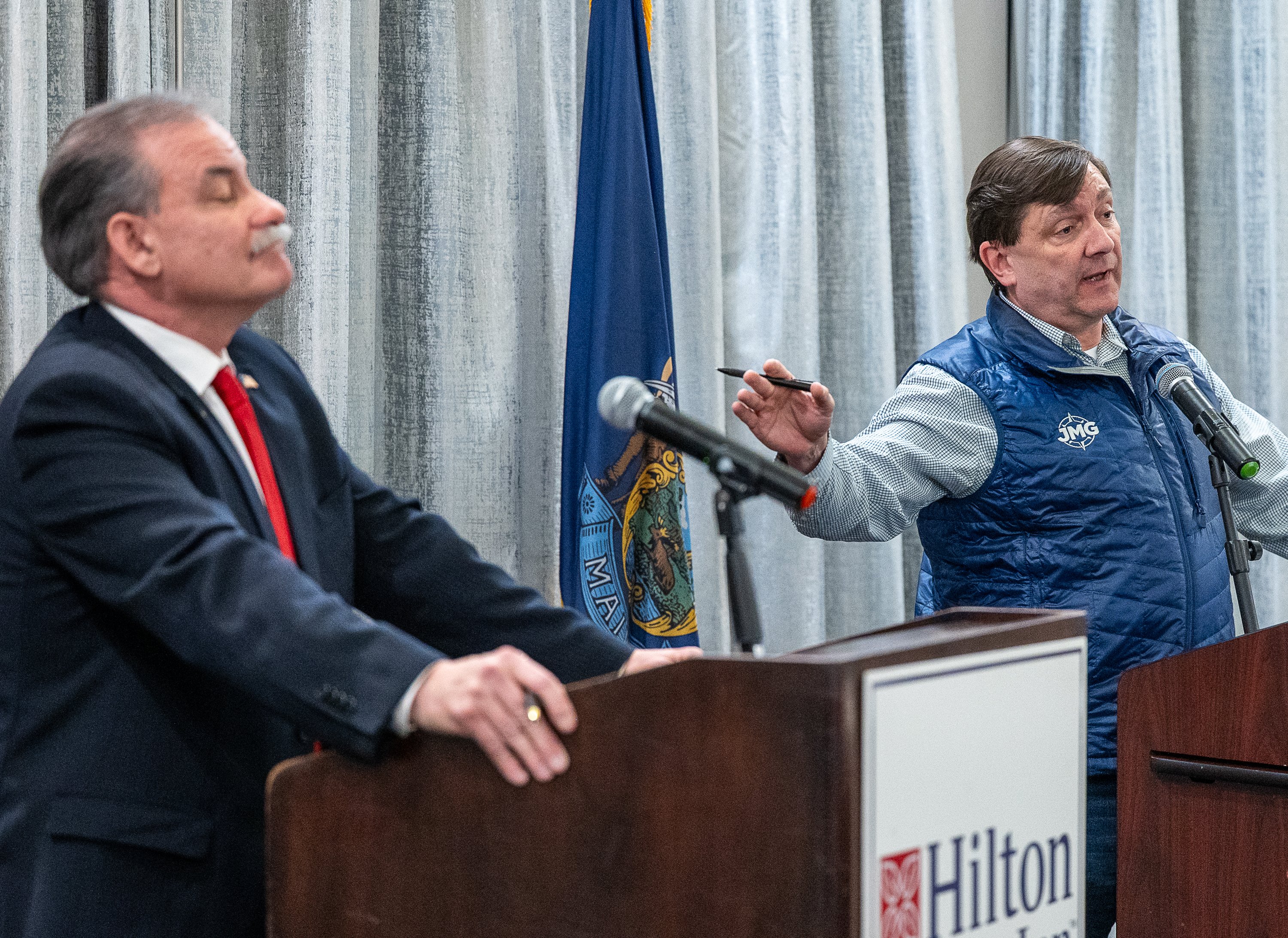
Charles said he supports immigrants who have gone through the proper legal processes at the debate, but laid blame on those who don’t have legal status.
“Illegal aliens are draining us of billions of dollars at the end of the day,” he said, adding that children who can’t speak English “drag down the rest” in schools.
Jackson said he was just stirring up fear.
“He’s been going around calling people a drain on society and that they’re part of the problem with crime,” he said. “It’s just constant race-baiting with this guy.”
FROM MAINE TO WASHINGTON, D.C.
Charles, 65, was born in Virginia, where his father was stationed at a U.S. Navy base. He moved to Maine with his family when he was 8 so they could be closer to relatives.
He grew up in Wayne and graduated from Maranacook High School. His mother, a teacher, instilled in Charles and his three siblings the importance of education and giving back, he said.
Ambitious from a young age, Charles graduated from Dartmouth College and Columbia Law School. He began his career clerking for a judge in the U.S. Court of Appeals for the 9th Circuit in Seattle and then worked as a litigator in New York and Washington, D.C.
Charles said he wasn’t fulfilled by that work — it was too focused on winning money for corporate clients — and he wanted to do something more service-oriented. In the mid-1990s, he was named staff director and chief counsel to a subcommittee of the U.S. House Committee on Government Oversight. He ran hearings, did legal work and managed investigations of federal agencies.
He later joined the U.S. Navy, serving as an intelligence officer from 1998 to 2009 in both reserve and active duty roles. Around the time of his enlistment, he started his company, The Charles Group, a consulting firm where he continues to serve as president.
Well-connected in Washington Republican circles, Charles became an assistant secretary of state for the Bureau of International Narcotics and Law Enforcement Affairs in 2003, under the Bush administration. The bureau, part of the U.S. Department of State, focuses on combating international narcotics production and trafficking, fighting international crime and strengthening law enforcement outside the U.S.
Charles joined at a time when the bureau was expanding its work and facing new pressures in the aftermath of the 9/11 terrorist attacks. A federal inspection report, published in July 2005, a few months after Charles left the job, said police training programs and counternarcotics challenges in Iraq and Afghanistan had significantly increased demands and created staffing challenges.
The report — which Jackson cited during the February debate — was both critical and complimentary of the bureau under his leadership. It said the bureau had a “solid record of achievement” in Iraq, Afghanistan and other programs, but cited “significant problems” in the bureau’s relationships with other offices in government.
In one example, the report said the bureau clashed with the Department of Defense over who should have oversight of police training programs in Iraq and Afghanistan. Amid these disputes, Charles’ bureau was “ineffective in presenting its positions,” the report said.
Charles acknowledged there was conflict, but he disputed the report’s findings that his side did not express its positions effectively. He said he was not afraid to “ruffle feathers” and would take the same approach if elected Maine governor.
“If someone’s performing well, they will be rewarded,” Charles said. “If they are ideological, or have their own agenda — and a lot of these bureaucrats have their own agenda — then that doesn’t fit with the mission and you’ll be removed.”
DRUG TRAFFICKING, SCHOOLS ARE PRIORITIES
Charles’ priorities include affordability and reducing energy costs, improving schools, addressing drug addiction, and eliminating Medicaid fraud.
He said a key way to address addiction is to support law enforcement, giving officers the resources they need. He also said he would leverage federal funding to expand treatment and prioritize prevention efforts in schools.
He has pledged to phase out the personal income tax over four years, something he said could be achieved by lowering state spending. There are currently nine other states, including Maine’s neighbor New Hampshire, that don’t have income tax.
Charles has also highlighted declining standardized test scores in schools, and said he wants to bring more accountability to education. Maine ranked near the bottom last year on a national assessment of fourth grade math and reading skills, and showed the largest drop in proficiency of any state when compared with pre-pandemic levels.
To Charles, that’s not acceptable. He said students are coddled and don’t face consequences for not doing their work.
“I want to see standards that are not modified for people who don’t want to do the hard learning,” he said.
CAN IT LAST?
While Charles has led polling to date, many voters have yet to familiarize themselves with the field. In both of the recent polls that showed Charles leading, the share of undecided voters was greater than the share of voters who said they preferred him.
Charlie Webster, a former state lawmaker who chaired the Maine Republican Party from 2008 to 2012, said Charles found early success because he was one of the first candidates to get in the race and worked hard.
“He’s been in the race the longest and has shaken a lot of hands,” Webster said.
But Webster questioned whether that momentum will last. He’s supporting Mason, who he said built up a better base of support during his years working in the Legislature. (Mason joined the race relatively late, in January.)
“I think you’re going to find that a lot of people will change their minds,” Webster said.
At the March debate in Bangor, Theresa Howard, of Limestone, proudly wore a red Bobby Charles T-shirt. “Bobby Charles is the man for me,” said Howard, who volunteers for his campaign and said his resume and work in the federal government stand out.
“He knows how to fight crime,” said Howard, 64. “I think we have to have someone like that in the state of Maine.”
But the overwhelming sentiment from voters at the Cross Insurance Center was that they’re still making up their minds.
“Ultimately, I’m looking for someone who has a plan that makes sense and isn’t just giving political rhetoric,” said Melissa Strang, of Orrington.
Strang said she doesn’t typically come to political rallies or debates.
“But because I’m so undecided, I was thinking this would help me figure out who’s most in line with my values.”

We invite you to add your comments. We encourage a thoughtful exchange of ideas and information on this website. By joining the conversation, you are agreeing to our commenting policy and terms of use. More information is found on our FAQs. You can update your screen name on the member's center.
Comments are managed by our staff during regular business hours Monday through Friday as well as limited hours on Saturday and Sunday. Comments held for moderation outside of those hours may take longer to approve.
Join the Conversation
Please sign into your Sun Journal account to participate in conversations below. If you do not have an account, you can register or subscribe. Questions? Please see our FAQs.