

From the moment she met Marcel, Jennifer Dupree knew they would be friends for life. Over the years, as their bond deepened, she realized there was a story worth telling — one that captured their friendship, their adventures and the injustices Marcel has faced throughout his life with cerebral palsy. With his blessing and encouragement, Dupree set out to write a nuanced account of Marcel’s experiences as a severely disabled person and the complexities of disability advocacy.
Many people go through life without ever finding a friendship as deep and dedicated as the one you and Marcel have with each other. What can we, your readers, learn from your relationship?
I think we all limit ourselves by putting people in boxes — like, “I can’t be friends with a 95-year-old because I’m only 50.” We need to have more openness. People keep calling my friendship with Marcel “unusual,” but I feel like all friendships are unusual. Once you leave childhood, making new friends and keeping those friends is hard. I hope people can learn to not limit themselves.
When you first met Marcel, would you have believed it if you were to have known that decades later, he would not only still be in your life but also that you would have published a book about him?
I knew we would always be friends — we really liked each other right away. Shortly after Marcel and I got to know each other, I did a semester at the Salt Institute for Documentary Studies at the Maine College of Art & Design. I produced a documentary about Marcel, filed it away and thought it wasn’t that interesting. I didn’t think I would ever write about him again. But, after experiencing more life alongside Marcel, I had the urge to return to the idea of writing about him and our friendship. At first, I was just telling Marcel’s story, but my team at Islandport Press encouraged me to write more about myself.
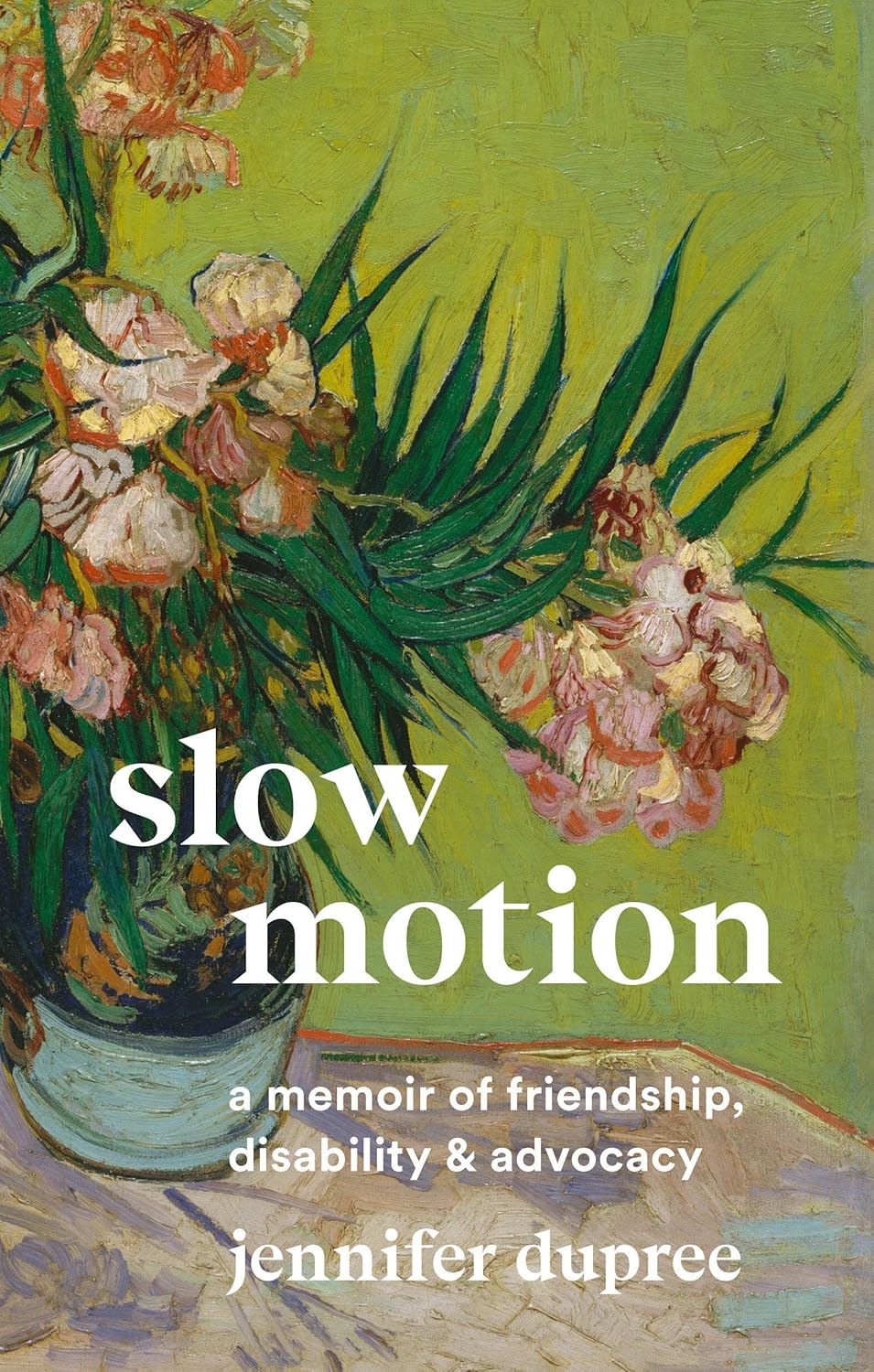
Speaking of Islandport Press, can you talk about your experience publishing this meaningful book with a small, local publisher?
I had sent “Slow Motion” out to a lot of different places. Islandport Press has a new publisher — KJ Grow — and this was her first acquisition. She called me and said, “I was looking for books with more empathy, and this is it.” I felt like she understood what I wanted to do and what I wanted to say. KJ and the team encouraged me to insert more of myself into the story. I resisted at first. Eventually, we found the right balance.
It’s important to have a publisher who understands what’s important. There were a lot of special moments. KJ wanted to meet Marcel, so we all had coffee together. Marcel also came to the book launch. It’s unusual to have your “subject” at that event, so that was really lovely.
I mostly write fiction and this was my first foray into memoir. Originally, I wrote this book in the second person, as though I were writing it to Marcel, but it wouldn’t have made sense for me to be telling him these stories, because he lived them with me. Islandport helped guide me as we moved most of the book into first person.
That’s right — you open this story by informing the reader that you alternate between first-person and second-person. In addition to those periodic shifts, you also switch between tenses. Can you talk about these stylistic decisions and how they informed your writing?
It’s really hard to pull off writing an entire book in the second person. But there were certain scenes that just felt more intimate, where I felt really strongly that it should stay in the second person. I wanted to bring the reader in. I think the second person does that — it creates intimacy, but it also implicates the reader. As far as tenses go, I chose to mostly stay in the present tense, but because the story is nonlinear, I chose to shift tenses often within the same paragraph or even the same sentence. I really didn’t want it to be a linear narrative.
While Marcel’s experience is unfortunately not unique — that is, to exist in an able-bodied society as a disabled person — there is a special Maine influence and theme woven throughout your story. Can you talk about the specific experience of living with cerebral palsy and caring for someone who has cerebral palsy in Maine?
It definitely has its unique challenges. In general, there are very few doctors who specialize in cerebral palsy in adults, because it is so rare for someone to live with it as long as Marcel has. In Maine, there aren’t many specialists at all. So what ends up happening is he sees one doctor for this and one doctor for that. And, then, there’s no public transportation, so it’s hard to get around.
But, at the same time, there’s something special about Maine. Where Marcel lives now, his neighbors all know him. Last summer, they realized they hadn’t seen him in a while. They inquired and found out that his electric wheelchair had broken, so they started visiting him three or four times a week in his group home, taking him outside to push him so he could get some fresh air. He didn’t have lights on his wheelchair, so his neighbors paid to have them installed. We have to be creative in Maine because there are so few resources at our disposal. There’s a real sense of community.
There is a lot to admire about Marcel’s palpable zest for life. What is the biggest lesson he has taught you?
Marcel can’t do some of what a lot of us consider the big things, like going on a bucket-list trip. There is a lot of striving in my orbit, but being friends with Marcel reminds me that it’s important to find pleasure in the smaller things in life. He finds so much joy in the things we consider ordinary.
Samara Brass is a writer and editor living in Somerville, Mass.
We invite you to add your comments. We encourage a thoughtful exchange of ideas and information on this website. By joining the conversation, you are agreeing to our commenting policy and terms of use. More information is found on our FAQs. You can update your screen name on the member's center.
Comments are managed by our staff during regular business hours Monday through Friday as well as limited hours on Saturday and Sunday. Comments held for moderation outside of those hours may take longer to approve.
Join the Conversation
Please sign into your Sun Journal account to participate in conversations below. If you do not have an account, you can register or subscribe. Questions? Please see our FAQs.