
Tux Turkel is a former staff writer for the Portland Press Herald who covered energy and utility issues.
I have a 2003 poster on my office wall by the artist Micah Wright.
In it, a workman in an industrial scene, complete with scaffolding and an oil derrick, holds some sort of gasoline nozzle and beckons with his gloved hand. The poster proclaims: “Cheap Oil is a RIGHT! Conservation is Just Letting the Terrorists WIN!”
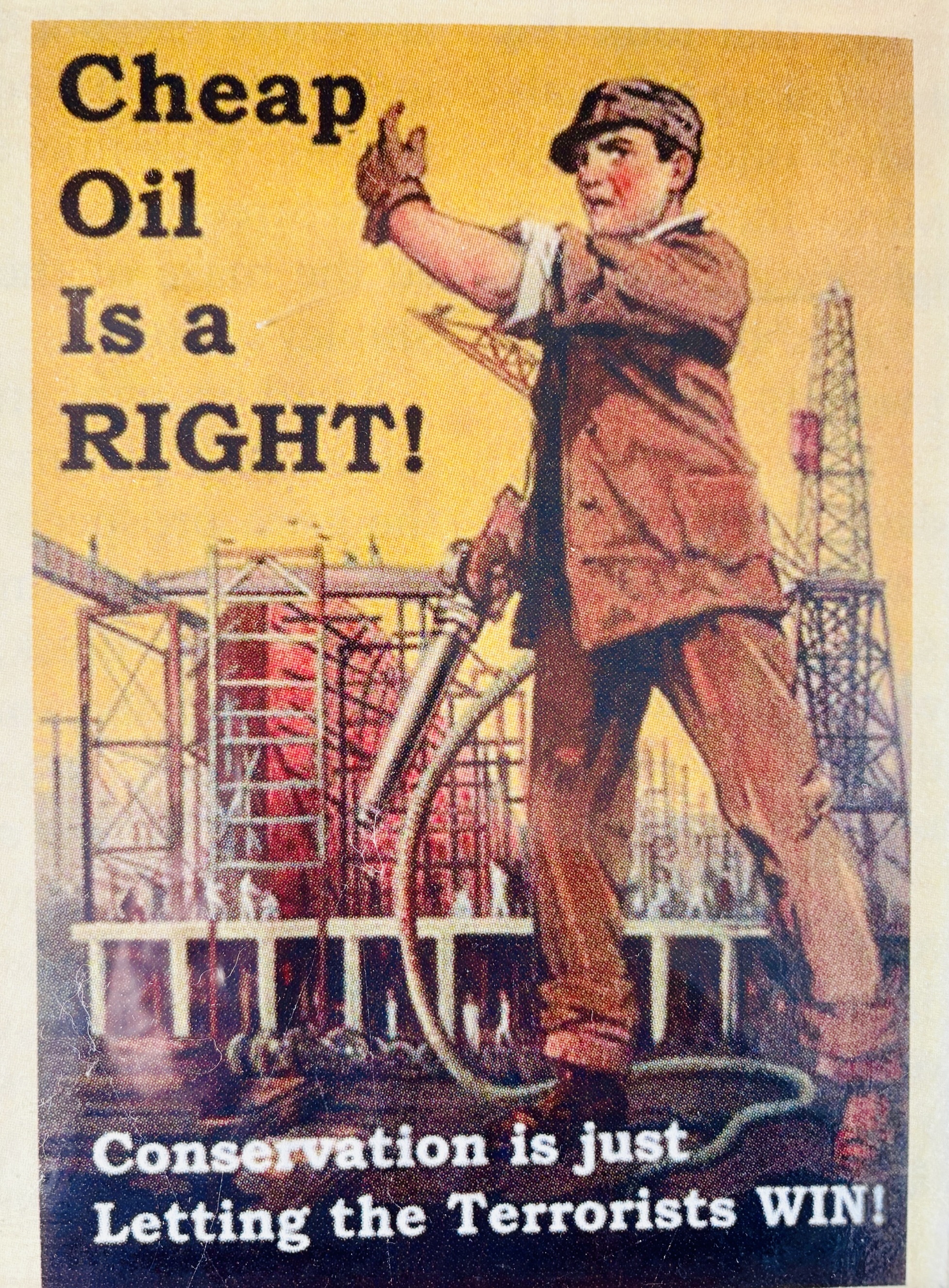
I think about that poster at times like these. In its satire, it sums up a timeless truth about the modern American condition. More than a half-century after the first shockwave set off by the so-called Arab oil embargo, many Americans still feel entitled to cheap energy. And they’re outraged when, for reasons they may not fully understand, gasoline suddenly becomes more expensive.
I was a college sophomore in Boston during the 1973-74 Arab oil embargo. I was commuting to school in a Fiat 124 wagon. (Worst car I ever owned.) It averaged 24 miles per gallon, which was better than many vehicles of the era, but it required premium fuel.
I wasn’t happy when gas prices jumped from 39 cents to 53 cents a gallon. That sounds cheap, but it’s $3.72 in today’s dollars, adjusted for inflation. Not much different than early April’s average pump price for regular of $3.97.
But one thing was different in 1974. The United States was a net importer of gasoline, and the embargo triggered a global shortage. The government responded with rationing — you could get gas on odd or even days, depending on your license plate number.
I didn’t really understand why this was happening. It hadn’t even occurred to me that gas prices changed much, because I’d only seen cheap oil. I installed a lock on my car’s gas door, because thieves were siphoning fuel from cars parked on the street overnight.
Today, unless you’re a young, clueless driver, you know gasoline prices have been on a roller coaster ride several times since 1974. Average prices briefly topped $5 a gallon after Russia invaded Ukraine in 2022. They fell to nearly $3 last spring, which now must seem like my 39 cents from the olden days.
This is perplexing, for some, because the United States is in an era of “energy dominance” thanks to fossil fuels, according to President Trump. We are now the world’s largest oil producer. But Trump fails to add that we also are the world’s largest oil consumer and that our prices are tied to global markets. Any disruption in supply — say, if we started a war with Iran, for example — is quickly reflected in what we pay at the pump.
A country that’s energy dominant also would mock the notion of conservation. That was burned into the national consciousness in 1977, when Jimmy Carter wore a cardigan and asked us to turn down the thermostat. Sacrifice equals weakness.
Today, we have the technology to substitute efficiency for conservation. We can do more with less. But Trump is gutting auto efficiency standards and electric vehicle incentives, because using more gasoline will somehow make us stronger and more dominant.
One thing the war with Iran is making clear is that the U.S. is energy dependent, not dominant. Trump never loses, so he’ll spin whatever happens with the war into a win. It might become the greatest military victory in American history, some people are saying. But 50 years on, if we are still so dependent on oil that Iran can choke off the flow and hamstring the global economy, aren’t the terrorists winning?
I was struck by a story last month in The New York Times noting that higher gas prices hadn’t sparked a drill-baby-drill boom in the Texas oil patch. Companies are skittish to invest, after laying off thousands of workers last year when prices fell. But pump prices were rising in mid-March when the Times interviewed a man who texted his friend in disbelief, after paying $140 to fill his work truck halfway. He couldn’t understand what happened to his cheap oil.
It’s not just that we feel entitled to cheap oil, it’s that we want it so we can drive giant trucks originally designed for contractors as our personal transportation. This is a uniquely American obsession. In most countries, it’s rare to see people cruising around in trucks that cost $50,000, weigh 5,000 pounds and get fewer than 20 miles per gallon.
This quirk may be part of the American DNA from our pioneer days. The view from a full-size pickup must remind us of driving a Conestoga wagon, with its elevated bench, vast cargo bay and enough ground clearance to get across the rutted prairie.
If we are still so dependent on oil that Iran can choke off the flow and hamstring the global economy, aren’t the terrorists winning?
Today, we could head west in an electric Conestoga. But the average American keeps a vehicle for 12 years. The sad truth is many of us are just trying to keep our rusty ride on the road. In that sense, gasoline is still cheap, even at $4 a gallon. It’s not high enough, for long enough, to push most people into another car payment, despite all the predictable media profiling those who had the foresight and yes, the privilege, to get an EV prior to the war.
There actually have been some very attractive deals on used EVs. But the sweet spot for many drivers might be a gas-electric hybrid, which is cheaper than a typical EV and doesn’t need to be plugged in.
Consider this comparison between an all-wheel-drive Ford Maverick, a right-for-the-times, small pickup. The straight-gas version averages 26 mpg combined. The hybrid makes 37 mpg, an 11-mile-per-gallon increase. The Maverick has a 14-gallon tank. That means the hybrid can go an additional 154 miles on a fill-up, which is like driving round-trip between Portland and Waterville.
But in seeing cheap oil as an American birthright, we lose sight of the cost, beyond the price at the pump. The true cost includes billions and billions of taxpayer dollars. Thousands of lives lost or ruined. Destroyed cities and essential infrastructure. The constant threat of retaliation.
This is what my poster doesn’t show. That cheap oil is a mirage and not a right, and as long as we remain so heavily addicted, the terrorists have won.
We invite you to add your comments. We encourage a thoughtful exchange of ideas and information on this website. By joining the conversation, you are agreeing to our commenting policy and terms of use. More information is found on our FAQs. You can update your screen name on the member's center.
Comments are managed by our staff during regular business hours Monday through Friday as well as limited hours on Saturday and Sunday. Comments held for moderation outside of those hours may take longer to approve.
Join the Conversation
Please sign into your Sun Journal account to participate in conversations below. If you do not have an account, you can register or subscribe. Questions? Please see our FAQs.