


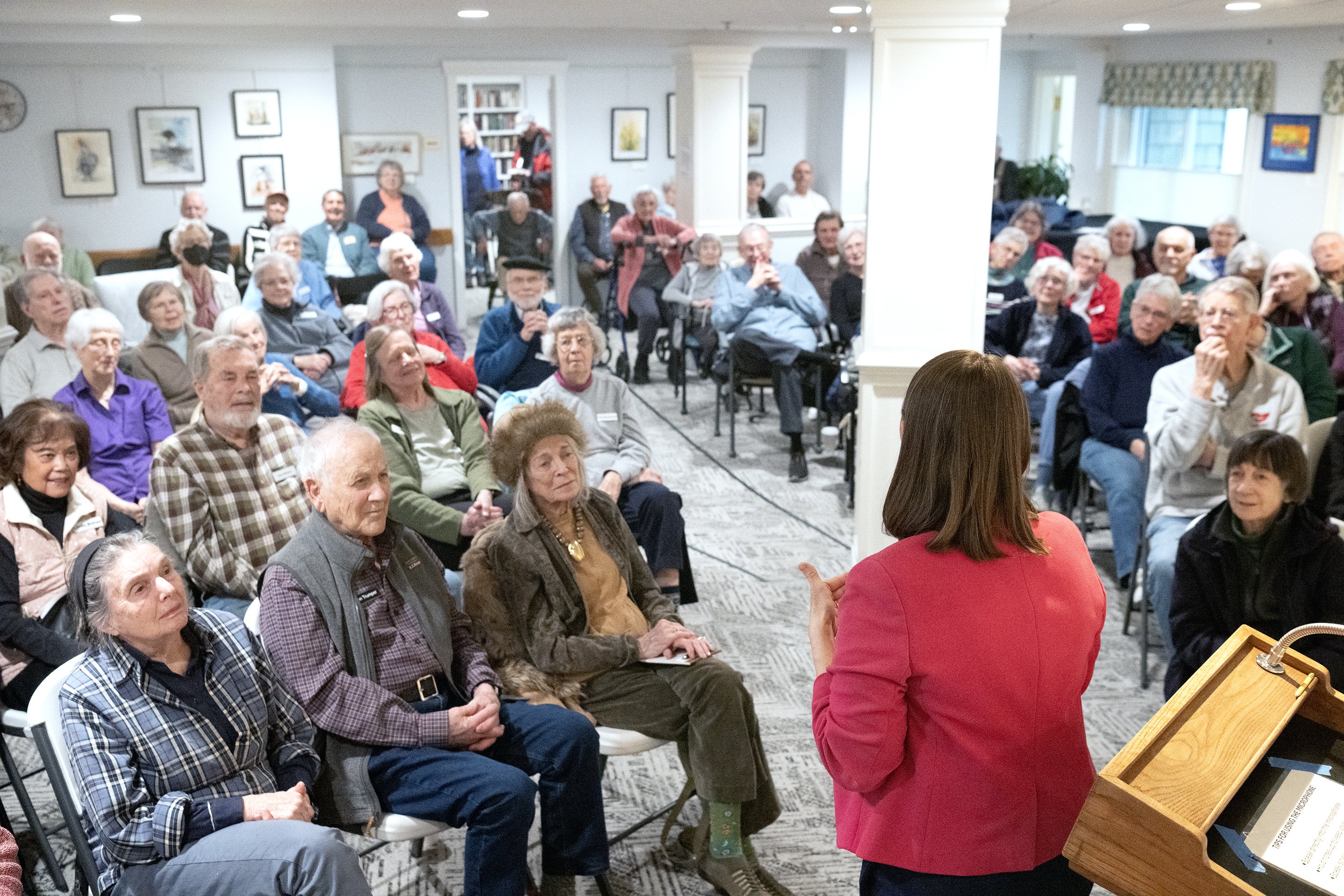
TOPSHAM — A standing room-only crowd filled the common area of the senior living community Shenna Bellows visited on a recent afternoon.
Bellows, a Democratic candidate for governor, talked about how her grandparents had retired to this place, The Highlands. She reminisced about eating dinner in the dining hall, and called out by name one resident who had known her grandfather before he died.
Then she launched into her life story: growing up in rural Hancock, working for the American Civil Liberties Union of Maine, serving in the state Senate and becoming Maine’s first female secretary of state. As soon as she was done, hands shot up with questions.
How would you change the education system so more young people can find jobs in Maine?
What is your plan to address climate change?
Would you be running for governor if Donald Trump wasn’t president?
Many in the crowd left satisfied.
“She has an energy that’s just spectacular,” resident Lynn Lockwood said after the event. “She’s really smart, and she has the passion you want to see in a candidate.”
Bellows is one of five Democrats running to succeed Gov. Janet Mills, who is term-limited and is running for U.S. Senate. In her bid for governor, she has made clashing with the Trump administration — something many Democratic voters are clamoring for — her calling card.
But in a competitive five-way primary, it remains to be seen whether Bellows has what it takes to win. Former Maine Speaker of the House Hannah Pingree has a lead over Bellows in fundraising, according to the most recent figures, from January. And two recent polls had Bellows in second and fourth place respectively among the Democratic candidates.
One of her greatest strengths, her willingness to take on Trump, may be a weakness as well.
Unlike many of the other Democratic candidates, Bellows has become a villain to Maine conservatives for her brash anti-Trump moves. And in a primary in which every candidate is vowing to push back against the president, it may be difficult for her to truly stand out.
Also in the race are Nirav Shah, former director of the Maine Center for Disease Control and Prevention; Angus King III, a renewable energy entrepreneur; and former Maine Senate President Troy Jackson.
Bellows said she brings a unique set of qualifications with her working class background, legislative service and time as an executive and manager. She says voters are sick of politicians who don’t say what they mean — and, according to her, she’s not that.
“I hear this all the time: I don’t always agree with you, but I trust you are saying what you mean, and that you’ll fight for us,” she said.
CLASHES WITH TRUMP, REPUBLICANS
Bellows was elected by the Legislature to serve as secretary of state in 2020 — a job that has kept her in the public eye plenty over the last few years.
Perhaps most notably, she made national headlines in 2023 with her decision to keep Trump off the Republican primary ballot after a group of residents challenged his eligibility. They argued Trump was ineligible because his role in inciting the Jan. 6, 2021, riots in Washington, D.C., violated the U.S. Constitution. Bellows agreed.
Soon after that, Bellows’ home in Manchester was “swatted,” — someone called in a fake emergency to draw a police response — and she and her staff reported receiving threatening communications from people unhappy with her decision.
Former Rep. John Andrews, R-Paris, led an attempt to impeach Bellows, but it was defeated 80-60 in the Democrat-controlled House.
Bellows ultimately allowed Trump onto the ballot after the U.S. Supreme Court weighed in on a similar case out of Colorado. The high court ruled that states did not have the right to exclude Trump from ballots.
Bellows reflected on the swatting while at The Highlands, recalling how she and her husband were forced to stay away from their home for a few days. She said it was scary, and sometimes she questions whether her job is worth the trouble. But she always arrives at the answer, “yes.”
“I believe in standing up for the Constitution and the rule of law no matter what,” she said.
Since voters sent Trump back to the White House, Bellows has kept getting in his way. When the Trump administration requested voter registration data from Maine, Bellows refused to provide it. She says the feds having this data would jeopardize privacy and put voter information at risk. Trump sued her over her refusal. At a press conference on the matter last summer, she told his administration to “go jump in the Gulf of Maine” — a phrase she has continued to echo.
In February, after Bellows announced she wouldn’t give undercover vehicle license plates to immigration agents, Republican leaders discussed impeaching her again.
They said the move jeopardized the safety of law enforcement, while Bellows, who earned plenty of publicity for the decision, said it was necessary to prevent potential abuses of power.
Bellows has also taken heat from state conservatives. In 2025, her office was bashed by a local right-wing news outlet after a woman in Newburgh discovered 250 misplaced absentee ballots. Bellows’ team has said the incident is still under investigation, but public records showed they clashed with their mail courier while probing the incident.
The leaders behind referendums pushing stricter voter identification requirements and restrictions on transgender athletes participating in school sports have also clashed with Bellows. Rep. Laurel Libby, R-Auburn, a lead organizer behind last year’s voter ID push, said Bellows has consistently shown bias in the way she’s worded ballot questions.
“She has worked in such a partisan way in this position, I don’t see Shenna Bellows as governor seeking to work in a bipartisan way,” Libby said.
Bellows said she’s not the partisan that some paint her to be. While in the Legislature, she worked on issues that she said mattered to both Democrats and Republicans, including lowering property taxes, improving access to school meals and addressing the opioid crisis.
And while some of her moves as secretary of state have been controversial, she said she’s built consensus on other work, such as her efforts to modernize the Bureau of Motor Vehicles.
Some critics have called on her to step down as the state’s top elections official while she runs for governor, but she has no plans to do so. Past secretaries in Maine and other states have not typically stepped down when running for other offices, she said.
There is precedent to back this up. In 2012, Republican Charlie Summers maintained his post as secretary of state while running for the U.S. Senate. Democrat Bill Diamond also ran for the 1st District seat in the U.S. House of Representatives while serving as secretary in 1994.
FROM ADVOCATE TO ELECTED OFFICIAL
Bellows, 51, grew up in Hancock, a town of 2,500 people in Down East Maine. Her father was a carpenter and her mother worked a variety of jobs. Although they were poor — they didn’t have electricity or running water until Bellows was in the fifth grade — she remembers Hancock as a good place to grow up and said her family always felt supported by the community.
Bellows was passionate about democracy and civil rights from a young age, and said she kept a copy of the Bill of Rights on her bedroom wall. Today, she carries a pocket-sized copy of the U.S. Constitution in her purse. When she was in grammar school, she wrote a letter to the editor of her local newspaper opposing then-president George H. W. Bush’s push to ban flag burning.
After graduating from Ellsworth High School, Bellows attended Middlebury College in Vermont. She went to work as an economic consultant in Washington, D.C., then joined the Peace Corps as a small business development volunteer in Panama. Back in the U.S., she went on to the AmeriCorps VISTA program, working on education issues in Nashville, Tennessee.
Bellows was then hired by the American Civil Liberties Union in D.C. as a field organizer, where she advocated for voting rights, reproductive freedom and marriage equality. In 2005, she returned to Maine to become executive director of the ACLU of Maine.
Bellows ran the Maine civil rights organization for eight years, and was a leader on the successful 2012 citizens initiative to legalize gay marriage. Betsy Smith, who at the time was the executive director of EqualityMaine, the state’s largest LGBTQ advocacy group, worked closely with Bellows. She said Bellows was part of a core group of advocates who contributed to the referendum’s success.
“She’s really well-grounded around decision making,” Smith said. “I think she would be a fantastic governor because she has the collaborative and political experience and the instincts to be the kind of leader that’s going to consider all points of view.”
At the ACLU, Bellows said she spent a lot of time trying to convince politicians to take certain positions. Eventually, she figured she might as well be the one to affect change directly.
Bellows left the Maine ACLU in 2013, announcing shortly after that she would challenge U.S. Sen. Susan Collins for her seat in 2014.
In the Senate race, Bellows impressed outside observers with her ability to raise $2 million and with her 350-mile promotional walk across Maine. But in a tough year for Democrats nationally, she didn’t gain the traction to defeat Collins, then a formidable three-term incumbent, and lost badly with 31% of the vote.
She kept running for things. In 2016, she was elected to the state Senate to represent several towns in central Maine.
Her district also voted for Trump, a Republican, for president that year — something Bellows has touted on the campaign trail as an example of her appeal to the rural working class. She said her focus on the issues that matter to people — health care, the cost of living and education — earned her broad support and got her reelected in 2018 and 2020.
DOES SHE HAVE THE SUPPORT?
Now, running for governor, Bellows said her positions are still inspired by her rural roots.
“I’m one of the only working class candidates who has that background of growing up poor, of working multiple jobs and paying off student loans,” she said.
Bellows has proposed lowering property taxes for Maine families by increasing taxes on residences owned by people who live out of state. She wants to create a Maine Housing Corps program modeled after AmeriCorps that would pay people to train in the trades and build more homes. And she’d push to cap returns for utility companies at 6%, a potential olive branch to families struggling to pay their rising energy bills.
She’s also pledged to continue the free community college program that started under Mills and has said she wants to improve state funding for hospitals and health centers.
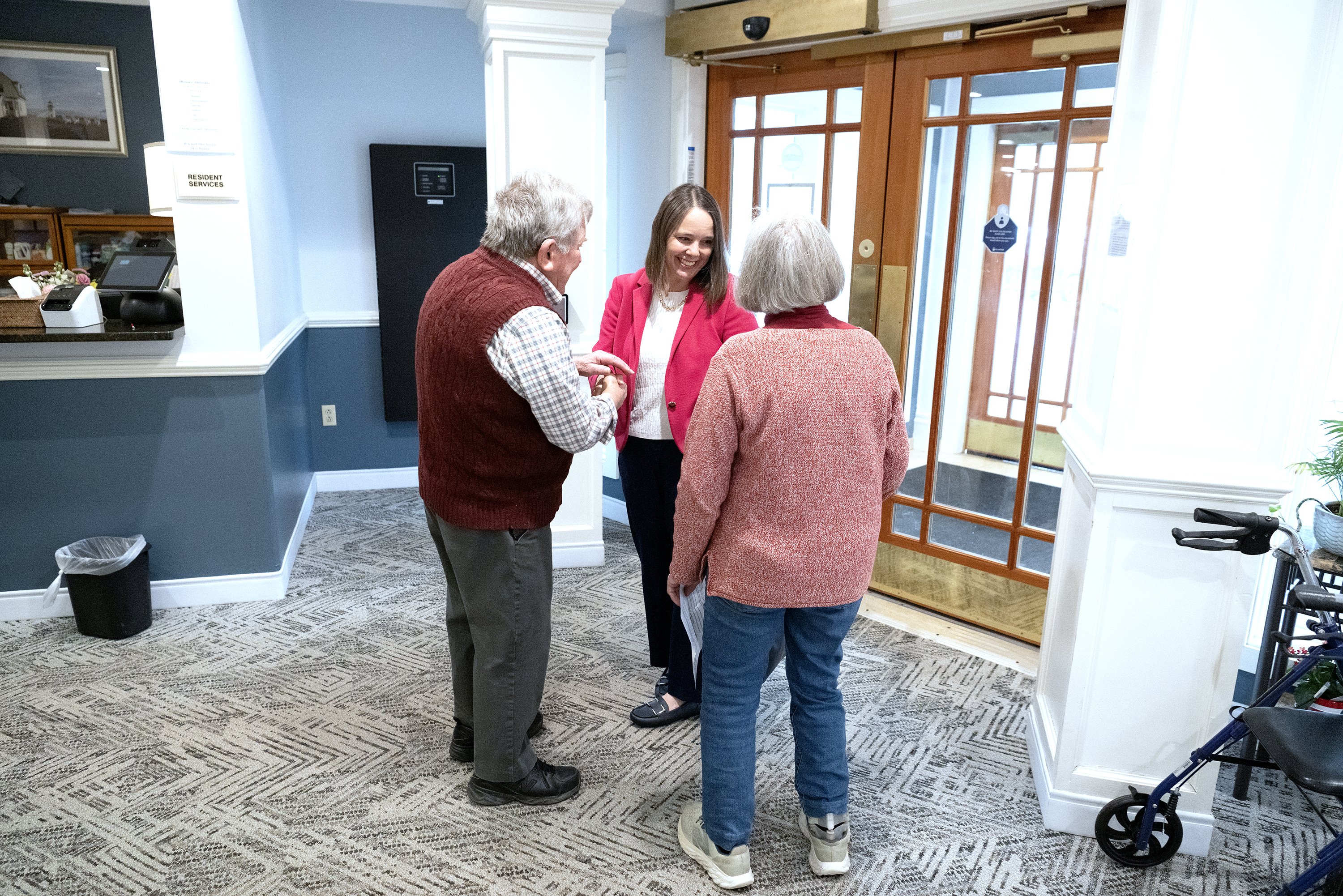
At The Highlands, voters said they were impressed with Bellows’ energy and enthusiasm. She talked passionately about standing up for democracy and fighting for the things she believes in, and she engaged the crowd with her personal anecdotes.
But Bellows’ visit also came on the heels of a campaign stop from Shah earlier in the week, and several residents said they were torn about whom to support.
“Right now, my head is swirling,” said Carole Vincent, who recently moved back to Maine from Florida and has been trying to learn as much as she can about the candidates.
“I’m so impressed with both of them,” she said. “I’m really going to have to do some more thinking before I decide.”

We invite you to add your comments. We encourage a thoughtful exchange of ideas and information on this website. By joining the conversation, you are agreeing to our commenting policy and terms of use. More information is found on our FAQs. You can update your screen name on the member's center.
Comments are managed by our staff during regular business hours Monday through Friday as well as limited hours on Saturday and Sunday. Comments held for moderation outside of those hours may take longer to approve.
Join the Conversation
Please sign into your Sun Journal account to participate in conversations below. If you do not have an account, you can register or subscribe. Questions? Please see our FAQs.