


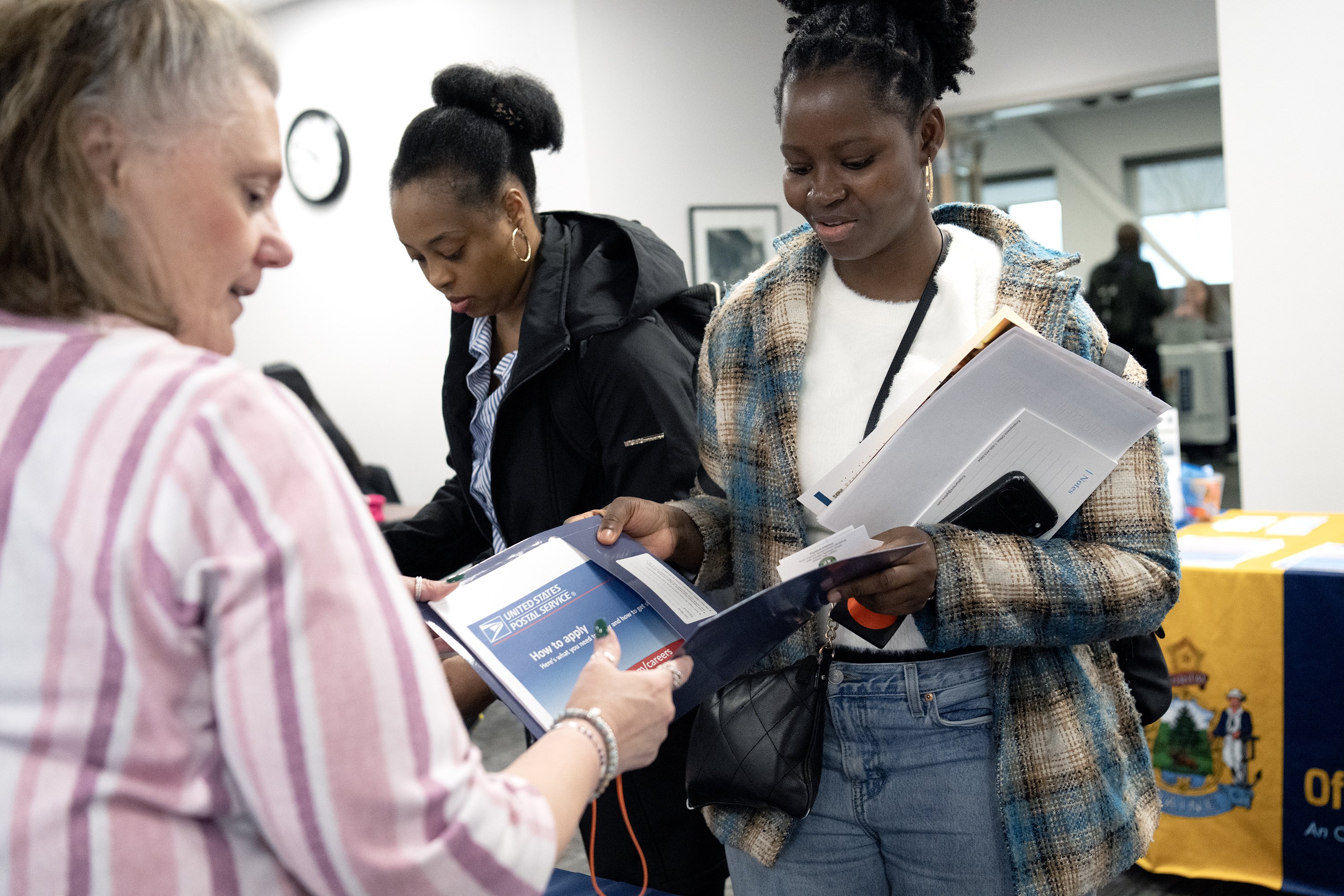
PORTLAND — Each month in a state office building near the Portland jetport, a dozen or so employers set up tables, tightly packed into conference rooms. They spread out candy, pens, buttons and notepads to entice job seekers.
At least 70% of people who come here looking for work are “new Mainers,” said Alex Richards, a career consultant who helps organize the events. They’ve come from places like South America, Angola and the Democratic Republic of Congo.
Matanda Raimundo was among the steady stream of people stopping at each table to hear about hundreds of jobs that were available in April.
“It’s my first opportunity to come here,” he said enthusiastically. Raimundo, who said he is seeking asylum from Angola, waited months to get his authorization to work in the U.S., eager to earn a steady income.
Since the 1990s, people have been able to apply to work while the federal government considers their eligibility for asylum. They can get a work permit after six months, but the whole asylum process takes years, even over a decade, giving them time to become regular members of the workforce.
Industries in Maine including manufacturing, health care and food, along with public services like transit, have relied on these workers to launch, maintain and grow business. In 2024, Maine’s entire congressional delegation tried and failed to pass a federal law that would’ve gotten eligible asylum seekers into the workforce even more quickly.
Now, the Trump administration is going in the opposite direction. It’s making a series of changes to upend the system, affecting employers, employees and potentially customers.
While there are no firm statistics about the number of asylum seekers working in Maine, about 8,600 people in the state have pending asylum applications, according to researchers at Syracuse University.
The changes have come piece by piece: the Trump administration has restricted people already in the workforce from renewing their work permits if they’re from 39 countries the administration deems a security risk; required that work permit renewals happen more often; and added hundreds of dollars in fees for applicants.
Next, the administration is proposing a rule that would pause new work permits for asylum seekers from any country for a period the administration said could be at least 14 years; and give U.S. Citizenship and Immigration Services discretion over whether all asylum seekers currently in the workforce should have their work permits renewed. The public has until April 24 to offer feedback.
The Trump administration acknowledges it may impact businesses in “lost productivity and profits.” It also said that taking some asylum seekers out of the workforce would reduce federal and state tax revenue.
If the newest set of rules gets finalized, Maine Chamber of Commerce President Patrick Woodcock said it would be disruptive.
“This labor force has become so integrated into some operations at companies in Maine,” Woodcock said. This has primarily happened over the past decade, he said, and the labor force from 10 years ago wouldn’t be adequate today.
The chamber plans to submit a comment on the rule before the deadline in the hope it can be improved.
The Trump administration argues the changes are necessary to root out fraud and abuse in the asylum system; reduce the massive backlog of asylum applications that the government has not been able to process; and protect national security after an asylee from Afghanistan shot two National Guard members last year.
BROADER GOAL
When the U.S. started to allow asylum seekers to work legally, “the idea was that they could support themselves and their family, and try not to go on welfare, work illegally or become destitute and homeless while their asylum case was playing out,” said Michael Knowles, one of the very first asylum officers in the early 1990s.
He worked for U.S. Citizenship and Immigration Services in Virginia until 2025 and is now executive vice president of AFGE Council 19, which represents unionized USCIS employees across the country.
The system to review applications was quickly overwhelmed, Knowles said, so the U.S. imposed the six-month waiting period between an asylum application and eligibility for a work permit that has been in effect ever since.
“We saw the influx of applications plummet,” Knowles said.
The Trump administration is hoping for a similar dropoff this time. One part of its proposal would double the waiting period to a year.
The administration’s broader goal is to reduce the number of people coming to the U.S. to seek asylum. It has said that if fewer people come, any lost tax revenue from removing large groups of immigrants from the workforce would be offset by a decreased need for public services. The Trump administration also wants to stamp out what it views as fraud in the asylum process.
Knowles said the agency’s staff is already good at rooting out fraud. “It’s actually a very rigorous standard for someone to meet,” he said. In his mind, the right solution would be to hire more staff at USCIS to process applications more quickly.
“The average asylum seeker doesn’t know if they qualify or not; all they know is they have to get the heck out of wherever they were before,” he said. For people whose applications end up getting denied, “it doesn’t mean they’re committing fraud; there’s nothing wrong morally or legally to apply for asylum.”
EMPLOYERS’ OPTIONS LIMITED
Just since last summer, hundreds of asylum seekers have received help from the Finance Authority of Maine to apply for first-time work authorizations.
Alison Conner regularly hires them at the ARC Labor Group, a Portland-based staffing agency. “We’re ramping up for our busy season — road projects, traffic control flaggers, live events,” she said at the April job fair.
She estimated 75-100 ARC employees would be affected if the newest work permit restrictions are put in place as written.
“If we lose people because the rules change, we’ll have to try harder to find people,” she said, adding that ARC’s costs for advertisements and job boards would increase as a result.
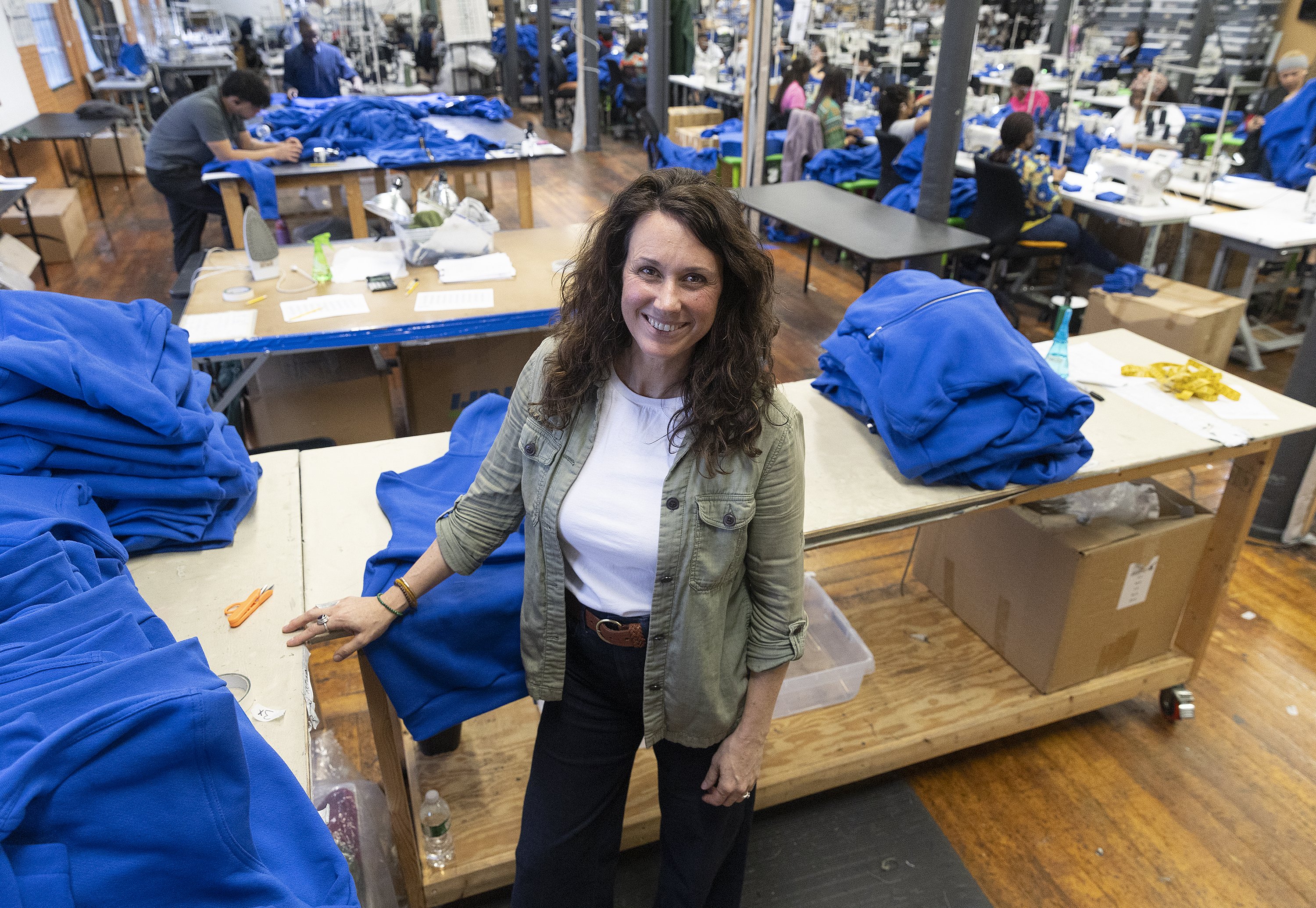
In Westbrook, when Ben and Whitney Waxman started their clothing manufacturing business 11 years ago, they put the word out that they were looking for apprentices.
“The only people that walked through our door were people who had just walked into this country,” Ben Waxman said.
Today, their company, American Roots, employs about 90 people, more than half of whom have come to the U.S. in the last decade. All of their employees follow the law and pay taxes, Waxman said.
No matter their background, the company tries to provide opportunities for people to move into the middle class, and in turn it supports American suppliers like a cotton grower in Texas and a thread company in North Carolina.
The company is growing; it’s hired about a dozen people since January. But, he said, “at the end of the day, if we don’t have the workers we can only scale so much.”
Transit services are already being affected because the Trump administration restricted certain groups of immigrants from renewing commercial drivers licenses. Greater Portland Metro Executive Director Glenn Felton expects a dozen of its 85 bus operators won’t be able to renew their licenses.
“Expansion of public transit will be more challenging and more expensive, I would suspect,” Felton said, because hiring has also slowed significantly due to the new rules. While it’s not under discussion right now, costs to raise pay in the future to try to attract more applicants would have to get passed onto customers.
The Trump administration and its allies, including a new conservative group called the Mass Deportation Coalition, say that foreign-born workers hurt wages for U.S.-born workers. The proposed new rule says if employers can hire American workers to fill jobs that asylum applicants would otherwise hold, those U.S.-born workers will benefit and there would be no productivity loss for employers.
It’s a big “if,” said Russell Ford, a Portland attorney who advises public and private employers on immigration compliance. He’s seen clients raise wages and offer bonuses, and it’s not working.
“They simply can’t find enough U.S. workers. They have recruiters, they scan the market — and they just can’t find the workforce,” Ford said. Maine’s unemployment rate is 3.3%, a full point lower than the nation overall.
The situation is not forecast to get any better. Maine’s workforce is aging, and while overall the population grew a little in 2025, there were more deaths than births. Immigrants are more likely to be working-age in Maine than U.S.-born residents.

At one Westbrook-based janitorial services company, a new owner took over last year and looked to hire people he could trust to get trained on technical cleaning methods and go into client businesses after hours. He said he offered a living wage, but struggled to find reliable people.
He turned to a local nonprofit that helps match immigrants in the community with work opportunities, and got 50 applicants on the spot.
“The ability to hire them helped me not go under,” said the business’ owner. Now that it’s grown, he employs a mix of U.S.-born and foreign-born workers.
He agreed to speak on the condition of anonymity because three of his employees have been detained by Immigration and Customs Enforcement in the past year, even though he clears all of his employees through E-Verify, the federal website that confirms whether applicants have legal work authorization. Records have shown that ICE has detained people who have valid work permits and are following the steps to request asylum.
Other employers in Maine have been reluctant to discuss the rule changes underway. Three health care providers in Maine declined interviews and seven other companies did not respond to requests for comment.
Going forward in 2026, the Mass Deportation Coalition, backed by the Heritage Foundation that has been influential in the Trump administration, is calling for more enforcement at worksites.
Woodcock, with the state chamber, worries that constraining immigrants’ ability to work will, in some cases, lead employers to take their business out of Maine to a state or country where there is a bigger workforce available.
In industries like food processing, he said, “It’s very competitive and competition is global.”
Depending on the economic calculations, employers could also decide to invest in equipment and productivity gains, Woodcock said, instead of raising wages for U.S.-born workers.
CONTINGENCY PLANS
Greater Portland Metro is checking if its bus operators are eligible to fast-track changes to their immigration status or could shift into other duties. Likewise, wherever possible Ford is helping companies and employees convert individuals’ immigration statuses to something more permanent, or obtain a different type of visa, in order to avoid losing employees.
But in some instances the only option for an employer is to think about sponsoring an employee for a green card, which can take 3-10 years for someone who doesn’t have a college degree, Ford said.
Woodcock said the Trump administration’s proposal to add discretion over renewals for people already in the workforce “creates a real, very challenging pathway” that lacks clarity about exactly what the threshold will be. Ford said his clients are increasingly unsure if their employees will be able to work in the future.
“You don’t know what that discretion is based on,” he said.
The chamber is preparing to help employees apply to renew their work authorizations under new regulations.
Labor unions and immigrant services groups have sued to stop recent changes to work permit renewals from countries the Trump administration deems a security risk. Ford said the new proposed work permit rules could get challenged in court, too.
“Nobody knows how it’s going to play out,” he said. “The ‘not knowing’ is wreaking havoc on businesses, and on people’s lives.”
What many businesses want is for Congress to reform immigration laws and provide a predictable, consistent avenue to get authorized workers.
The owner of the janitorial services company in the Portland area said he’s gotten no notifications this year from the federal government about rule changes that affect who he can hire, nor any notice when his employees have gotten detained by ICE.
“I can’t fully wrap my head around trying to run a business with 15 employees and keep up with the changes,” he said. “You get so frustrated.”

Meanwhile, among the last group of asylum seekers to get work authorization before the new Trump rules could take effect was a neatly dressed man at the job fair in Portland who asked to go by his initials, J.E., to avoid attracting attention. He didn’t want to talk about the reasons he left his home country of Angola, but he said he worked as an electronics maintenance technician there.
“Now I’m open for any kind of work,” he said, in order to pay for food and rent. “If you’re only waiting for someone to pay for everything for you, you don’t feel good. You need to provide for yourself.”

Comments are not available on this story. Read more about why we allow commenting on some stories and not on others.
We believe it's important to offer commenting on certain stories as a benefit to our readers. At its best, our comments sections can be a productive platform for readers to engage with our journalism, offer thoughts on coverage and issues, and drive conversation in a respectful, solutions-based way. It's a form of open discourse that can be useful to our community, public officials, journalists and others.
We do not enable comments on everything — exceptions include most crime stories, and coverage involving personal tragedy or sensitive issues that invite personal attacks instead of thoughtful discussion.
You can read more here about our commenting policy and terms of use. More information is also found on our FAQs.
Show less