


Gov. Janet Mills’ veto of a proposed statewide data center moratorium has cleared the way for projects in Maine, including redevelopment plans at the former Androscoggin Mill in Jay.
The governor said the bill failed to include an exemption for a project with strong local and regional support.
“A moratorium is appropriate given the impacts of massive data centers in other states on the environment and on electricity rates,” Mills wrote. “But the final version of this bill fails to allow for a specific project in the Town of Jay that enjoys strong local support from its host community and region.”
Mills pointed to the economic stakes in Jay, calling the mill’s 2023 closure “a devastating blow” and emphasizing the difficulty of attracting reinvestment to the brownfield site after years of failed redevelopment efforts.
A brownfield site is a property where redevelopment is impeded because of contamination, real or perceived, according to maine.gov.
In rural areas like Jay, data and broadband connectivity has consistently proved a challenge. Proponents of the data centers say the economic boon would aid efforts to expand internet access.
The steep valleys, long winters and low population density has contributed to delayed broadband expansion here and continues to drive up the cost of building it, according to Maine Connectivity Authority.
Fiber-optic networks are threading through western Maine and high-speed internet is being built across the region, but connecting each individual home is the most difficult and costly part of the process. In rural areas, long distances between homes, challenging terrain and limited customer density increase construction costs while reducing the return on each connection.
High-speed internet is increasingly viewed as a prerequisite for economic recovery in post-industrial towns. The fiber cables being installed along rural roads represent a new form of infrastructure investment, replacing the role once held by rail lines and industrial plants.
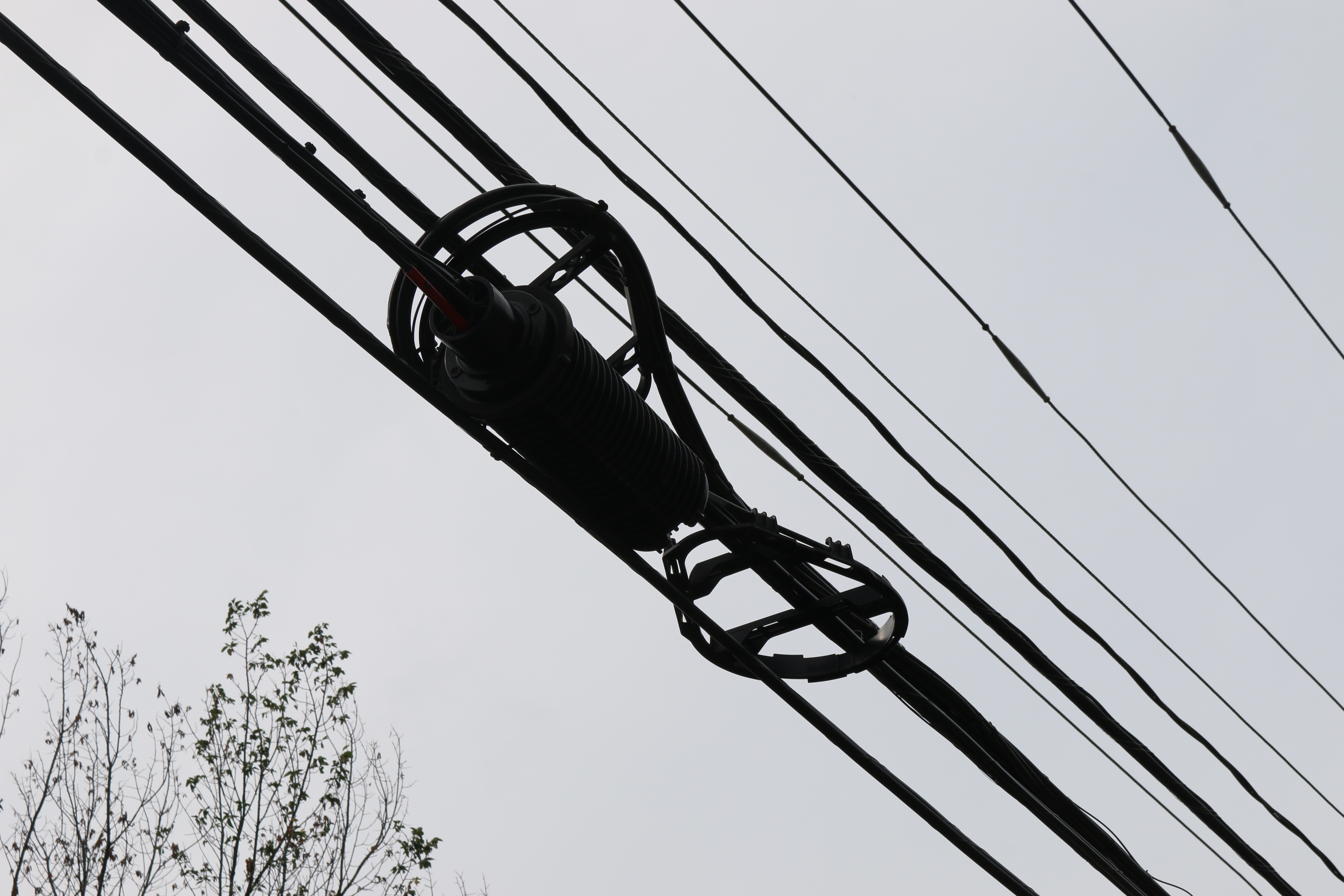
The Maine Connectivity Authority said connecting regions a key gap. Its MooseNet initiative is building a statewide open-access fiber system designed to provide high-capacity regional connections. MooseNet complements the Three Ring Binder, a 1,100-mile open-access fiber-optic network that allows providers to extend service into rural areas where building new infrastructure would be costly. It is typically the most expensive and time-consuming part of any broadband project.
Fiber also supports wireless infrastructure in areas where running cable to every home is not yet practical, providing high-capacity backhaul to towers and fixed wireless systems.
Stevie Hellenbeck, of Industry, said her $57-per-month Fidium fiber connection performs well most of the time, but outages expose weaknesses in support.
“When I lost service, there was no way to contact technical support other than an overseas call center, and no way to reach a local technician,” Hellenbeck said. She said a service appointment was scheduled two to three days later, leaving her without internet.
A Jay resident who asked not to be named said rising prices prompted a switch from Spectrum to fiber, but performance has been inconsistent in parts of the home. “The connection is weak in parts of the house, and we’re looking at adding extenders,” the resident said.
Performance depends heavily on installation quality. Additionally, most rural installations use existing utility poles. Underground fiber avoids exposure to weather but can be affected by frost heaves and shifting soil. Aerial lines are faster and less expensive to install but require coordination with pole owners and utilities.
Wildlife can also pose a risk, as rodents such as squirrels and rats are known to chew through cable sheathing, occasionally causing outages in aerial and underground fiber systems.
The Maine Connectivity Authority convened a Utility Pole Data and Performance Working Group in 2025 to address delays in that process.
REGIONAL IMPACT
Fiber expansion in Franklin County has been supported by multiple state and federal funding programs, including more than $3.6 million for Farmington-area projects and $4.8 million for the Rangeley region, both awarded in 2021.
Local estimates indicate that roughly 96% of homes and businesses in the county have access to fiber service.
Additional capacity has been added through infrastructure projects such as the New England Clean Energy Connect corridor, which includes fiber integrated into transmission lines running about 145 miles through western Maine. While this infrastructure does not connect directly to homes, it provides high-capacity pathways that support local network expansion.
Demand for bandwidth is increasing as artificial intelligence and cloud computing drive higher data usage.
Research has shown that existing fiber infrastructure can support significantly higher transmission speeds with upgraded equipment, suggesting that networks being built today may have far greater long-term capacity than originally anticipated.
At the same time, policymakers are evaluating how infrastructure growth should be managed.
The vetoed moratorium bill, An Act to Establish the Maine Data Center Coordination Council and Place a Temporary Limitation on Certain Data Centers, would have imposed a temporary statewide moratorium on large-scale data centers.
Gov. Mills expressed reservations about the proposal while acknowledging both infrastructure concerns and the economic stakes for western Maine.
“The Town of Jay worked for two years on a $550 million data center redevelopment project to finally bring jobs and investment back to the mill site,” Mills wrote. The project is expected to create more than 800 construction jobs and at least 100 permanent positions while contributing significant property tax revenue, she added.
She also said developers plan to reuse industrial buildings and infrastructure at the site, reducing the environmental and ratepayer impacts cited in the bill.
The Maine Legislature finalized action on the bill last week, with the House voting 79-62 and the Senate approving it 21-13 that evening, sending it to Mills for final approval. The measure would have prohibited new data centers with electric loads of 20 megawatts or more from receiving permits or approvals until November 2027, while a newly created Data Center Coordination Council studies potential impacts and develops policy recommendations.
Mills vetoed the bill on April 24, saying she supported a temporary moratorium in principle but would not approve one that blocked the Jay project, citing the absence of an exemption for the proposed redevelopment at the former Androscoggin Mill.

Because the bill did not receive a two-thirds majority in either chamber, the veto is unlikely to be overridden, allowing projects in Jay and elsewhere in Maine to move forward. they include plans for demolition at the mill site as early as July, while the state instead moves toward studying data center impacts through an executive order rather than a formal moratorium.
Tony McDonald, a senior partner with The Boulos Company involved in redevelopment plans for the former Jay mill site, previously said uncertainty around the proposal could affect broader investment.
The veto removes a key layer of regulatory uncertainty that developers had warned could stall investment, allowing the Jay project to proceed under its existing permits and timeline.
“It really is mostly interior work for this initial push,” McDonald said. “The project is scheduled to be operational in early 2028, with landscaping work likely in 2027, and the state Site Location of Development permit will require updating.”
Emerging technologies such as multi-core fiber and hollow-core fiber, which is in limited deployment, could further expand capacity and reduce latency.
The veto removes a key layer of regulatory uncertainty that developers had warned could stall investment, allowing the Jay project to move forward under its existing approvals.
In Jay, that shift is already underway, as the former mill site moves from stalled redevelopment efforts toward a new role built on digital infrastructure rather than paper production.

Supporting Sponsor for Franklin Journal, Livermore Falls Advertiser, Rangeley Highlander and Rumford Falls Times.
Keeping communities informed by supporting local news. franklinsavings.bank

We invite you to add your comments. We encourage a thoughtful exchange of ideas and information on this website. By joining the conversation, you are agreeing to our commenting policy and terms of use. More information is found on our FAQs. You can update your screen name on the member's center.
Comments are managed by our staff during regular business hours Monday through Friday as well as limited hours on Saturday and Sunday. Comments held for moderation outside of those hours may take longer to approve.
Join the Conversation
Please sign into your Sun Journal account to participate in conversations below. If you do not have an account, you can register or subscribe. Questions? Please see our FAQs.