
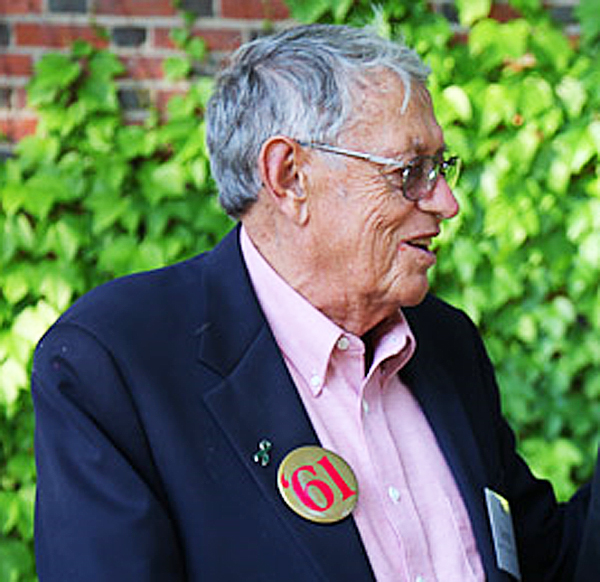
James Carignan, retired longtime Bates College dean and former Lewiston city councilman who survived being shot and two heart transplants, passed away at age 71 on Sunday in Brunswick following a battle with heart and renal disease.
Friends and colleagues used words such as committed, dedicated, extraordinary, optimistic and visionary to describe the man who spent his life serving Bates College and the community that surrounds it.
“He believed in the capacity of people to solve problems together when respect was present,” Peggy Rotundo of the Harward Center for Community Partnerships at Bates College said. “He is an inspiring mentor and believed deeply in the capacity of growth of all around him.”
Rotundo, who also represents a Lewiston district in the Maine Legislature, worked closely with Carignan when the liberal arts college started the Bates Center for Service Learning, which eventually evolved into the nationally recognized Harward Center.
Carignan joined his alma mater as its dean of men in 1970 and was the final person to hold that position after urging officials to eliminate the position and unify its student population. In 1971, he was appointed dean of the college. For more than 30 years, he helped shaped the future of Bates College until his retirement in 2003.
“Jim understood the founding values of the college — namely to provide a good education to those students who qualify, regardless of their background and ability to pay,” Carl Straub, former dean of faculty at Bates, said.
Like most who reminisced about Carignan Sunday evening, Straub said that his longtime colleague understood that vision better than anyone on the campus. His understanding and civility gained him respect among faculty and students alike.
While serving as the college’s dean of students, Carignan saw himself as an educator and teacher first, rather than a disciplinarian, according to Rotundo. Instead of simply doling out punishment when students ended up in his office, Carignan looked for teachable moments in the meetings.
In 1985, one such moment might have led to Carignan’s being shot by a sniper while sitting at his kitchen table. Earlier that same day, Carignan confronted a Bates students about possible criminal activity and gave the student a choice. He told the young man to either resign from the college with the chance to return or face a campus disciplinary board.
The bullet lodged less than an inch from his heart. Carignan later told a Sun Journal reporter that he believed the damage it caused led years later to his two heart transplants.
Although the student was arrested and charged with the shooting, the young man was acquitted at trial. Carignan, on the other hand, still considered him responsible even years later.
And yet, where such trauma and tragedy might deter most people, the life-altering moment seemed to energize Carignan even more. He will forever be recognized as an educator who raised generation after generation of Bates students to be part of the solution instead of the problem when it came to their communities.
“Jim believed strongly that colleges like Bates had a responsibility to educate students in good citizenship,” Straub said. “Therefore, he himself provided a good example of that through his own grassroots way of participating in public service.”
That creed of leading by example led to his involvement with public service and several civic organizations. In addition to serving two terms on the Lewiston City Council, Carignan also served on the State Board of Education, the Maine Learning Results Task Force and the St. Mary’s Health Care System Board.
Peter Garcia, an attorney with Skelton, Taintor & Abbott in Auburn, served with Carignan on the L-A Together Commission. He called him a tireless servant of the people who never made an enemy because of his conviction to treat everyone with dignity and respect.
Garcia, too, admired Carignan for leading by example, teaching others to get involved and work to better their community by pitching in and doing his share.
“I remember a story he used to tell when speaking in public about migrating geese and about how the flock had it easier because they all worked together and together they followed the leader,” Garcia said. “Jim led by example for this entire community.”
Comments are no longer available on this story