

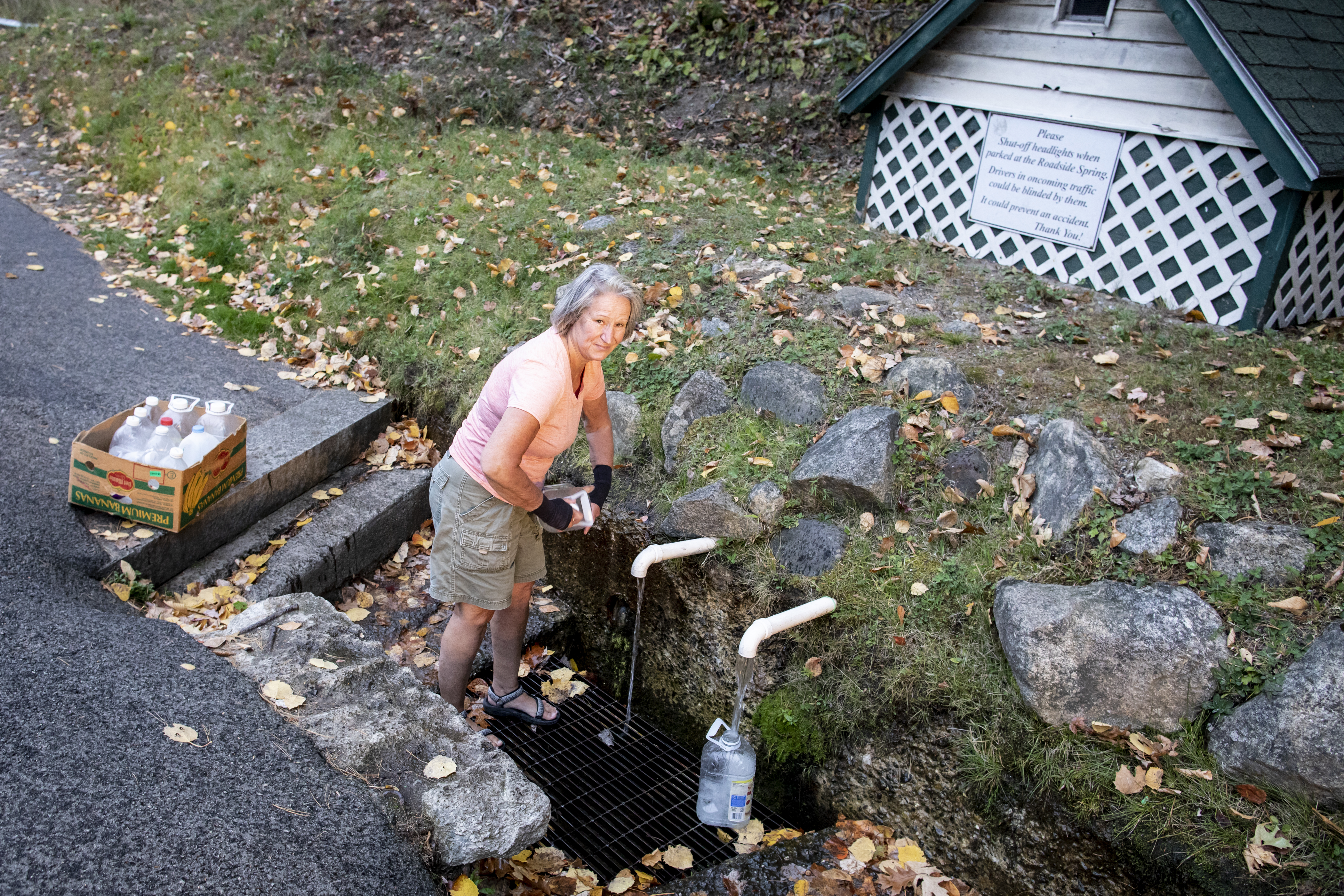
A well-known roadside spring beside Route 26 in Woodstock has been a popular source of free drinking water for decades, but its future is unclear as town officials work to confirm the exact location of the water source.
The spring’s well house on South Main Street is on property owned by Mike and Kathy Giunta. However, the spring may lie on an adjacent parcel that is for sale.
Woodstock Town Manager Tonya Lewis said the town is hoping to determine the spring’s location through a hydrological study.
With help from Erica Bufkins and Catherine Mardosa of the Androscoggin Valley Council of Governments, Lewis said she hopes to receive a resiliency grant to offset the estimated $14,000 cost for a study.
“If the spring is directly up from the well house, it is less concerning than if it takes a turn onto the property that is for sale,” Lewis said, “since new property owners blasting for construction or drilling a well could disrupt the spring.”
Under Maine law, a 100-foot radius around a public drinking water source is protected. But Lewis noted that may not be enough.
“The likelihood of the spring only being 50 feet up from where it comes out is pretty low,” she said.
The spring is one of only three in Maine registered as a public drinking water source.
Jim Chandler of Woodstock said the Maine Department of Transportation wanted to fill in and close the spring in 2000. He and the Woodstock Conservation Commission stepped in, worked out an agreement that the town would take responsibility for the spring, refurbished the well and piping, and began testing the water under state rules. For 25 years, Chandler has driven every month to A&L Labs in Auburn for a test that would not be valid if he only mailed the samples.
Lewis described Chandler as “very passionate about the spring.”
“If anything were to ever be awry we would have to immediately close the spring,” Lewis said.
The state requires Chandler’s monthly testing for contaminants and still oversees the spring, along with the other two state-registered springs, because they meet the U.S. Environmental Protection Agency’s definition of a public water supply, serving an average of 25 or more people a day for at least 60 days a year.
In August, a “For Sale” sign placed next to the well house caused concern among residents.
“For some people, this is their sole drinking source,” Lewis said.
She explained that some wells in Woodstock village and neighboring Greenwood produce iron-rich water that many find unpleasant to drink.
Chandler added that some well water is high in minerals, such as chlorine, or a spring user’s well may go dry because of drought, leading them to rely on the roadside spring.
“The North Pond campers and Newry skiers all use the water,” Lewis said. “We get people from everywhere.”
“Twenty-four hours a day people are at the spring filling their bottles,” she said. “Even in the dark, it’s hard to go by and not see anyone there.”

We invite you to add your comments. We encourage a thoughtful exchange of ideas and information on this website. By joining the conversation, you are agreeing to our commenting policy and terms of use. More information is found on our FAQs. You can update your screen name on the member's center.
Comments are managed by our staff during regular business hours Monday through Friday as well as limited hours on Saturday and Sunday. Comments held for moderation outside of those hours may take longer to approve.
Join the Conversation
Please sign into your Sun Journal account to participate in conversations below. If you do not have an account, you can register or subscribe. Questions? Please see our FAQs.