

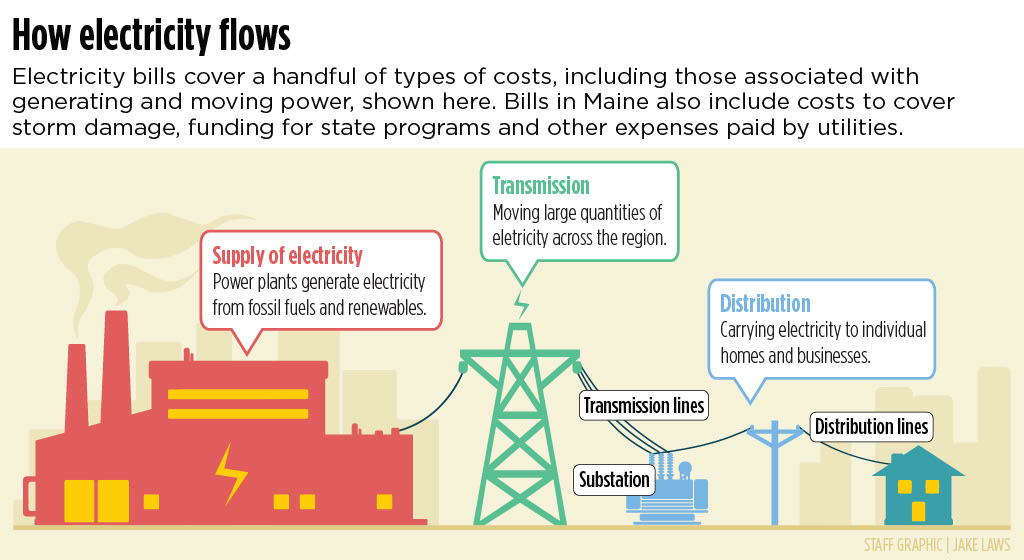
In Maine, power bills cover a range of costs that play different roles in keeping the lights on, including separate rates to generate and move electricity, fund policies enacted by the state government and pay for damage caused by storms.
But between confusing terminology and changes that effect take at different times in the year, it’s not always clear what you’re paying for.
We asked Maine’s two largest electrical utilities and several state agencies to break down the average residential bill, then analyzed where the money goes.
Here’s how a sample bill from Central Maine Power Co., which serves southern, central and western parts of the state, divides down. (For details on Versant Power, which covers Bangor and northern parts of the state, click here.)
The percentage of each category will change depending on the amount of power used, so your bill may break down differently.
Total — $153.87
The average bill for renters and homeowners in October was $153.87, according to the Office of the Public Advocate and CMP. That’s based on the use of 550 kilowatt-hours of electricity, the typical monthly usage among the utility’s customers.
In 2015, a household using that amount of electricity would pay about $80 per month, according to state data. In other words, that total has risen by more than 90% in the last decade.
Supply of electricity — $58.37
A large portion of each bill covers the cost of producing electricity and is paid to companies that generate power throughout the region. CMP collects the charge but passes the money along.
Most residential customers take the default “standard offer,” which is determined through a competitive bidding process. Each year, regulators at the Maine Public Utilities Commission solicit proposals from electricity producers and select the following year’s price. Changes to these rates go into effect on Jan. 1.
This year, state regulators chose to source power from Constellation Energy Commodities Group Maine and the New Brunswick Energy Marketing Corp. Those companies generate about 39% of their electricity from fossil fuels; 33% from wind, solar and hydro; 16% from burning waste and biomass; and 11% from nuclear energy, according to records from the utilities commission.
People can also opt to source their power from competitive electricity providers, which offer different rates and fee structures. A minority of customers choose that option.
In this example, supply costs make up about 38% of the total bill.
The remainder, which is labeled “CMP delivery” on the bill, is split into fixed and volumetric charges that cover the following categories. The fixed component is $29.88, which covers the first 50 kWh; the rest is volumetric, meaning customers pay for each additional kilowatt-hour they consume.
Transmission — $26.36
Transmission refers to the movement of massive quantities of energy over long distances, including from generation sites to local substations, according to the Federal Energy Regulatory Commission. This part of the bill goes to CMP.
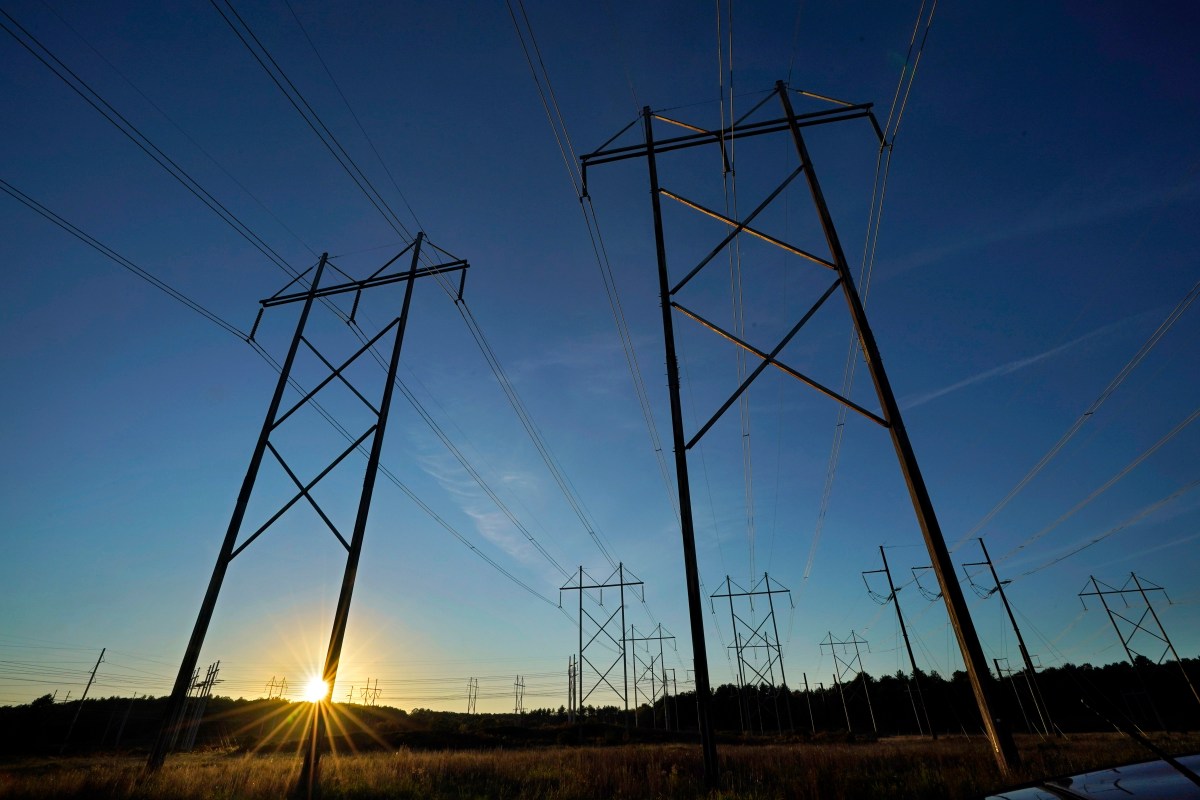
Transmission lines can carry about double — or more — the voltage load of local lines. They are often held by large, metal structures with branching arms and usually run along dedicated rights of way, not public roads, according to the Office of the Public Advocate.
The federal commission oversees transmission rates for the entire New England region, which shares infrastructure that allows energy to flow across state lines.
In this average case, transmission makes up about 17% of the bill.
Distribution — $34.73
Distribution refers to the movement of smaller quantities of electricity to individual homes — another portion of the bill that goes directly to CMP.
This includes the electricity carried through towns and neighborhoods by overhead or buried wires that run along residential roads. It’s the final stage before electricity reaches residential customers, according to Electric Power Engineers, an industry consulting firm.
Earlier this year, the utility asked state regulators for permission to increase distribution rates through annual changes starting in October 2026. Though that request was dismissed Tuesday, CMP can — and likely will — still pursue some increase to these rates.
The additional money would fund infrastructure upgrades and allow the utility to hire more workers. CMP has said that spending more on distribution now could mean spending less on damage from storms later.
Distribution makes up about 23% of this sample bill.
Storm cost reconciliation — $20.20
CMP does not budget in advance for storms. Instead, it pays for storm damage as it occurs and attempts to recoup some of that money from ratepayers down the line.
The utility has for years pointed to rising storm costs as the key driver of its rate increases.
Current bills include the costs to repair after winter storms in 2023 and 2024, which knocked out power for hundreds of thousands of Mainers and cost the company hundreds of millions of dollars in equipment, labor and lodging for out-of-state crews.
“We have had four extreme storms rivaling or exceeding the Ice Storm of 1998 in terms of outages and impact over the past three years alone,” said CMP spokesperson Dustin Wlodkowski.
The utility declined to state exactly how that $20.20 is broken up between the individual years, citing complications in the math. The Public Utilities Commission does not track individual storm costs in rates, spokesperson Susan Faloon said.
So far, Maine has seen a relatively mild 2025. If the trend holds, CMP has suggested storm costs could fall next year, softening the overall impact of the rate increase the utility proposed its five-year plan. But opponents have noted that Maine has several more weeks of potential storms, which ratepayers could be asked to cover in the future.
In this example, storm costs make up about 13% of the bill.
Policy and stranded costs — $14.20
The final category covers costs required by state policy, including subsidies for home electrification and assistance for vulnerable Mainers.
Roughly $4.26 helps fund Efficiency Maine Trust, a quasi-state agency that promotes home electrification and energy efficiency by offering, for example, rebates on heat pumps and upgraded insulation.
Another 80 cents helps Mainers pay their electricity bills through the Low-Income Assistance Program, which offers a credit on electricity bills. That program, offered by the quasi-state agency MaineHousing, is available to some residents who qualify for the Low-Income Home Energy Assistance Program, which covers heating costs.
And about $9.14 pays for what utilities and regulators call “stranded costs.” In CMP’s case, this includes credits for customers with rooftop solar panels who participate in Maine’s net energy billing program, as well as expenses that have resulted from the state restructuring its electricity laws decades ago.
Collectively, these fees make up about 9% of this sample bill.

We invite you to add your comments. We encourage a thoughtful exchange of ideas and information on this website. By joining the conversation, you are agreeing to our commenting policy and terms of use. More information is found on our FAQs. You can update your screen name on the member's center.
Comments are managed by our staff during regular business hours Monday through Friday as well as limited hours on Saturday and Sunday. Comments held for moderation outside of those hours may take longer to approve.
Join the Conversation
Please sign into your Sun Journal account to participate in conversations below. If you do not have an account, you can register or subscribe. Questions? Please see our FAQs.