


An environmental advocacy group is suing the federal government to force regulators to decide if the American horseshoe crab, facing steep population declines and demand for its blood from the biomedical industry, should be protected under the Endangered Species Act.
The Center for Biological Diversity announced Monday in a news release that it has filed a lawsuit against the National Marine Fisheries Service, also NOAA Fisheries, for failing to issue an initial finding as petitioned by the group in February 2024.
The federal agency was supposed to determine the arthropod’s fate as an endangered species by May 2024.
Filed in federal court in Annapolis, Maryland, the lawsuit is asking a judge to force the agency to complete the initial review.
American horseshoe crabs live along the coast from Maine to Louisiana, and have lived unchanged for hundreds of millions of years. The arthropods are fished most in the Delaware Bay area, where they are used as bait in eel and whelk fisheries. However, most are harvested for their blood for biomedical purposes, including drug safety and medical devices.
According to the Atlantic States Marine Fisheries Commission’s 2024 stock assessment, most crabs “collected and bled by the biomedical industry are released alive to the water from where they were collected. However, a portion of these crabs die from the procedure.”
While horseshoe crabs are no strangers to Maine, their numbers are drastically lower than in the mid-Atlantic states. The assessment said the Northeast stock is neutral or stable, New York’s stock is poor and populations in the Delaware Bay and Southeast are classified as “good.” The assessment, which extends data through 2022, found coastwide catches have remained below quota since 2000, but noted increased biomedical use.
While the commission lists population abundance and fishing mortality as unknown, a 2009 study confirmed a 70% decline since 1998. The assessment said biomedical mortality reached its peak in 2022, even while bait harvests remained below quota.
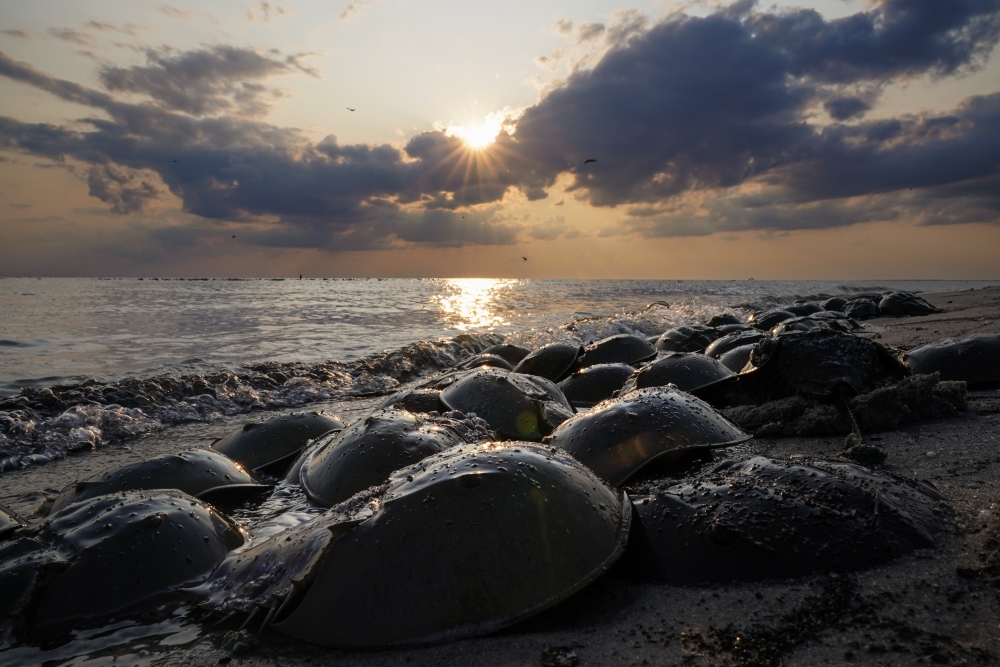
The Center for Biological Diversity Southeast Director and senior scientist Will Harlan said stock assessments mask a deeper warning sign, especially on spawning beaches ,which face their own dangers from sea level rise as populations in northerly states, Maine included, increase due to warming waters.
“The best long-term data we have is spawning egg density,” Harlan said. “That used to be about 50,000 eggs per square meter. In recent years, it’s been closer to 5,000 to 8,000, an order of magnitude lower.”
Conservation advocates say overharvesting and habitat loss are the culprits for the severe decline in population. Harlan said biomedical harvesting has doubled over the past seven years, with over a million harvested in 2024 alone, despite synthetic alternatives approved and available for laboratory use. He said some pharmaceutical companies like Eli Lilly have transitioned most of their testing to synthetic alternatives, a more reliable supply than horseshoe crab harvests.
“(Companies) see it as a better business decision,” Harlan said, adding that laboratory-produced substitutes are more advantageous than relying on a declining species.
“But right now, companies have to ask the FDA for permission for every single drug they want to test using the synthetic,” he said. “That’s cumbersome and expensive.”
Harlan argued that new regulations and a fast track to using synthetics in biomedical testing will improve horseshoe crab populations while cutting costs and paperwork for the pharmaceutical industry.
Fishing regulations for these harvests are mostly managed through interstate agreements and limits have increased in some areas despite population declines, the Center for Biological Diversity said. Harlan said current regulations have helped stabilize historically low population, but a growing demand continues to put pressure on the species.
Maine requires a permit from the Maine Department of Marine Resources for a daily limit of 25 horseshoe crabs per person. Harvesting, killing or possessing the arthropod or its eggs is illegal during their spawning season, which runs from May 1 to Oct. 30. Harvests must be reported to state regulators.
In October 2024, the Atlantic States Marine Fisheries Commission’s Horseshoe Crab Management Board issued an addendum to the fishery management plan in the Delaware Bay area. The addendum seeks to stabilize populations by limiting harvesters to male-only catches for a year.
Not only do the arthropods also face decline due to pressures from coastal development and sea level rise degrading spawning grounds, but predators, particularly migratory birds, are also at risk. The rufa red-knot, a species listed as threatened under the Endangered Species Act, depends on horseshoe crab eggs during spring migration.
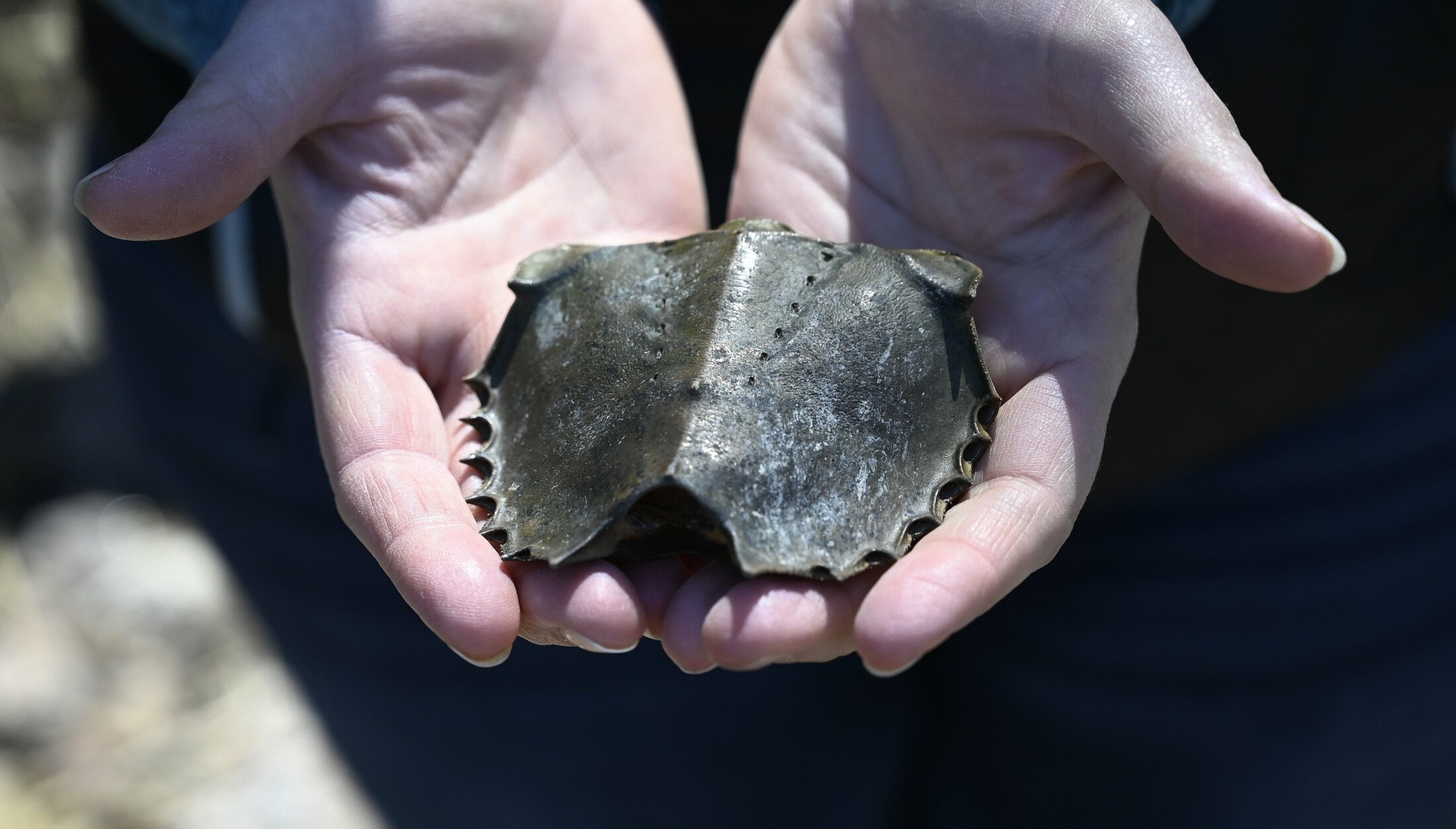
Since the Center for Biological Diversity filed its petition for initial finding, it has received no updates or communication from NOAA Fisheries, Harlan said. In the meantime, he sees a new threat on the horizon.
“There are three other species of horseshoe crabs in Asia even more endangered than (ours),” he said. “Now those companies are looking to the American horseshoe crab, many setting up shop in the United States. We’re going to see increased demand for horseshoe crab blood harvests, and that’s another reason why we need to get this species listed as soon as possible.”
NOAA Fisheries declined to comment due to pending litigation.

We invite you to add your comments. We encourage a thoughtful exchange of ideas and information on this website. By joining the conversation, you are agreeing to our commenting policy and terms of use. More information is found on our FAQs. You can update your screen name on the member's center.
Comments are managed by our staff during regular business hours Monday through Friday as well as limited hours on Saturday and Sunday. Comments held for moderation outside of those hours may take longer to approve.
Join the Conversation
Please sign into your Sun Journal account to participate in conversations below. If you do not have an account, you can register or subscribe. Questions? Please see our FAQs.