

JAY — Representatives from Walden Renewables introduced a potential large-scale solar development during a Feb. 10 Select Board meeting, outlining early plans that could result in one of Maine’s largest solar energy facilities while acknowledging that permitting, land acquisition and design work remain years from completion.

Dale Knapp, head of development for Walden Renewables, told board members the company is in the early stages of evaluating a project near the former Androscoggin Mill property off Riley Road. Knapp said they have an option to purchase the surplus land around the mill.
Knapp was joined by developer Nate Colannino, who said the company wanted to introduce itself publicly as it begins preliminary planning and land discussions.
Walden Renewables is a Portland-based renewable energy developer focused on grid-scale wind and solar projects. The company was founded in 2013 by Henry Weitzner and co-founded by Jack Kenworthy, who lives in Kittery. Company officials said New England remains a core market, although Walden has expanded operations into states, including Pennsylvania, Alabama, Kansas and Mississippi.
Knapp said Walden develops, owns and operates its projects and sells electricity primarily to large utility customers. He said the company has completed renewable energy projects across New England, including wind development in Antrim, New Hampshire, and several projects in Maine. Knapp said Walden has been involved in renewable energy projects in communities, including Leeds and Sanford.
FORMER MILL SITE KEY TO PROPOSAL
Knapp said Walden’s interest in Jay stems largely from existing power infrastructure connected to the former International Paper mill property.
According to Knapp, the former mill site included a three-turbine gas-fired power generator that is being decommissioned. He said that process leaves an available interconnection to the ISO New England (ISO-NE) power grid capable of supporting about 150 megawatts of generation.
ISO-NE is the independent organization that operates and coordinates the regional electric power grid across most of New England, including Maine.
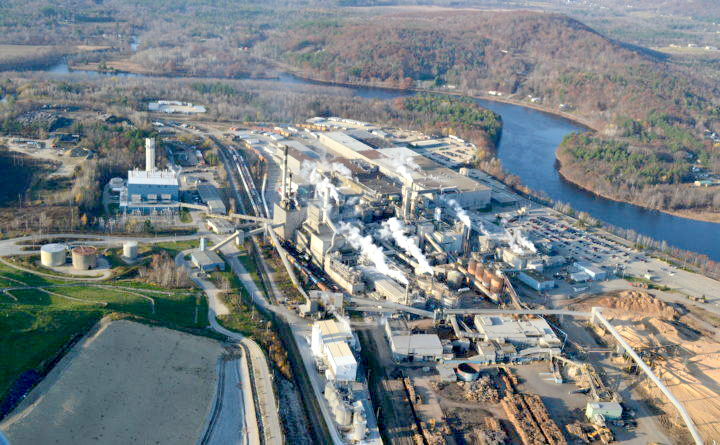
Knapp told the board Walden has obtained rights tied to the grid interconnection and surplus mill land along Alden Hill Road. He said the agreement was signed at the end of 2025 and the company is conducting due diligence work.
Public land record confirmation of the purchase or transfer of development rights could not be independently verified as of publication.
Knapp said the company is also reaching out to nearby landowners about potential lease agreements for undeveloped timberland.
“We wanted to make sure that we raised our hand and let folks know who we are,” Knapp said, adding that the company wants to remain transparent as discussions continue.
LARGE FOOTPRINT PROPOSED
Knapp said a solar project capable of generating 150 megawatts could require roughly 900 to 1,000 acres. He said Walden controls about 550 acres tied to surplus mill property, but environmental setbacks such as wetlands and streams will reduce usable land. Additional acreage would likely be needed through voluntary lease agreements with local property owners.
Colannino said the existing interconnection significantly reduces development risk and timeline uncertainty.
“Usually that process can take seven or eight years,” Colannino said. “Here, it may still take three to five years, but it’s a unique opportunity.”
Knapp said the final size of the project remains uncertain and could be smaller depending on land availability and permitting results. Even a reduced project of about 120 megawatts would still be considered a large facility.
POTENTIAL TAX AGREEMENT DISCUSSED
Knapp said Walden would likely seek a tax increment financing agreement or similar tax stabilization structure with the town if the project advances. He said Walden has entered into similar agreements in other Maine communities that provide long-term predictable tax revenue for municipalities.
Knapp said the company does not rely on state renewable energy subsidies and instead operates as an independent power producer that sells electricity into wholesale markets or through power purchase agreements.
PERMITTING AND ENVIRONMENTAL REQUIREMENTS
Knapp said any solar project of this scale would require extensive state permitting, including review by the Maine Department of Environmental Protection. He said Maine law requires developers of solar projects larger than three acres to post a decommissioning bond before construction begins. The bond is reviewed every five years and is intended to ensure funding exists to remove equipment and restore the property if the project ceases operation.
Under state law, solar companies are also required to establish an escrow account with sufficient funds to clean up and restore the project site if necessary.
Knapp said Walden intends to use setbacks, wooded buffers and agricultural-style fencing to reduce visual impact and preserve surrounding property values. He encouraged residents and officials to visit a Walden solar project in Leeds to observe site conditions.
Select Board members thanked the company for the informational presentation but took no action.
LARGE SOLAR DEVELOPMENT CONCERNS
Large-scale solar projects can provide local tax revenue and renewable energy production but have also prompted concerns in communities across Maine and New England.
Debates over large renewable energy projects have surfaced in communities across the United States, including in Moscow, Maine, where residents voted to ban large commercial solar farms over concerns about land use and environmental impacts. Research has also found that homes within a half-mile of solar installations can experience modest resale value declines, while properties farther away typically show no measurable change.
Community engagement, local input and careful project planning are frequently cited as factors that can reduce conflict and improve public acceptance of renewable energy development.
Common concerns include the conversion of large tracts of forest or farmland into energy infrastructure, which can affect wildlife habitat and land use patterns. Other concerns raised were visual impacts, potential property value changes and stormwater runoff from cleared land.
Wildlife advocates have also shared concerns that large fenced solar facilities can restrict animal movement and reduce available habitat, particularly when projects convert forest or open land into energy infrastructure.
Questions are also frequently raised about long-term equipment disposal and land restoration. Solar panels typically have an operational lifespan of 25 to 35 years. While many materials can be recycled, panel recycling infrastructure in the United States is still developing, and disposal costs can be significant. Maine’s bonding requirement is designed to ensure funds are available to remove panels, foundations and electrical infrastructure if a developer ceases operations or abandons a site.
Even when projects are properly decommissioned, land that has been graded, cleared or compacted can take years to return to previous ecological conditions, depending on restoration efforts and soil quality.
Several Maine communities have debated or temporarily restricted large solar developments while evaluating environmental and land-use impacts. Municipalities, including Greene, have considered or enacted pauses on solar expansion as officials weigh long-term disposal, wildlife and land preservation concerns.
In Andover, voters approved a 180-day moratorium on utility-scale solar projects in 2025 to revisit local ordinances, with some residents describing existing installations as an eyesore and urging stricter limits on project size, increased setbacks and visual screening requirements. Town officials have considered extending the pause while drafting clearer standards for future solar development.
PROJECT REMAINS IN EARLY STAGES
Knapp emphasized the Jay project remains in the planning and land acquisition phase, with construction potentially several years away.
“We still have a lot of land work to do before we know exactly how big the facility will be,” Knapp said.
Company officials said they plan to continue meeting with residents and local officials as development planning progresses.

We invite you to add your comments. We encourage a thoughtful exchange of ideas and information on this website. By joining the conversation, you are agreeing to our commenting policy and terms of use. More information is found on our FAQs. You can modify your screen name here.
Comments are managed by our staff during regular business hours Monday through Friday as well as limited hours on Saturday and Sunday. Comments held for moderation outside of those hours may take longer to approve.
Join the Conversation
Please sign into your Sun Journal account to participate in conversations below. If you do not have an account, you can register or subscribe. Questions? Please see our FAQs.