

The question went through Marcia Wood’s mind over and over: How much longer can we hang on?
Wood’s Freeport field hockey team was holding a 2-0 lead in the 2023 Class B final, but Cony had the Falcons under siege. The Rams were attacking Freeport relentlessly in the second half, and the penalty corners were piling up. Six in the second half alone. Then 10, 12, 15.
“I’m like, ‘OK, at some point it’s going to get through,'” the Freeport coach said.
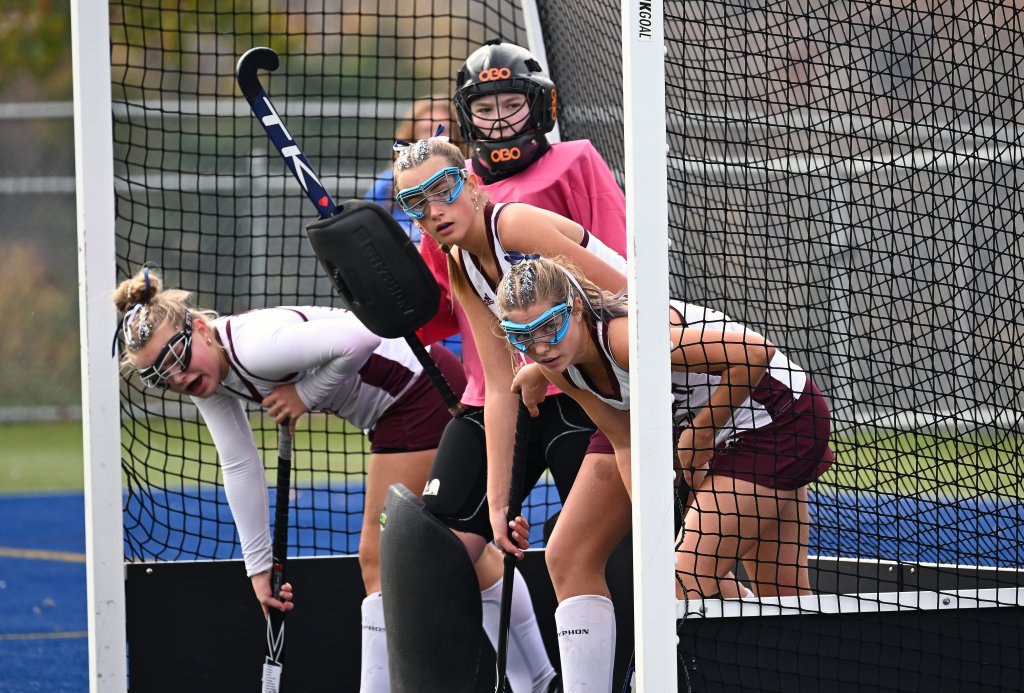
But it never did. Eighteen corners for the half and 23 for the game were called against Freeport, but the Falcons escaped them all en route to a 2-0 victory — and showed that defending corners can be the escape valve to winning a game that is seemingly trying to go the other way.
“That game, it was defense that saved us,” Wood said.
There’s no point in a field hockey game where the advantage shifts to the offense more drastically than on corners. The defending team is outmanned at a 2-to-1 ratio, trying to keep up in a chaotic few seconds while the ball is always a heartbeat away from finding a stick that can redirect it home. For the attacking team, corners are the chances it’s been looking for, and golden opportunities to score a game-changing goal.
Which makes it all the more important for teams to have a trusted, practiced and reliable plan to stop them.
“It’s a big part, absolutely. We incorporate offensive and defensive corners into almost every practice we have,” Lewiston coach Jenessa Talarico said. “We also like to train multiple kids to do it. Even though during a game you only have four (defenders), we like to really train the whole team. Eventually, they’ll all be in that situation, even if it’s not this year.”
In simplest terms, the point of every corner defense is the same: Get to the point where the ball is being sent on the insert, and try to disrupt the shot or the pass that the receiving hitter can make. Do that, and the attack collapses.
“If you stop the shot,” Biddeford sophomore Mia Mariello summed up, “(then) basically, you’ve won the corner.”
It’s easier said than done, however, which creates room for strategy. While some teams might go full speed to the top of the circle, others might hang back and create more traffic closer to the net. Some might play more of a zone, some might send two or three toward the circle to provide pressure. Some play a diamond formation, some play a box, some put two players on the posts, some stagger them.
Decades ago, when field hockey was a slower game played exclusively on grass, corner defense was more straightforward, Skowhegan coach Paula Doughty said. Now, with the popularity of turf fields and the ever-increasing skill level of offensive players, corner attacks are more sophisticated, which means defenses have to be, too.
“In the old days, you just set up a corner and you tried to do it. It’s not that way anymore,” Doughty said. “Some teams always pass, so you might want a different system, you might want a box. Or other teams, they might go in and out, you might want a triangle. Another team, you might want to fly a trailer. It depends. … Nobody knows what we’re going to do until the game starts.”
The other key is picking the right four players to carry out the defensive plan. Each has a different ideal skill set. Posts, playing near the goal, have to be defensive-minded and strong with their sticks as the last line of defense. Trails, who look for where the ball might go next after being received, have to have good anticipation, with an ability to quickly react to what’s playing out around them.
And then there’s the flyer, the player racing out to deny the shot at the top of the circle, who’s the key to the whole operation. The flyer needs to be fast, fearless and relentless.
“It’s somebody that’s super tough,” Gorham coach Becky Manson said. “They do get hit. They get hit in the knee, which is above the shin guard, so you need someone that can withstand a beating.”
It helps to be a little crazy. The flyer could see a fully wound-up shot whizzing at her head. She has to know that, and not flinch.
“I think I’ve been hit so many times that I’m just like, ‘You know what, why not?'” said Mariello, Biddeford’s flyer. “And I just run at it.”
Biddeford coach Caitlin Tremberth knew she had a natural flyer when Mariello came along.
“She got a tooth knocked out. She’s nuts,” she said. “She’ll dive for things, she’s a one-in-a-million athlete. … It’s always something. But she doesn’t care.”
Neither does Skowhegan’s flyer, junior Lillian Smith.
“It’s throwing caution to the wind and being fast,” Smith said. “Maybe a little bit of stupidity? Who knows. … It heals at the end of the day. I’m young, I only get to do this for so long. I personally love flying, it’s one of my favorite aspects of the sport.”
Speed and fearlessness are big, but so is patience and poise. The last thing a flyer wants to do is overrun the point, allowing an attacker to get by her and make the disadvantage even more steep.
“If you go right out and steamroll them, they can just easily dribble to the side, go around you, and they’re wide open,” said Lizalyn Boudreau, Freeport’s flyer. “You want to come out hard, but not so much you run right past them. You want to still be there to potentially stop a shot.”

It’s all about maintaining calm in the chaos, particularly as the attack drags on.
“Composure’s a big thing. We can’t freak out when we’re in there,” Wood said. “When we freak out is when we make mistakes, and when we make mistakes, that’s when they’re doing multiple, multiple corners in a row, and that’s when we’re starting to get tired and make more mistakes, because we’re panicking.”
When done right, a defended corner can have a galvanizing effect, much like a goal-line stand in football or a penalty kill in ice hockey, because the defense knows it’s come up with a potential game-saving stop.
“(Opponents) do get frustrated, definitely,” Smith said. “And honestly, that does embolden us. … It’s them breaking down.”

We invite you to add your comments. We encourage a thoughtful exchange of ideas and information on this website. By joining the conversation, you are agreeing to our commenting policy and terms of use. More information is found on our FAQs. You can modify your screen name here.
Comments are managed by our staff during regular business hours Monday through Friday as well as limited hours on Saturday and Sunday. Comments held for moderation outside of those hours may take longer to approve.
Join the Conversation
Please sign into your Sun Journal account to participate in conversations below. If you do not have an account, you can register or subscribe. Questions? Please see our FAQs.