

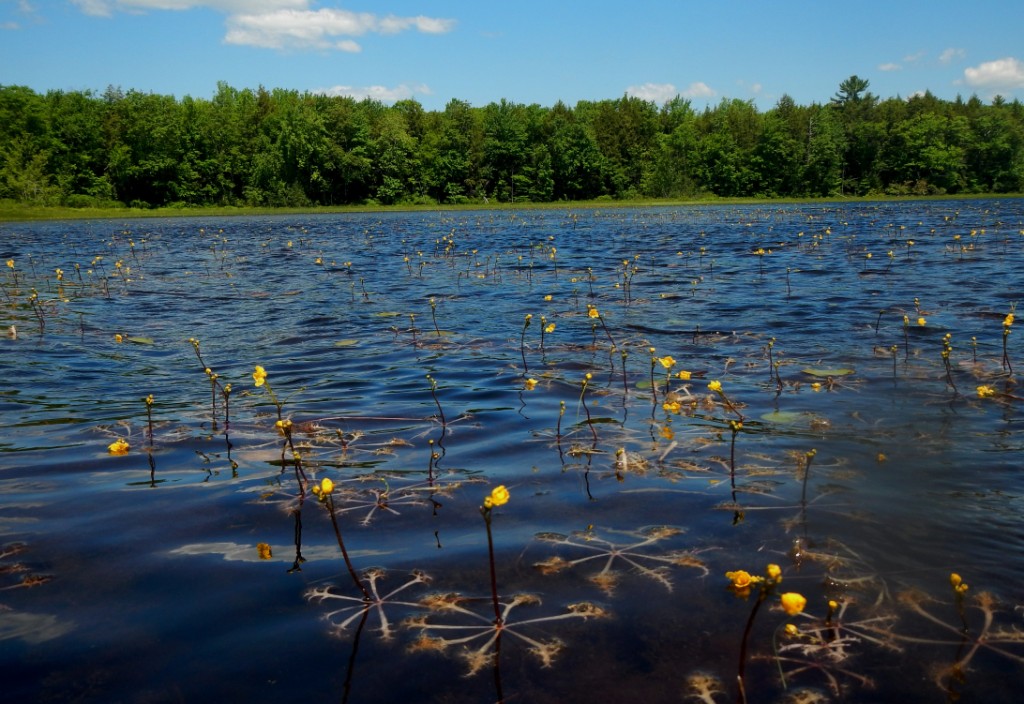
FAYETTE — A dense infestation of the invasive aquatic plant swollen bladderwort has spread throughout much of Tilton Pond in Fayette, making eradication unrealistic.
Management efforts are shifting toward preventing the plant from spreading to nearby waters, according to the Maine Department of Environmental Protection.
In a Feb. 27 public message to residents around Tilton, David and Basin ponds, Maine DEP aquatic biologist John McPhedran said the plant, Utricularia inflata, is widely established across the pond.
“Tilton Pond is heavily infested with the aquatic invasive plant, swollen bladderwort (SB, Utricularia inflata). This plant can be found, mixed with native bladderworts and other native plants, throughout much of Tilton Pond,” McPhedran wrote. “The high density of SB makes eradication of SB from Tilton Pond unrealistic.”
Swollen bladderwort is a floating aquatic plant that can form dense mats on the surface of lakes and ponds, crowding out native vegetation and affecting recreation such as boating and swimming.
State officials say the infestation is widespread within the pond.
“Swollen bladderwort appears to be in most places where plants are able to grow in Tilton Pond,” Maine DEP Deputy Commissioner and Communications Director David Madore said in an email response to questions. “Additionally, since this is a free-floating plant, SB could grow anywhere in the pond.”
“This is a widespread, well-established infestation,” Madore said. “When an infestation is well-established, eradication is generally not considered feasible.”
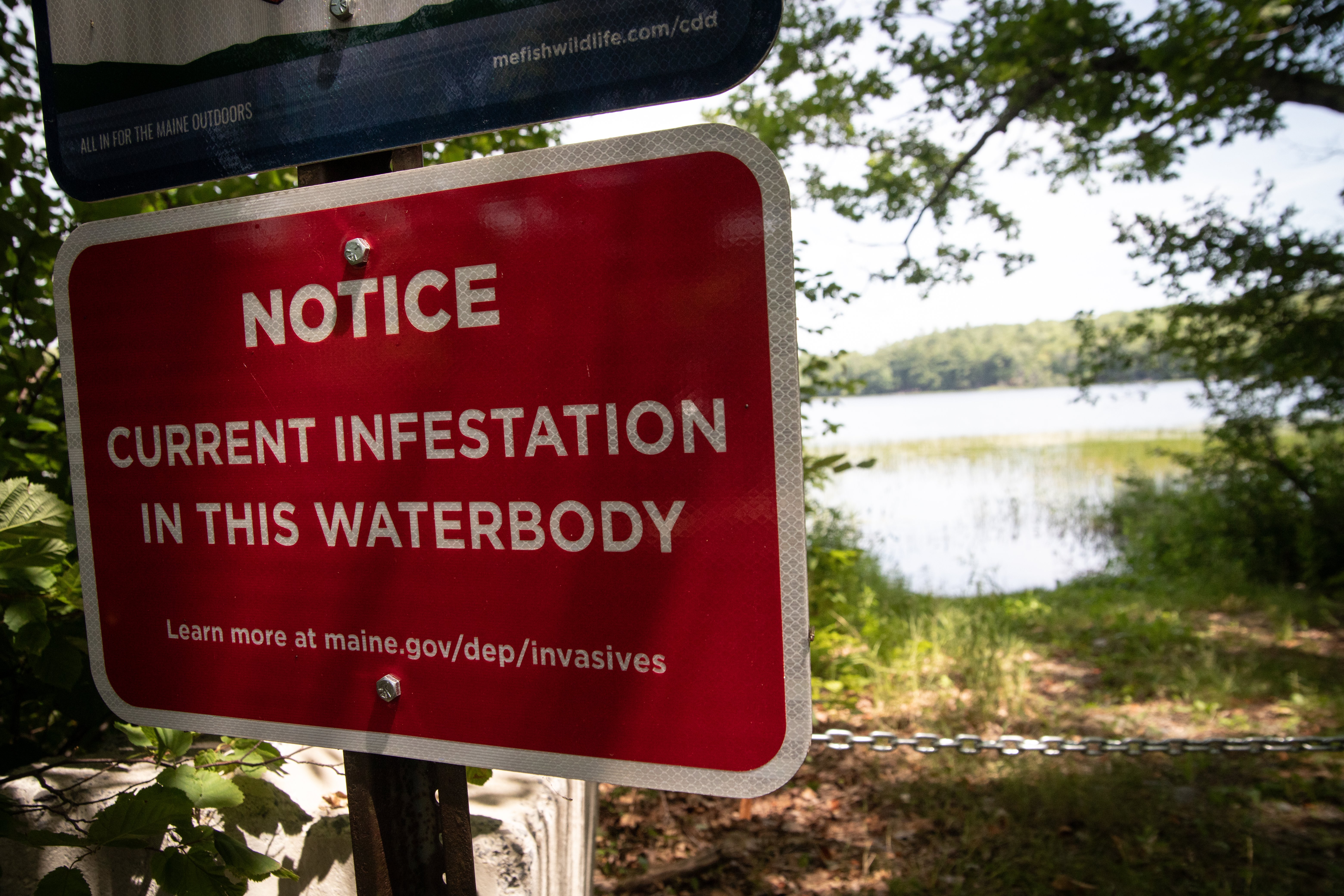
Instead, a management plan developed in 2025 focuses on preventing the plant from spreading into connected waterways. According to the DEP, the downstream waters considered most at risk are David and Parker ponds.
To reduce the risk of spread, nets have been installed at the outlet of Tilton Pond to capture plant fragments that could move downstream.
“Nets have been installed to catch any fragments of SB,” Madore said. “These nets are maintained by staff of the 30 Mile River Watershed Association. So far, these nets appear to be effective, and other spread prevention methods are being considered for this particular site.”
The DEP and the Mount Vernon-based 30 Mile River Watershed Association are also working with residents and volunteers to monitor nearby waters and manage dense patches that interfere with recreation.
Manual removal and herbicide treatment are both methods used to manage aquatic invasive plants, but chemical treatment is not currently an option in Tilton Pond because no proven, approved herbicide is available for the species in Maine.
State officials are monitoring a herbicide treatment underway in Massachusetts to determine whether it could eventually be considered in Maine. If the treatment proves effective, the infestation in Tilton Pond could be evaluated through the state’s prioritization process for aquatic herbicide applications.
For now, prevention remains the primary goal.
“In 2026, the goal for management of SB in Tilton Pond is to prevent spread to downstream waters,” McPhedran wrote in the message to residents.
Boaters and residents can help reduce the risk of spreading invasive plants by cleaning, draining and drying boats and equipment before moving between water bodies. Madore said aquatic plants often spread through fragments carried by propellers, anchors, paddles and other gear.
Local volunteers may also assist with monitoring or manual removal efforts, but the DEP recommends that anyone interested coordinate with the 30 Mile River Watershed Association and receive training to ensure removal is done properly.
Editor’s Note: This article has been corrected to say that 30 Mile River Watershed Association is based in Mount Vernon.

Supporting Sponsor for Franklin Journal, Livermore Falls Advertiser, Rangeley Highlander and Rumford Falls Times.
Keeping communities informed by supporting local news. franklinsavings.bank

We invite you to add your comments. We encourage a thoughtful exchange of ideas and information on this website. By joining the conversation, you are agreeing to our commenting policy and terms of use. More information is found on our FAQs. You can update your screen name on the member's center.
Comments are managed by our staff during regular business hours Monday through Friday as well as limited hours on Saturday and Sunday. Comments held for moderation outside of those hours may take longer to approve.
Join the Conversation
Please sign into your Sun Journal account to participate in conversations below. If you do not have an account, you can register or subscribe. Questions? Please see our FAQs.