


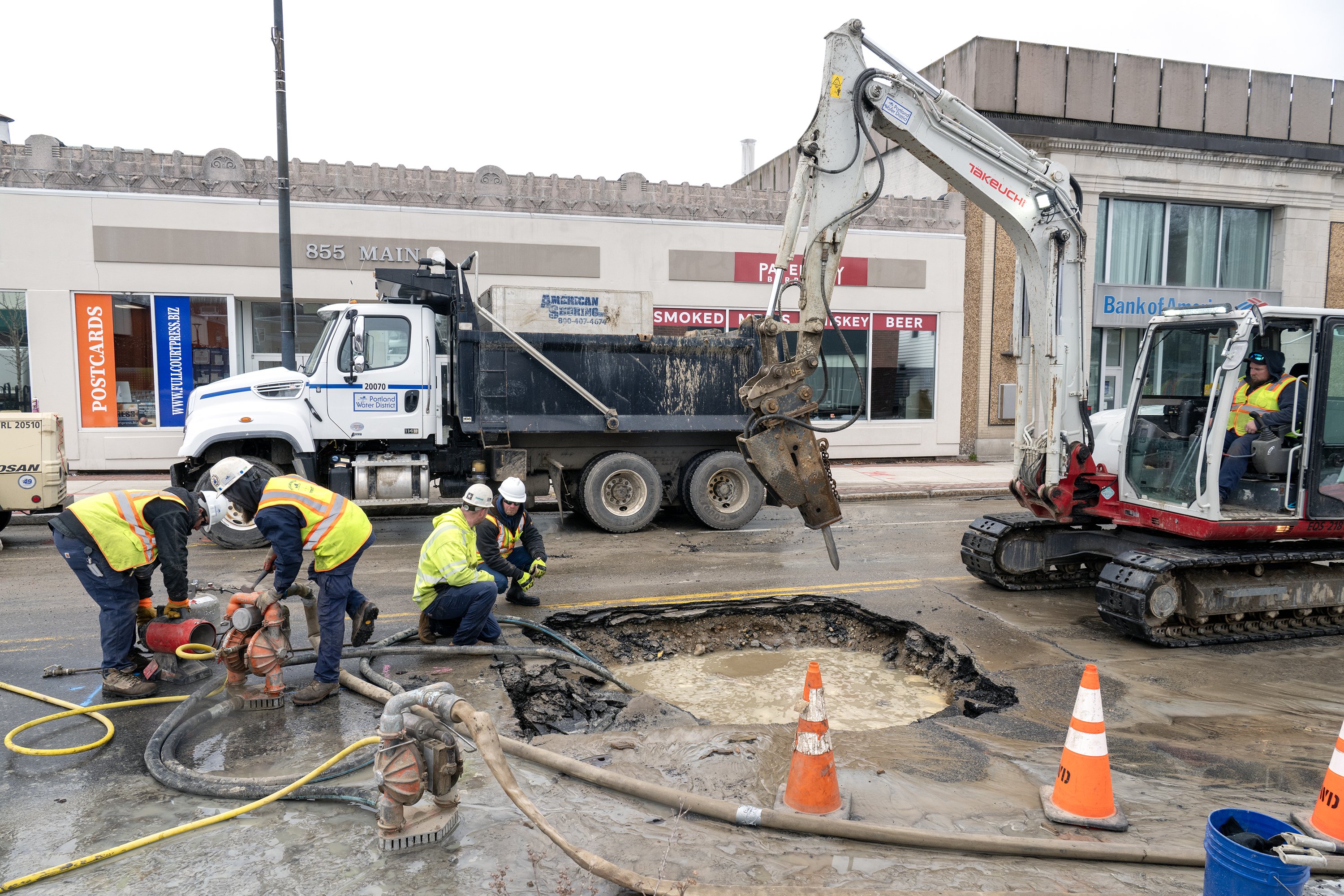
It was a soggy, dramatic scene when a water main broke in Lewiston last month.
Tens of thousands of gallons gushed from the pipe, tearing through pavement and covering roadways in more than a foot of water.
Schools closed the following day. Homes nearest the break flooded. Water pressure dropped throughout much of the city, leaving thousands of residents without any flow for more than an hour. A boil-water order stretched for more than a day.
More than two weeks later, it’s not clear what caused the break, said Erica Kidd, deputy director of utilities for the city’s Public Works Department. The department has ruled out the possibility that any of its operations triggered it, she said.
“Sometimes breaks just happen,” Kidd said.
Officials and trade group leaders throughout Maine agree that even “catastrophic” breaks like the one in Lewiston last month are often unpredictable. The scale of any given break depends on a slew of factors — the material and age of a pipe, the surrounding topography and the schedules of staff who could be dispatched for repairs.
Main breaks happen all the time. The next one will likely be minor, officials say.
But maybe not.
In recent interviews, officials said they are concerned about the future of Maine’s water infrastructure. The pipes that service about half of the people in the state are getting older, more dilapidated and more expensive to repair. And it’s not clear where the money to pay for ongoing maintenance will come from.
Since water infrastructure is generally hidden underground, ratepayers can struggle to understand or even consider its importance.
“Generally, folks have a hard time believing something if they can’t see it,” said Ed Molleo, executive director of the Maine Water Utilities Association. “If you’re not in the water system, you’re probably not giving it a second thought until you go to turn the tap, and it doesn’t turn on — or somebody tells you that you have a boil-water order.”
Overall, Maine’s drinking water systems earned a C- from the American Society of Civil Engineers in 2024, which was down from the C it earned in 2020 and the C+ in 2016 — but in line with the country’s overall grade.
The condition of Maine’s pipes varies by area. But in an age of rising costs, some communities have been putting off regular maintenance out of fear that ratepayers can’t or won’t stomach higher payments.
“‘If it ain’t broke, don’t fix it’ becomes a mentality that is, unfortunately, leaned on,” Molleo said.
OLD PIPES
As a rule of thumb, water utilities should aim to replace about 1% of their pipes each year, industry leaders and water officials said — though some argue it should be closer to 2%. Assuming the average water main lasts a century before wearing out, that rate would be enough to keep up with deterioration.
System sizes can vary significantly, from less than 50 miles in places like the Oxford County town of Paris to about 1,000 miles for the Portland Water District, which serves more than 10 municipalities. Lewiston has about 160 miles of pipe in its distribution system, some of which was installed in the late 1800s, officials said.
Following the 1% rule, those three systems should theoretically be replacing half a mile, 10 miles and 1.6 miles each year, respectively.
But many systems have struggled to keep pace. The overall rate of replacement in Maine has fallen below that threshold for decades, according to the 2024 report card.
Molleo said the state’s drinking water infrastructure is “probably a little behind the average of the U.S.,” especially in rural corners, where water utilities generally have a smaller customer base through which to spread the costs of upkeep and upgrades.
He said a significant portion of Maine’s drinking water pipes are between 50 and 80 years old, but he noted that system ages vary widely from town to town. If a town has been getting public water for more than a century, it’s very likely to have century-old pipes somewhere, he said.
Since most mains are several feet underground — and could be under roads or homes — it can be challenging to keep track of their condition in real time. That’s different from more visible utilities, like overhead power and phone lines.
When some communities make repairs, they outfit new pipes with sensors that allow officials to monitor whether the pipes are likely to have issues. But it’s also common, and generally cheaper, for utilities to simply dig to the broken pipe and replace it with a new one.
PAYING FOR IT
Water utilities get money from a range of sources, including bills charged directly to customers, local property taxes and government grants and loans. But in general, officials said, their needs eclipse the available funding.
One key resource is the Drinking Water State Revolving Fund, which is administered jointly by the Maine Department of Health and Human Services and the Maine Municipal Bond Bank. It offers low-interest loans and, for the neediest areas, loan forgiveness, with funding sourced from federal and state coffers.
From 2022 to 2025, the revolving fund had between $33 million and $50 million available to award annually. But funding requests routinely total double (or more) the available dollars, according to DHHS. In fiscal 2026, the fund is expected have $54 million available, compared with $147 million requested.
“There’s never enough money available,” said Amy Lachance, director of the Drinking Water Program.
In recent years, the revolving fund saw millions in additional funding from the Bipartisan Infrastructure Law pushed by then-President Joe Biden, but that money is expected to dry up in 2027, she said.
“We are a bit concerned we’re kind of heading off what we call a funding cliff,” Lachance said.
Her office encourages utilities to raise their rates regularly to meet their systems’ needs, Lachance said.
Ideally, utilities would have master plans looking a decade or more into the future — forecasting costs and how rates will have to change to keep up, she said. But in reality, many districts have to prioritize spending on emergencies as they arise.
The exact cost of emergency responses varies widely based on the level of damage, but they can be pricey.
Lewiston’s break last month, for example, is expected to cost the city about $30,000 between labor and materials, though the exact cost has not yet been tallied, a city spokesperson said. She added that if the city had to hire outside contractors instead of having an in-house crew to respond, it probably would have cost $10,000 more. That figure does not include damage to people’s homes, which remains an open question.
Raising rates can be a challenge, especially in communities that haven’t increased prices for several years, or have lower incomes.
Last year, several water districts hiked their rates by more than 20%, and some by as much as 75%, to pay for repairs after years of deferred maintenance.
Water bills are often relatively modest compared with other utilities — for example, the average household in Portland pays about $32 a month for water, compared with about $168 for electricity.
Still, the relative size of those changes shocked many local residents. Some complained that the increase was too great a change to shoulder all at once. Others questioned whether the sudden spikes could have been mitigated by more regular increases.
WARNING SIGNS
There is no easy way for a water system to predict where its next break will occur. Age and material of pipes are just one variable to consider, industry leaders said. External factors like soil makeup, the depth of a winter’s frost and erosion can also influence the likelihood of a leak.
If one spot has frequent small leaks or drops in pressure, that could warrant a closer look, said Brad Sawyer, deputy executive director of the Maine Rural Water Association. But utilities generally avoid digging up pipes to inspect them unless there is some known issue.
“If there isn’t a problem, you don’t want to disturb it,” he said.
That’s because reaching a pipe can mean digging a ditch or tearing up a road. Plus, removing a heavy chunk of ground could change the pressure difference between the inside and outside of a pipe, creating new stress.
But Molleo said there is a way for customers to sense a break might be coming: if your water rates haven’t increased in several years, your pipes might be in rough shape, he said.
Ideally, rates would increase slightly every year to cover maintenance needs and keep pace with inflation, he argued. Stagnant rates can be a sign of deferred maintenance, which increases the chance of older parts failing, Molleo said.
“When you’re talking about something like drinking water, that everybody absolutely needs, you can’t defer maintenance,” he said. “You can’t defer costs there.”

We invite you to add your comments. We encourage a thoughtful exchange of ideas and information on this website. By joining the conversation, you are agreeing to our commenting policy and terms of use. More information is found on our FAQs. You can update your screen name on the member's center.
Comments are managed by our staff during regular business hours Monday through Friday as well as limited hours on Saturday and Sunday. Comments held for moderation outside of those hours may take longer to approve.
Join the Conversation
Please sign into your Sun Journal account to participate in conversations below. If you do not have an account, you can register or subscribe. Questions? Please see our FAQs.