
Summary of recommendations reached by Advice for America conference:
• Poll new immigrants to see what they think makes a safe and inclusive community, because it won’t look the same as it does for people already living in that community.
• Have a network of folks ready to respond to immigrant bias situations, such as the pig head-rolling incident in Lewiston. Have people ready to respond to media.
• Develop culture brokers to be alert for anti-immigrant bias in health care, education, the workforce, in law enforcement and in the media, and empower these brokers to raise concerns as they develop.
• Make contact with federal and state representatives, ask for resettlement resources and financial support. The more elected officials know, they more they can leverage money for their communities down the line.
• Engage employers with the immigrant community. Employers need to educate their staff that bias is not tolerated. They must have guidelines and standards for when there is a bias violation. They must hire more refugees, providing opportunities for upward mobility. Employers must develop in-house mentoring programs, consider providing transportation to and from work, provide child care and make translators available in the workplace. Social service agencies could collaborate with business owners to make these things happen because not every employer has the resources to do all this alone.
• Faith-based communities need to talk about bias issues more, offering post-service gatherings in Christian and other organizations and talk about solutions in a faith-based way, including increased understanding of the Muslim faith. Interfaith projects would be a good way to share culture, including dance, food, sports and arts.
• Develop a jump-team approach of police, churches, businesses, social service agencies, schools, the media and others so that when there is an instance of bias, or other crisis, the team can work together to resolve issues quickly.
He sat passively at the table, wearing a casual black-and-white collared shirt and sporting a yellow Livestrong band on his left wrist.
He talked about his youth in a small town. The people there were poor, but filled with spirit and faith.
In 2004, when he was 19 years old, he moved to Decatur, Ga., where he found life hard. It was hard to find a job. Hard to get into college. Hard to find housing.
Two years later, he moved to Lewiston after hearing from others how nice it was. Everything here was different.
College was accessible. Housing was affordable.
“It’s a better life,” he said, and so good that his mother and several brothers have since moved to Maine.
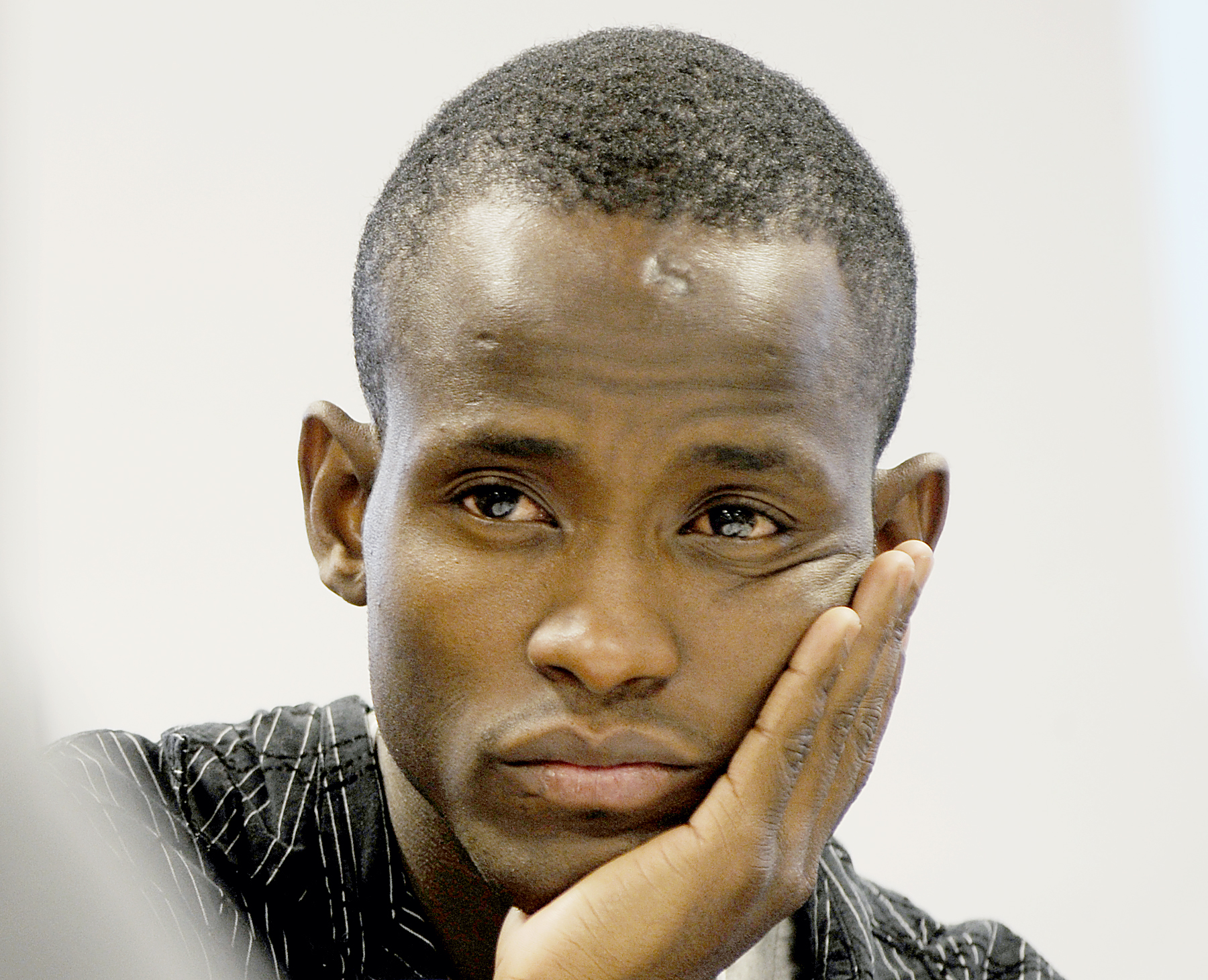
Rilwan Osman is from Somalia and now living in Lewiston.
He had never seen snow before moving to Maine, and thought every American city was the same as the next.
He found it disconcerting to be exposed to people who don’t speak his language or listen to his music. But, he’s found a better life here, and intends to stay.
The arrival of Osman and thousands of other Somalis strained the Twin Cities’ ability to accommodate them, creating tensions among the New Mainers and existing Mainers. Their arrival also created an immediate need to hire dozens of teachers, translators and others to help immigrants sort through Maine’s social service network to find housing and qualify for public programs.
How the cities handled that tension and how residents managed the settlement have brought national focus on how it all happened and what residents and newcomers here learned through the process. The country is looking for a little advice from Maine.
* * *
Although the first Somali-Americans arrived on America’s shores in the 1920s, the real in-migration began after civil war broke out in Somalia in the early 1990s. Refugees fled the strife, and began arriving in the United States in earnest a decade later.
The integration of Somalis into American culture has not been easy, and the process in the Twin Cities has been both welcoming and hateful. The way the people here have behaved — the good and bad — has been observed by other cities like Fort Wayne, Boise, Frederick, Md., and Manchester, N.H., which are facing the same mass in-migration. These cities are looking to Lewiston and Auburn for advice.
Last week, Steve Wessler, executive director of the Center for Preventing Hate in Portland, hosted a conference to gather local advice to share with these interested cities. It was part of a three-year outreach program called The New Migration Project, gathering praise and criticism from Lewiston and Auburn people attending the conference, most of whom were white and working in social services, education or other public service, and sharing their advice with the nation.
The theme that developed over the 8-hour session was that Lewiston and Auburn have done some terrific things to ease racial bias, reacting to mounting tensions that came to a head in 2006, but that significant pockets of resistance to the Somalis’ presence still exist. There was a real focus that businesses must share a greater responsibility for integrating the new Mainers into the workforce by providing child care, transportation and other amenities to ease the step from welfare to work. And, prevalent in the discussion, was the belief among these social service workers and educators that the media has played an overtly negative role in reporting on Somalis and their presence here.
There was, at the end of the day, a platform of recommendations developed that put the responsibility of peaceful integration at the feet of existing communities, not that of newcomers. That, instead of immigrants stepping onto this land of opportunity and making their own way as pioneers, that there is a great need to develop more networks to cocoon and protect immigrants when they arrive and for years afterward.
There was a very strong feeling, among those who spoke, that Somalis and other new immigrants must not feel the need to ditch their culture to successfully integrate. That there must be a way to become Americanized without erasing the past. And that Somalis should not have to pay the price Francos paid to avoid prejudice, discrimination and racism, which was to separate themselves from their culture.
* * *
After Wessler opened the conference, explaining that the recommendations of the group would be used to advise groups in other cities, he split attendees into small breakout sessions to craft specific advice.
In one session, where the first topic was to define what is a “safe and inclusive community,” the group recommended that any community dealing with racial bias can ease conflict by:
• Having a respect and willingness to learn about new cultures, and accepting differences.
• New Mainers (or immigrants in other cities) cannot be segregated to housing in certain downtown tracts, similar to poor people 50 years ago, but should be placed in neighborhoods throughout communities.
• City officials need to make an effort to welcome immigrant elders, to work together.
• Immigrants need intensive orientation when they arrive, such as how to work basic appliances, what public transportation is available, where to apply for welfare and other benefits, how the American school systems work, including the grading and graduation processes, and how to understand police.
• Communities need language access programs that really work.
This break-out group mentioned some local programs that have successfully embraced these ideals including the Time Dollar, Lots to Gardens, the Trinity Jubilee Center, Safe Schools, Work Ready, ASPIRE, Muslim Money project, to help business understand religious norms in the lending process, the African Immigrant Community Group, Adult Education classes, and the celebration of Somali holidays by others in the community.
But even though there have been successes, there is still work to be done here. Specific recommendations included:
• Challenging any one who utters a bias statement, or takes a bias action, by asking them why they act that way. Question racial thinking.
• Don’t accept stereotyping, and resist making universal assumptions about someone based on ethnicity. Base opinion on personal experience, and not what you’ve been told by others.
• Workplaces must become more diverse in staffing, be diligent about clamping down on harassment, which may mean developing employees’ acceptance skills, and provide confidentiality so someone who feels threatened at work can talk to a member of a human resources department, or other company head. Employers need to be aware of laws protecting diversity and stopping harassment, and not wait for a lawsuit to be brought to create acceptance.
• Schools must expand the use of written materials in languages other than English for those parents of new immigrants who don’t speak English.
• Doctors must be more clear about what medications are being prescribed because pharmacies are not required to have translators, and there is a lot of confusion among non-English speakers about how and what prescription medication to take.
• Media must be more positive about reporting on the Somali community. Media, the group voiced, should be used to create advantage for new immigrants, not create problems. And media must also do its part to limit the number of blogger comments allowed on online news stories, because these comments are generally negative and unhelpful.
• Businesses could create a more welcoming atmosphere for immigrants by hiring more newcomers when they arrive, and working to understand and accommodate religious practices during the workday.
Of the 90 people registered for the conference, only four represented the business community, a number that was generally viewed to be a telling and unfavorable gauge of local business interest in supporting Somali integration.
Throughout the day, there was consistent sentiment that the Somali community needs help, and what’s been done is a good start and worth sharing with the nation, but the work is not done.
“These people are someone’s sons and daughters, too,” one home health care worker said, hoping that every member of the communities of Lewiston and Auburn gain some tools to accept the Somalis in a more positive light.
Migration: the new migration project
The New Migration Project is a public education program focused on reducing anti-immigrant bias in neighborhoods across the United States. Programs are designed to foster relationships between long-term residents and new resettled immigrants in an effort to create safe, inclusive communities.
— Center for Preventing Hate
I have a little news for advice-givers who attended last week’s Advice for America conference hosted by the Center for Preventing Hate. They may believe the Somali integration post-2006 here has been a success worthy of national model, but that view is not wholly shared in the Twin Cities.
Near the end of the day-long conference, the Center’s executive director, Steve Wessler, asked the predominantly white, social-working audience how many had heard a negative comment about Somalis in the past week. Less than a dozen of the 90 seated there raised their hands.
I hear negative comments every day. Every. Day. It’s distressing, but it’s real.
I can only guess that these social workers, educators and others working in the public sector do not always hear what I hear on the street because they can be insulated in their programs, focused on their mission, and too many do not — themselves — integrate with the community at-large.
One woman made a point to inform others that although she works with the Somali community, she lives “in another world in Lewiston where the people don’t interact with the newcomers.” She doesn’t socialize with Somalis and doesn’t know anyone who does. Just comes to work in the downtown and goes home.
How better to insulate oneself from the more general community of Lewiston? Or never hear what others who do not agree with you may have to share about their experiences?
I was surprised to hear, repeatedly, that this group overwhelmingly believes local businesses have not done enough to help the immigrants, and need to do more. Not a little more. A lot more.
They suggested repeatedly, and with conviction, that local businesses need to consider providing transportation, child care, on-site translation services, and hire immigrants for the fast track to advancement if new Mainers are to be truly welcomed.
Doing all this would require an enormous amount of resources that would be downright impossible for most businesses here, even with massive public support.
Lewiston’s two largest businesses, the only ones employing more than 1,000 people, are the nonprofit hospitals. The five next-largest businesses are Bates College, Tambrands, TD Bank, Wal-Mart Distribution Center and Wal-Mart. These businesses, especially the hospitals, are doing much, if not all, of what conference-goers advise.
The rest of the businesses in Lewiston and Auburn employ fewer than 500 employees, most far fewer than that, and it would be a tremendous burden to comply with this advice. Suggesting otherwise is not routed in reality.
Provide transportation? To whom? For anyone without a car, or just an immigrant?
A better recommendation might have been for businesses to make a point to acquaint all those without cars with the cities’ public buses and services provided by Western Maine Transportation. Or, maybe simple carpooling.
In one of the morning sessions I attended, I listened to nearly three hours of advice about how Americans can learn to build safe and inclusive communities, without stereotypes, rumor and innuendo. During that conversation the media was attacked for negative coverage, the facts of how the Sun Journal reported the recent car accident at Lewiston High School were incorrectly repeated, and then I was asked to leave because my presence was making at least one member of the group uncomfortable.
See the interesting irony here? While listening to what this group advises for others to develop safe and inclusive communities, I was verbally attacked and asked to leave. That’s neither safe nor inclusive.
Outspoken members of this group were uniformly angry that the Sun Journal identified Bilow Farah, the driver charged with driving to endanger and driving without a valid driver’s license after striking a 16-year-old student at the school with her car, as a Somali woman in the headline. The Sun Journal did not do that. Any suggestion otherwise is fiction.
Farah was identified, at the end of the story, as having participated in a series by Colby College in Waterville about Somali Bantus who immigrated to Maine from Africa, demonstrating her civic commitment. That’s a good thing, right?
Members of the group went on to criticize the report for including the year, make and model of Farah’s car, saying it wasn’t relevant to the story. These details are included, when we know them, in every accident story of any significance, and this was one was significant. I don’t recall ever getting a call of complaint from anyone in that room for publishing the year, make or model of vehicles involved in other accidents in Lewiston or elsewhere, so it was this singular accident seen as a problem.
The Sun Journal was further criticized for publishing Farah’s photo, taken when she was booked at the Androscoggin County Jail. Once again, publishing photos of people facing criminal charges is routinely part of reports as a matter of basic information.
In the Farah photo, she was not wearing her traditional headscarf, which had been removed as a matter of jail policy before the photo was taken. A police officer sitting in on this discussion explained that the scarf was removed as a safety measure during the booking process, per jail policy, because of fear of suicide. Not fear of Farah’s suicide specifically, but standard operating procedure to prevent such an action in any cell by any inmate at the jail. There was no purposeful effort here to embarrass or target her because of her faith, despite innuendo otherwise.
It was maddening to sit in that room and hear direct and pointed criticism that the media distorts the facts, after hearing how far this group had distorted the facts of the Sun Journal’s coverage of the Farah accident.
Hypocritical or just uninformed? I don’t know, but it was definitely biased. The very measures being discussed as essential to protect New Mainers were not afforded the hard-working and intensely talented, caring staff here at the Sun Journal.
I saw with great clarity a gap in how this group perceives the climate of acceptance in Lewiston and what that climate actually is in multiple corners of this city, and a real chasm in this group’s view of the media and the truth.
There is no question that the Center for Preventing Hate has done and continues to do important, productive and progressive work, and the effort to share Lewiston’s experience is admirable and imaginative. But any advice coming out of Lewiston should be viewed as through a kaleidoscope of distorted views.
Rilwan Osman listens during the day-long conference “Advice for America: What Lewiston-Auburn has learned since 2000 about fostering relationships between residents and newcomers” at the University of Southern Maine’s Lewiston-Auburn College.
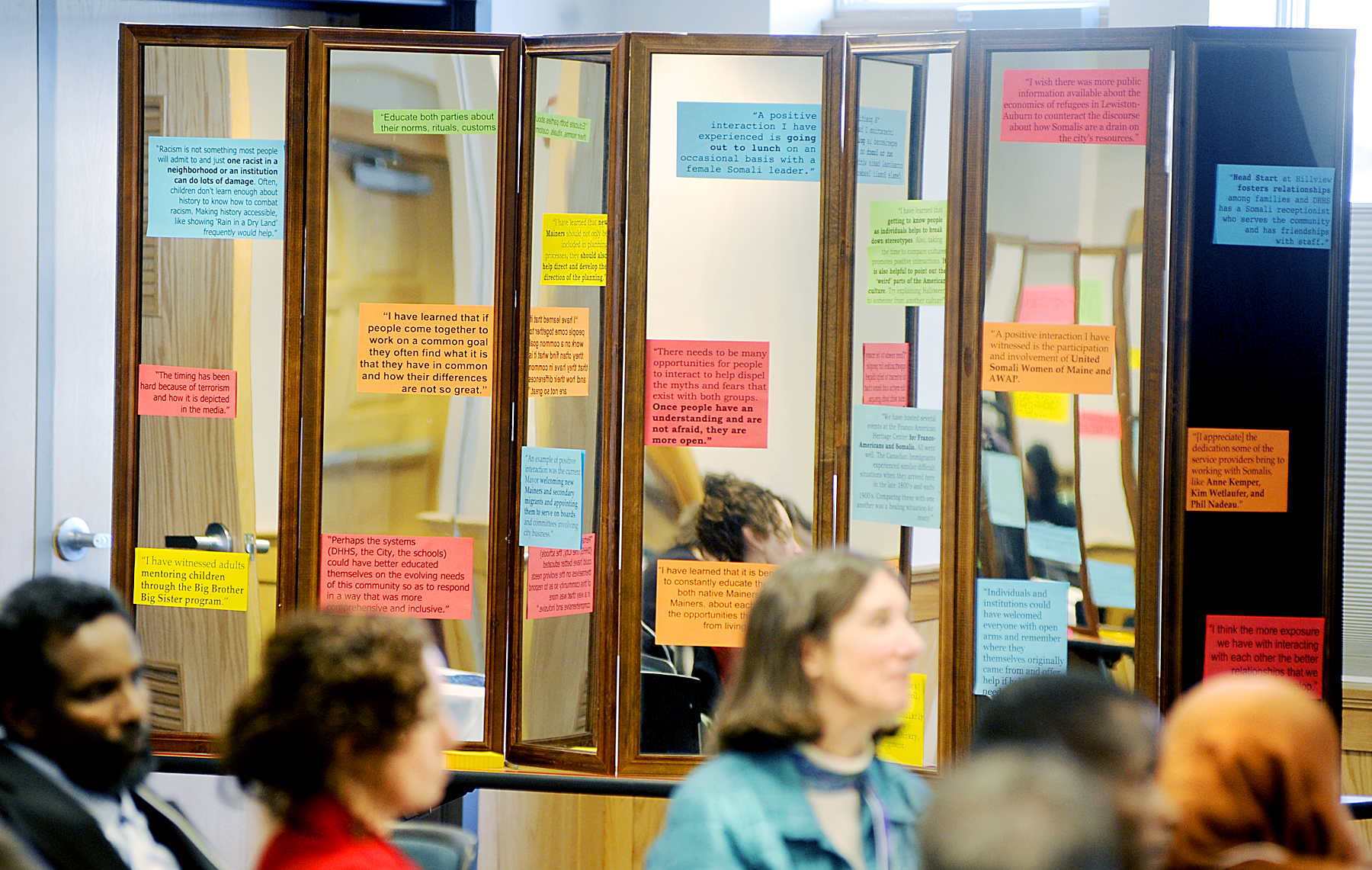
Participants sit in front of a reflection wall during the day-long conference “Advice for America: What Lewiston-Auburn has learned since 2000 about fostering relationships between residents and newcomers” at the University of Southern Maine’s Lewiston-Auburn College.
Comments are no longer available on this story