
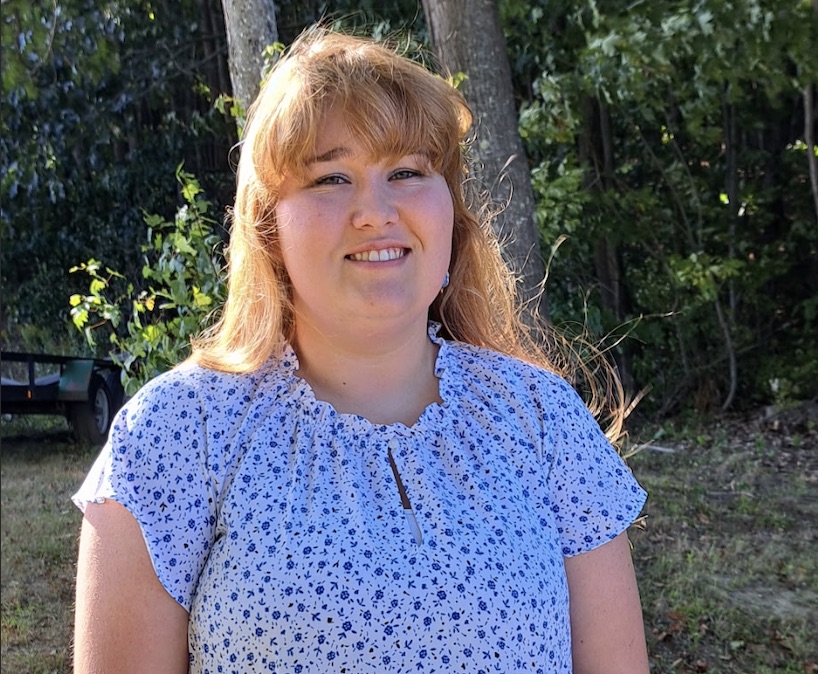
Name: Lydia Chapman
Age: 20
Occupation: Full-time employee/student
Community involvement: Candidate for School Committee
1. Why do you think you are the most qualified or best candidate for this seat?
I grew up in Auburn and have lived here my whole life. I am a graduate of Edward Little(High School) and have observed how poorly students are set up for real life. I feel as though the goal is only to have students graduate and not what they need to get them to that point. It seems as though we are not considering how these children will be future adults, and if we aren’t setting them up for success no good can come from that. We want educated individuals to work alongside in our lovely community, as Auburn should be.
2. What is the most important issue facing the Auburn School Department and how would you address it? Be specific.
Our low proficiency rates in reading, writing, math, and science is the biggest issue that I feel is facing the Auburn School Department. I would address this by bringing the credits needed to graduate back up to 24, as it was lowered to 20, then 18, and now students can get an 11-credit diploma through the state of Maine, which is the lowest in the nation. This seems to go alongside my feelings that the only current goal is having students graduate. Which is not as important as students going to be educated.
3. What can you do as a school committee member to improve test scores and graduation rates?
I would call to the validity of the graduation rates, as both Auburn Middle School and Edward Little High School rank in the bottom 80% of Maine schools based on proficiency scores in reading, writing, math, and science. However, Edward Little reports a graduation rate of 92% as of 2024, putting them in the top 20% of Maine schools for graduation rates. This indicates students graduating without actually being prepared for the real world. I would focus on policies that ensure students are actually learning as opposed to pushing them through to graduate.
Name: Quinn Gormely
Age: 31
Occupation: Advocate for survivors of sexual violence, hospital chaplain
Family: My husband Ezra and son Terrence, 18
Community involvement: Member at High Street Congregational Church, UCC, current member of the School Committee, active in statewide nonprofits, including Midcoast Symphony Orchestra, Maine Women’s Lobby, and Mabel Wadsworth Center.
1. Why do you think you are the most qualified or best candidate for this seat?

As a current member of the Auburn School Committee, I bring over a decade of experience in public health, advocacy and collaborative problem-solving. My background as a hospital chaplain and sexual assault survivor advocate has taught me to listen carefully, bridge differences, and focus on practical solutions. I’ve applied these skills throughout my service on the Curriculum and Health & Safety subcommittees, helping to advance thoughtful, inclusive policies. My work in LGBTQ+ and disability inclusion informs a steady commitment to ensuring every Auburn student feels seen, supported and empowered to thrive.
2. What is the most important issue facing the Auburn School Department and how would you address it? Be specific.
A growing number of Auburn students are experiencing homelessness or housing instability, which directly affects learning, attendance and well-being. When students don’t have stable housing, every other goal becomes harder to reach. As a committee member, I’ve supported efforts to strengthen wraparound services and community partnerships that connect families with resources. We need to continue investing in social workers, counselors and staff who can meet these needs early and effectively. Ensuring that every student has safety, stability and belonging is foundational to academic success.
3. What can you do as a School Committee member to improve test scores and graduation rates?
Auburn’s graduation rate now exceeds 95 percent, reflecting real progress. The School Committee’s role in further improvement is structural, focused on investing in the right tools and supports. I would like to see expanded access to math tutoring, a need identified by parents and educators. During my last term, our Curriculum Committee helped standardize new science materials with adaptive e-learning features that adjust reading levels to meet students where they are. This kind of innovation, using technology to balance consistent standards with personalized learning, helps ensure that challenges in one subject do not become barriers in another.
Comments are not available on this story. Read more about why we allow commenting on some stories and not on others.
We believe it's important to offer commenting on certain stories as a benefit to our readers. At its best, our comments sections can be a productive platform for readers to engage with our journalism, offer thoughts on coverage and issues, and drive conversation in a respectful, solutions-based way. It's a form of open discourse that can be useful to our community, public officials, journalists and others.
We do not enable comments on everything — exceptions include most crime stories, and coverage involving personal tragedy or sensitive issues that invite personal attacks instead of thoughtful discussion.
You can read more here about our commenting policy and terms of use. More information is also found on our FAQs.
Show less