

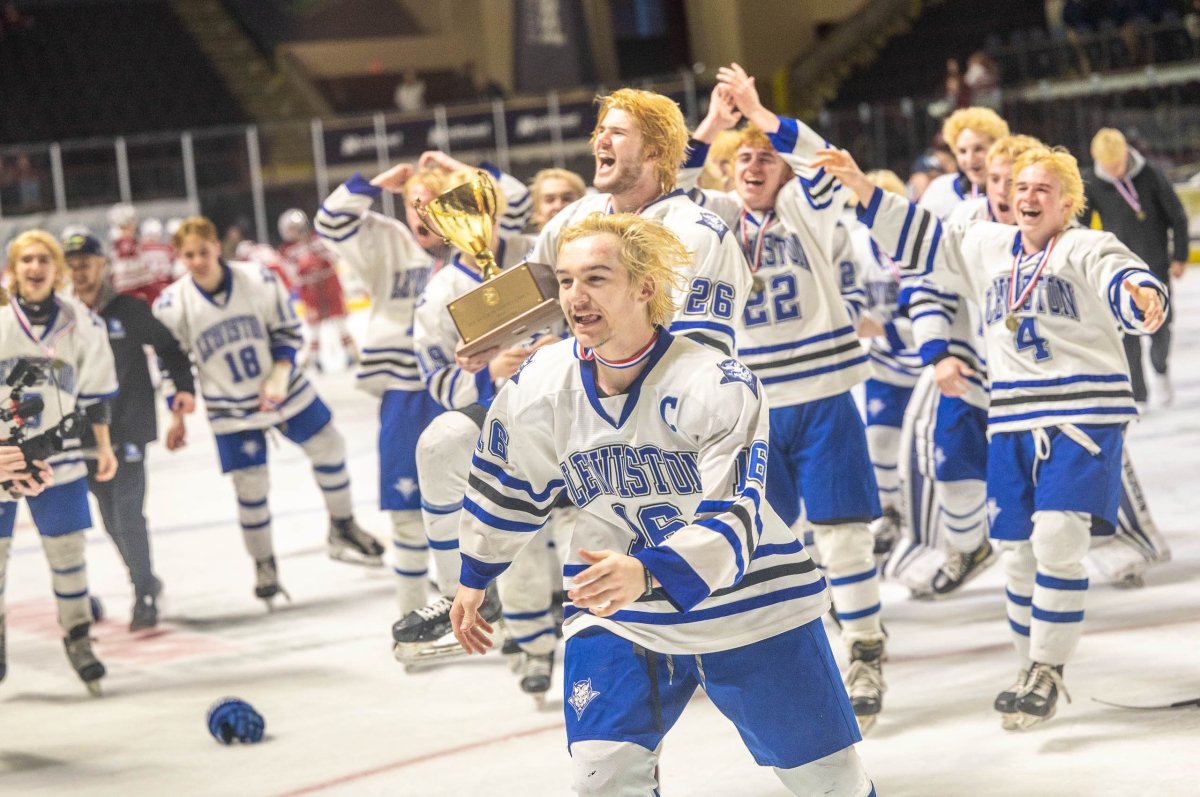
Cooperative ice hockey teams are nothing new to the Maine high school sports landscape. They’ve been around for decades, allowing players from schools without the depth for a solo program to get on the ice and play. This season, though, the announcements of two new co-op teams were met with an uncomfortable pause.
Bangor and Brewer joined forces, with a handful of players from Skowhegan and Narraguagus in tow. In the most surprising co-op yet, Lewiston absorbed the former Mt. Ararat/Lisbon/Morse team, which saw its season end prematurely last season with a hazing scandal.
“We knew it was coming going into last year,” said Lewiston coach Sam Cloutier. “Last year, we graduated 12 of 22 (players), counting JV and varsity… I don’t think Lewiston’s alone.”
It was just two years ago that Lewiston defeated Bangor in the Class A championship game to win its 25th state title. Lewiston has long been touted as the Maine’s hockey capitol. Longtime hockey powerhouse St. Dominic’s closed at the end of the last school year.
This year, there are 28 boys hockey teams competing statewide. Twenty seasons ago, 2005-06, 28 teams competed in Class A alone. Only eight teams will take the ice this winter representing one school: Thornton Academy, Edward Little, Scarborough and Falmouth in Class A, and Messalonskee, Camden Hills, Greely and Cape Elizabeth in Class B. Even Kents Hill, the private school that upgraded its junior varsity program to MPA varsity status last season and played for the Class A championship, will have players from Oceanside on its roster this season.
Participation in boys ice hockey has dropped by a little more than 33% in the past 20 years. According to data compiled by the National Federation of State High School Associations, 1,380 boys played high school hockey in Maine in 2005-06. Last season, 917 boys took part.
As to why there’s been such a drop in high hockey participation in a generation, the answer is multifaceted.
“I think anytime someone gives a simple answer, it’s not the right one,” said Dennis Hagemann, coach of the Brunswick/Freeport co-op team. “It has layers.”
There are fewer students in Maine than 20 years ago, and hockey is an expensive sport, with skates alone costing hundreds of dollars. Chad Foye, the athletic director at Messalonskee and chair of the MPA ice hockey committee, said he thinks some of the current decline is from youth players giving up hockey when rinks were closed during the pandemic five years ago.
More than ever, some players opt to attend a prep school or play for a club or junior program rather than their school. Longtime Greely boys hockey coach Barry Mothes said there are five players who could be on his roster this season who decided to play somewhere else where they could get more ice time.
“These programs have existed in the past, but they’ve really grown in the last few years,” Mothes said. “(High school hockey) goes from the third week in November to early March, at best. It’s a 23-game schedule, at best. For a long time, that was enough for people.”
Some of Maine’s top players never skated a shift for their local high school. Westbrook native Carter Amico, currently a freshman defenseman at Boston University and the 38th overall pick in June’s NHL draft by the Philadelphia Flyers, attended Mount Saint Charles in Rhode Island before joining the United States National Development program. Falmouth’s Brock James, a freshman forward at the University of Maine, played in prep school before playing junior hockey.
Hagemann said a change to the MPA’s bona fide team rule, which requires student athletes to choose either their high school or a club team, might help increase high school participation numbers. Why make them choose, he said.
“That I think is worth a conversation,” Hagemann said.
Cloutier is a former Lewiston player who graduated in 2011.
“We didn’t have the numbers they had in the ’90s, but we still had 50, 60 kids trying out,” he said of his time as a player.
Foye formerly coached the Cony boys hockey team. He saw participation shrink over his final seasons coaching the Rams a decade ago. Still, he said, the team always had enough players to compete. Cony now draws players from seven other schools.

As for how long Messalonskee can compete without joining forces with at least one more school, Foye isn’t sure.
“We have quite a few seniors this year. It might not be long,” he said.
With more co-op teams, there’s been a call to tighten regulation of them, MPA executive director Mike Burnham said. An ad hoc committee will study options, he said.
Could the day come when the MPA chooses not to sponsor ice hockey, and leave the sport to the private club teams? Burnham was frank with his answer.
“Unfortunately, the answer to that is yes,” he said.
That idea has not been formally proposed, Burnham added, but if participation continues to drop, it could be considered.

We invite you to add your comments. We encourage a thoughtful exchange of ideas and information on this website. By joining the conversation, you are agreeing to our commenting policy and terms of use. More information is found on our FAQs. You can modify your screen name here.
Comments are managed by our staff during regular business hours Monday through Friday as well as limited hours on Saturday and Sunday. Comments held for moderation outside of those hours may take longer to approve.
Join the Conversation
Please sign into your Sun Journal account to participate in conversations below. If you do not have an account, you can register or subscribe. Questions? Please see our FAQs.