

MEXICO — A first-ever independent review of Med-Care Ambulance has given the River Valley’s emergency service high marks for leadership and employee engagement.
That assessment, given for the first time in the company’s 37-year history, came as a welcome relief, said Chief Paul Landry Jr.
“That was a little nerve-racking for me because you’re calling somebody in to assess how I’m running things, and it’s such an open process,” Landry said on Oct. 22. “The results, I was very happy with. They came back with six recommendations for us.”
Earlier this year, Med-Care received a $70,000 Maine EMS System Assessment grant. Conducting that evaluation was SafeTech Solutions, a national company that concentrates on rural EMS because it’s so hard to sustain.
Med-Care, a quasi-municipal company, serves 15,902 people over a 560-square-mile area that includes Andover, Byron, Canton, Carthage, Dixfield, Hanover, Mexico, Newry, Peru, Roxbury and Rumford, as well as some unorganized territories.
Landry said that SafeTech had two people onsite for three days this fall, interviewing almost all 40 active staff members, as well as 30 members of the community.
“And they invited select board members from each of the 11 towns. It was meant to determine what they desired for EMS services, what they knew about it, and what they thought about Med-Care,” Landry said. “They went over everything from our financials to our operating plans to our emergency plans, to find out if there were any areas of inefficiencies.”
He noted, “It was important for them to have a say, to be able to ask the questions and to give their input and concerns to a third party and not have to worry about management finding out that they said something bad. They could just be open with these people and answer their questions and speak their mind.”
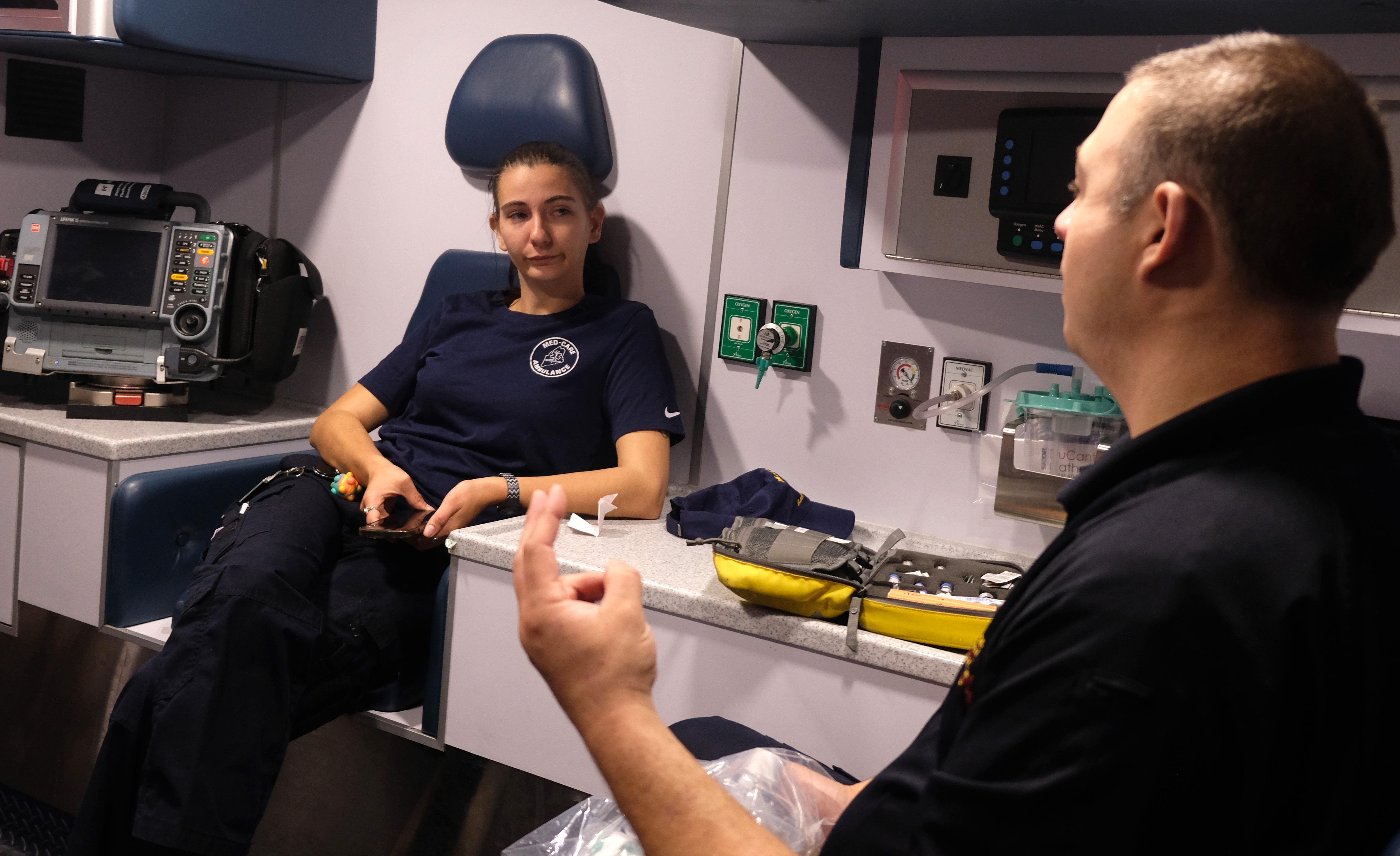
SafeTech made a public presentation Oct. 15 at Med-Care about their evaluation of the organization, attended primarily by board members, but with two members of the public.
Capt. Kyle Baker, who has worked as an EMT for 18 years and is a supervisor, was not interviewed by SafeTech for the evaluation, but he said the value of the assessment goes beyond having a good reputation.
“We’re kind of the only game in town — we’re in a corner, all by ourselves,” Baker said. “And there’s nobody capable of providing the same level of care within spitting distance. We’re all swamped. We’re all in a staffing crisis because EMS does not pay well.”
Having an assessment “with teeth behind it” is valuable, Baker said, because staff and the public can reference the data and use it to inform decisions.
Deputy Chief Berta Broomhall agreed, adding that officials didn’t know what to expect after receiving the grant and deciding on the SafeTech review. “They said that normally when an ambulance service asks them to come in and do an assessment, it’s because they’re in dire straits,” Broomhall said.
Landry noted that Med-Care did really well in employee engagement.
“We’ve been working really hard over the last year and a half at building a culture here,” he said. “People live and work here 24 hours at a time, so it’s important that you have a positive, inclusive culture.”
REVIEW RECOMMENDATIONS
Landry said the assessment comes just before the budget process gets underway and the interlocal agreement renewal with local towns is coming in 2028.
“People are going to want to know that we’re being good stewards with public money,” Landry said. “Our position is so much better than what it was just five years ago, with the fact that we have reserves now. We’re not operating on a week-to-week revenue cycle. We started a capital plan to be able to fund our big items in the future.”
SafeTech made six recommendations:
- Begin a conversation to increase the community subsidy to allow for more competitive wages and greater capital funds.
- Regularly use data to determine if resources are appropriately aligned with call volumes and system needs.
- A capital equipment replacement plan has been developed. Continue that effort as well as designating a funding mechanism for forecasted replacement costs.
- Standardize an annual report to present to stakeholders.
- Provide leadership and specifically front line supervisors (captain), with structured leadership training.
- Continue building and maintaining relationships and influence with key stakeholders in order to ensure transparency, support and a shared vision for EMS in the River Valley.
Landry said Med-Care’s staffing has been stable.They have 17 full-time people, including the chief and deputy chief. There are 30 part-time and per diem personnel and currently no full-time openings.
“We do have turnover, which is normal in this industry,” he said, “but we’ve created a system where we’ve created part-time people who are looking for full-time employment, so we’re able to fill vacancies fairly quickly.
“I really attribute that to our culture here because we’re certainly not even near to the highest paid agency in the area,” he added. “We’re in the middle of the road as far as compensation goes.”
CAPITAL CONCERNS
Landry said Med-Care is currently charging towns a rate of $43 per capita.
“When the per capita goes up a dollar, that only raises $15,900, which is less than half a week’s payroll,” he said.
He said that with the small population, that means less call volume and fewer people to absorb any taxation. The call volume has been flat for three years at around 4,250 per year. And that’s just calls for service — a lot are no transports, meaning no patient is brought to the hospital in an ambulance. If there is no hospital transport, Med-Care is not compensated for the call.
On a positive note, Landry said that since 2020, Med-Care has brought in about $1.65 million in grants, with almost all of those being competitive grants. In each of the last two years, Med-Care has received grants toward the purchase of an ambulance.
The grants are all written by Landry, Assistant Chief Dakota Turnbull and Broomhall.
“Our issue now is just trying to focus on our capital, but if we can get that taken care of, we don’t have the interest or the loans, and that frees up a lot of money,” Landry said.
Baker said management has had an open-door policy.
“I never had a concern that I haven’t been able to address in the same day,” he said.
He said one of the issues in the past was the condition of the vehicles.
“It was abysmal. It was not safe. It was to the point some of us didn’t want to come to work,” Baker said. “Every truck was a remount or a second or third gen ambulance. These things were falling apart.”
Landry said their fleet consists of six ambulances and two chase vehicles — one for the chief and the other for community paramedicine, and an intercept for a needed paramedic.
He said that almost yearly, a vehicle needs to be replaced.
“You can’t account for maintenance issues that you can’t see coming, but there’s a plan in place to replace these trucks with trucks that are up to the task, with serviceable equipment,” he said.
Baker said employees are fortunate because they are not owned by a corporate entity.
“We’re not owned by a hospital system,” he said. “There’s not a business division whose job is to make sure that you put in payroll down to the nearest minute.”
Baker said every person experiences four to six significant emotional traumas in their entire lives, whereas the average EMS provider experiences more than 600. “And that is a real fact,” he said. “The reason that’s important is that micro-trauma matters, so you don’t know you have a problem until you have a big problem. I can speak openly about it because I’ve had mental health issues because of this job.”
Broomhall added, “What we do is a job, but it is a job that most people would not want to be anywhere near.”

We invite you to add your comments. We encourage a thoughtful exchange of ideas and information on this website. By joining the conversation, you are agreeing to our commenting policy and terms of use. More information is found on our FAQs. You can modify your screen name here.
Comments are managed by our staff during regular business hours Monday through Friday as well as limited hours on Saturday and Sunday. Comments held for moderation outside of those hours may take longer to approve.
Join the Conversation
Please sign into your Sun Journal account to participate in conversations below. If you do not have an account, you can register or subscribe. Questions? Please see our FAQs.