


For more than a century, Greenwood’s town reports have quietly documented the challenges of rural education, from epidemics and enrollment declines to staffing shortages and deteriorating schoolhouses.
In 2025, Historian Will Chapman preserved 137 years of those reports online, offering a window into how local schools reflected — and responded to — broader social and public health crises.
School reports repeatedly cite concerns over attendance, teacher retention and building maintenance, as well as the impact of disease. In 1919, Superintendent Charles Lord reported closing several schools for weeks because of “the epidemic.” In 1923, Superintendent F.E. Russell noted that scarlet fever spread through three districts, claiming three young lives despite measures that included burning textbooks and disinfecting school buildings.
The reports also trace changing views of education. A parent-teacher association formed at Locke’s Mills village in 1915 sought closer cooperation between home and school, while a state-mandated “Rural School Betterment” program outlined in 1916 aimed to guarantee adequate facilities, teachers and materials in rural schools.
ATTENDANCE
In 1893, Greenwood Supervisor of Schools G.W. Richardson told townspeople he believed the school system was delivering value.
“In submitting the school report for the past year, I think I can say, on the whole, we have received good returns for the money expended,” he said. “The average attendance has been all that could be expected.”
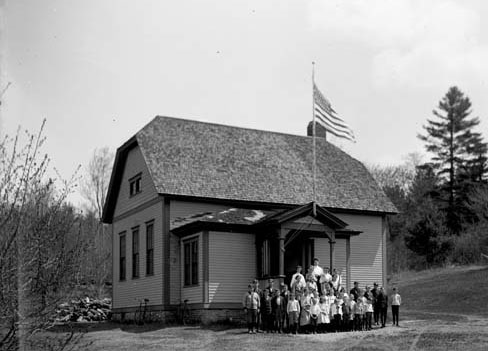
Three warrant articles that year recommended shifting students to other districts among the town’s 11 schools. The changes could require students to travel a mile or more, Richardson said, but would ensure a longer school year.
By 1914, Supervisor of Schools E.F. Callahan struck a far sharper tone, criticizing families for avoiding compulsory attendance: “… many of the parents seek to evade the compulsory attendance law at every opportunity. This condition is by no means confined to our foreign population who might offer in excuse a variety of more or less valid reasons, but it crops out in families, who, from their positions in the town, one would expect to know better.”
Callahan cited two boys, ages 10 and 13, who could not do first-grade work.
“This is not because of any mental inferiority. Nor are they foreigners. The plain facts in the case are they have not been compelled to go to school till they have arrived at an age where their lack is a serious embarrassment,” Callahan said. “The same condition pertains to an extent with our foreign pupils. This is deplorable.”
After the rebuke, Callahan asked for “approval of my work and retention for another year,” adding that he hoped to conduct his duties by automobile, “which should double its efficiency.”
Callahan remained supervisor in 1915, but governance had shifted to a three-member school board. By then, two of the town’s 11 schools had closed, and a 30-week school year was required.
TEACHER RETENTION
From the earliest town reports, Greenwood officials struggled to keep teachers in their classrooms. One-room schoolhouses, often isolated and far from home, made long-term retention difficult. Many superintendents came and went, and most praised and supported the teachers who stayed on.
In 1895, Supervisor W.A. Holt reported generally positive results despite those challenges.
“Out of the 227 scholars we have in town, we support eight schools,” Holt said. “The scholars that attended these schools have been under the instructors, as I thought in my judgment, proper to manage them and most excellent work has been done.”
Holt emphasized that classroom order depended largely on teacher conduct: “If a teacher is orderly, uses good language at all times, is easy and graceful in manner and is always polite to pupils, as well as others, there is very little to fear in the general deportment of that school.”
At the same time, Holt said the school committee sought continuity.
“In the assignment of teachers, your ‘committee’ tried to select the best and retain the same as long as good work was done, giving the preference to teachers of our own town, qualifications being equal,” he said.
Two decades after Holt, new regulations complicated staffing efforts. In 1915, Callahan reported that updated state certification laws had taken effect.
“This has made a temporary scarcity of teachers, with a consequent rise in salaries. In the end it will give us better teachers, but we must expect to pay more,” Callahan said. “The farmer should be willing to pay as much for a person to train his children as for one to care for his stock. Often this is not true, however.”
By midcentury, the issue persisted. In 1946, Superintendent Donald M. Christie warned that the state would face a teacher shortage “fully as serious as for the past year” for at least two or three more years. “The best single way of protecting against this is to offer salaries at least on an equal with other communities,” he wrote.

BUILDINGS
The 1914 town report shows Greenwood still operating on two 10-week terms, for a 20-week school year, spread across 11 schoolhouses. Maintenance and repairs were a persistent concern.
“At Greenwood City the school-house is in very bad condition. Here we have over 20 children enrolled in a school supplied only with the rudest benches, recognized by all as detrimental to the health, present and future of the little ones forced to use them,” the report said. “It is amazing that this school should have been neglected so long in favor of others where the registration is a third or less than that here.”
By 1922, Greenwood had 195 children between the ages of 5 and 21 attending nine schools: Irish, Shadagee, Tubbs, Richardson, Patch Mountain, Greenwood City, Bryant, Locke’s Mills Primary and Locke’s Mills Grammar.
“Three schools have had shed and toilets fitted up to comply with the recent State law. Five others need the change, but two can wait another year,” Superintendent Russell reported.
REGIONAL SOLUTIONS
By 1936, Greenwood students were attending high school outside the town. The town report lists tuition payments of $1,095 to Gould Academy in Bethel, $700 to Woodstock and $196 to the town of Paris. Superintendent Carrie Wight noted that while common school enrollment continued to decline, high school attendance was rising. Twenty-six Greenwood students were enrolled in high schools.
“This tuition expenditure seems a heavy tax on the citizens of Greenwood, but the town should be proud to have so many boys and girls attending secondary schools,” Wight said.
By 1960, the school system was straining to keep up. A Greenwood town committee reported the need for a larger Locke’s Mills School to meet expected enrollment increases. In the meantime, both Locke’s Mills and the Greenwood City School remained in use, and a school fund was established. In 1962, Greenwood paid Bethel tuition for 14 Irish Neighborhood students to attend Bethel schools, two additional students expected to attend the following year.
In 1965, Greenwood voted to join School Administrative District 44 and a year later in 1966, the title of a Howe Hill schoolhouse featured in a DownEast article was transferred to the district as well. Following the change, the school would be home for only three grades and eventually two in its final year. It was closed in 1981 at the end of the school year.
In 1965, Superintendent Horace Maxcy wrote a letter marking the close of Greenwood’s schoolhouse era.
“This is the final report on the schools of Greenwood which will appear in your Town Report. Next year and thereafter the report will be in the Report of the School District,” Maxcy wrote.
“On August 16, 1965, following a vote by the town, Greenwood joined Andover, Bethel, Newry and Woodstock to form School Administrative District #14. The purpose of the District is to provide an educational program which, with the establishment of a new high school, will be superior to one that the towns would be able to operate alone.
“The success of the newly-formed District and the quality of education which will be provided is still the responsibility of the people. Continued interest and support are necessary. There will be problems, but if each citizen will accept this responsibility we can have those things for which we have strived.”

We invite you to add your comments. We encourage a thoughtful exchange of ideas and information on this website. By joining the conversation, you are agreeing to our commenting policy and terms of use. More information is found on our FAQs. You can update your screen name on the member's center.
Comments are managed by our staff during regular business hours Monday through Friday as well as limited hours on Saturday and Sunday. Comments held for moderation outside of those hours may take longer to approve.
Join the Conversation
Please sign into your Sun Journal account to participate in conversations below. If you do not have an account, you can register or subscribe. Questions? Please see our FAQs.