
It’s a challenge for the human brain to reckon with deep time. Visits to the Great Pyramids or Stonehenge can jog us out of present-tense bias and into a consideration of the histories that shaped current cultures. The oldest known bristlecone pine has stood for 4,800 years, but good luck visiting it since its exact location is (for obvious reasons) a secret. And those portals through time are mere blinks when held against Earth’s 4.54-billion-year geological past. For insight into our planet’s deepest history, and what it might reveal about our possible future, it’s a good idea to talk to a geologist.
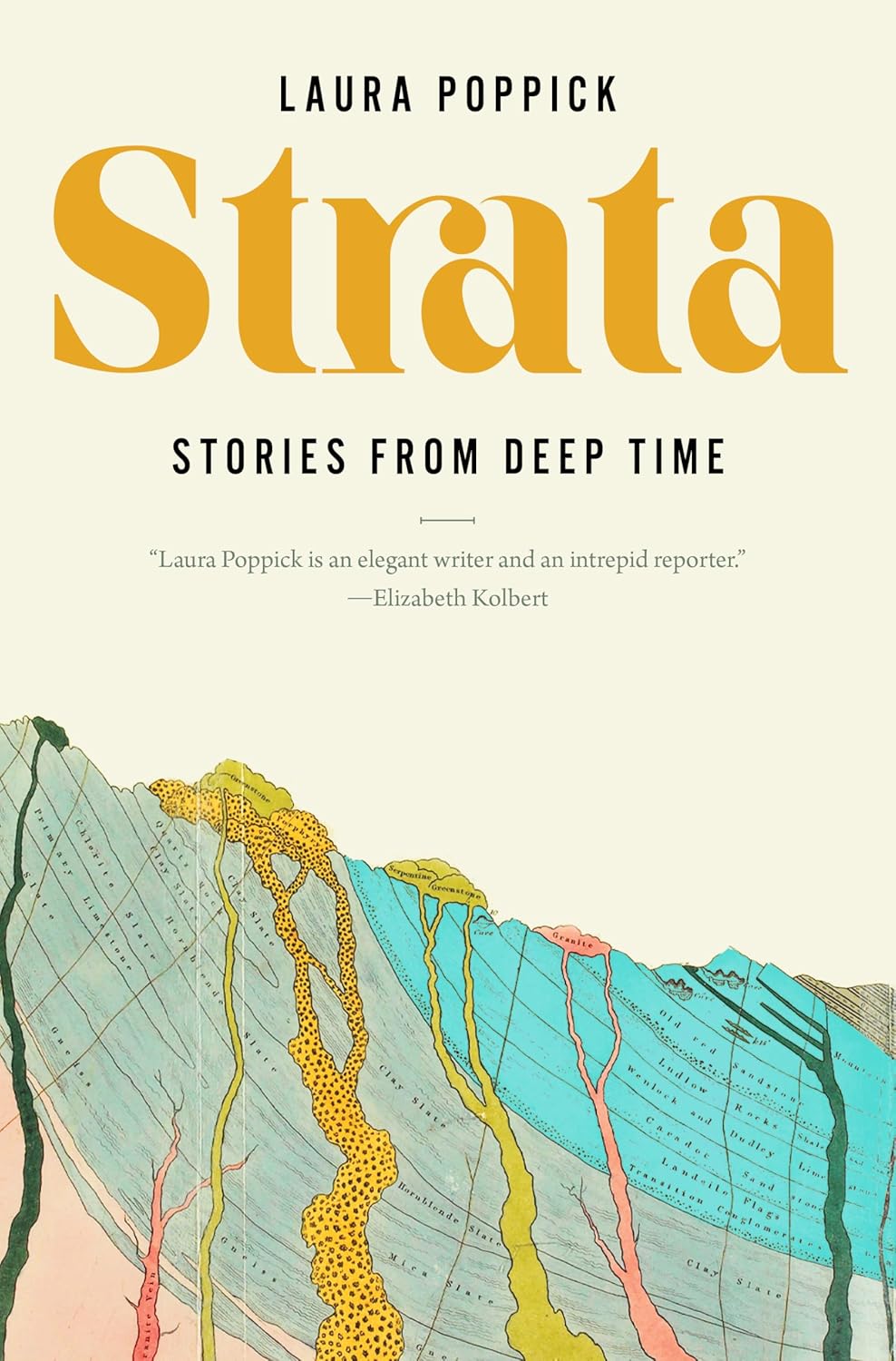
That’s what Portland-based science writer Laura Poppick does in her engaging debut, “Strata: Stories from Deep Time.” In the tradition of Rachel Carson and John McPhee, “Strata” translates complex science for a general audience, keeping the information rigorous but accessible — and focused on the layered remnants of ancient “sand, silt, and clay” that stripe landscapes and hold within them clues to a vast shifting planet. Poppick’s intrepid enthusiasm makes for a fascinating read, even for those of us who wouldn’t recognize a fossil if we stumbled over it on a hike.
Her aim is to direct our attention not just to the past, but to our present era of environmental upheaval — and to the awe-inspiring confluence of factors that quite literally laid the groundwork for our own human story. “By pushing ourselves to the edge of crisis, we have found ourselves nose to nose with our origins,” Poppick writes. “Our planet seems to be telling us to take a look back. To remember how unlikely each of our lives is, and yet here we are.”
Organized around four periods of Earth history, examining the evolution of air, ice, mud and heat, the book illuminates how “Earth didn’t appear fully formed waiting for us to arrive, but instead spun through a series of intense growth spurts that cumulatively, over billions of years, built the landscapes we now have the privilege of inhabiting. … a bacterial blob evolved to turn sunshine into sugar and filled the atmosphere with oxygen for the first time; … a series of global ice ages may have paved the way for multicellular life; … the rise of plants on land instigated an onslaught of mud that rewrote the surface of the planet; … and past periods of heat can tell us something about our moment of warmth today.”
Poppick brings readers to sites including an epic iron mine in Minnesota, Wyoming’s Bighorn Canyon, a Norwegian archipelago, Ireland’s Dingle Peninsula, the Australian Outback and Coastal Newfoundland. At Colby College in Waterville, she visits the lab of a paleobotanist who is a leading researcher into ancient wildfire studies:
“… he first dissolves his rock samples in acid, then sieves out the tiny black specks left behind. To manipulate and orient each fleck for microscope analysis, he uses a wooden skewer that has a single whisker from his cat, Bingo, duct-taped to the end.” (It’s a low-budget tool that fits the bill for delicately adjusting samples; here’s hoping Bingo is credited in research papers).
All the scientists Poppick meets along the way contribute valuable, incremental and painstaking progress toward our understanding of the earth systems underpinning the planet. Geology is a slow science, and an imperfect one. As Poppick puts it, “Studying strata is like reading the pages of a book — if you took that book and dropped it to the seafloor and then expected to be able to read everything word for word after that seafloor cracked up into a mountain range millions of years later.” Point taken: it’s not for the faint of heart!
At every turn, studying deep time requires us to set aside our limited experience of how Earth looks, acts and evolves. Scientists struggle with human subjectivity too. In 1964, when the British geologist Brian Harland put forth a theory about a massive ice event, now known as the Great Infra-Cambrian Ice Age that covered nearly 100% of the Earth’s surface, he faced intense pushback because “many of his colleagues … couldn’t imagine a version of Earth that could ever get that cold, nor could they see how the planet would spin out of such a deep chill. They couldn’t, it seemed, grapple with the possibility that Earth was once much different than it is today.”
There’s a requisite humility in the work; all scientists, and maybe especially geologists, must accept that their pet theories, often built over decades of work, may be proven entirely wrong. Hold your convictions loosely because the next researcher might upend all assumptions. (In this way, the scientific method holds lessons for us all.)
And what can Earth’s mind-boggling deep past tell us about our future? Poppick outlines an extinction event near the beginning of the Triassic period (roughly 252 million years ago), the single worst mass extinction in Earth history. Many other periods of volcanic activity took place over time, but none with such a devastating impact on life forms. What made this different? “…The magma that welled up from the mantle sat directly beneath massive reservoirs of oil, gas, and coal. As that magma rose to Earth’s surface, it burned and combusted those fossil fuels, releasing not only carbon dioxide but also toxic butanes and benzenes and ozone-depleting gases. Perhaps this is all starting to sound familiar to you.”
The painstaking, slow work of geology, Poppick argues, has much to reveal for those of us dwelling in the Anthropocene. The research into ancient wildfires conducted at Colby, for example, can help improve climate models and wildfire projections today.
But Poppick also makes an impassioned, persuasive argument that studying the strata offers more than useful data. It offers an opportunity for humans to slow down and pay attention, to make room for a deep sense of wonder about our home and our fleeting time here. On encountering the same swooping pattern in layers of sand and silt in Ireland that she’d seen in Southern Australia, Poppick writes, “Encountering such familiar couplets in this place I had never been felt like overhearing a familiar language spoken in a far-flung part of the world, or finding a familiar constellation in an unfamiliar sky. I dragged my thumb up and down the layers and felt grounded by each pulse, each quiet avalanche that had pushed the dune forward so long ago … this cyclicity, this giving into gravity to make way for something new, has always existed at the center of the Earth system, at the center of each life.”
Or as one of the researchers in Poppick’s book puts it, “People could be more happy if they spent more time looking at rocks.” Amen to that.
Genanne Walsh is the author of a novel, “Twister,” and a creative nonfiction chapbook, “Eggs in Purgatory.” She lives in Portland.