


Atop mountains along the Appalachian Trail, being able to understand the type of snow that falls is key to being able to predict everything from skiing quality to trail stability and even the climate.
According to scientists and weather observers, precipitation, temperature and moisture in the clouds determine the microscopic shape of snowflakes — six-sided structures whose shape varies depending on the conditions. Scientists have long understood that these variables control whether snow forms as dense, compact flakes or light, fluffy powder.
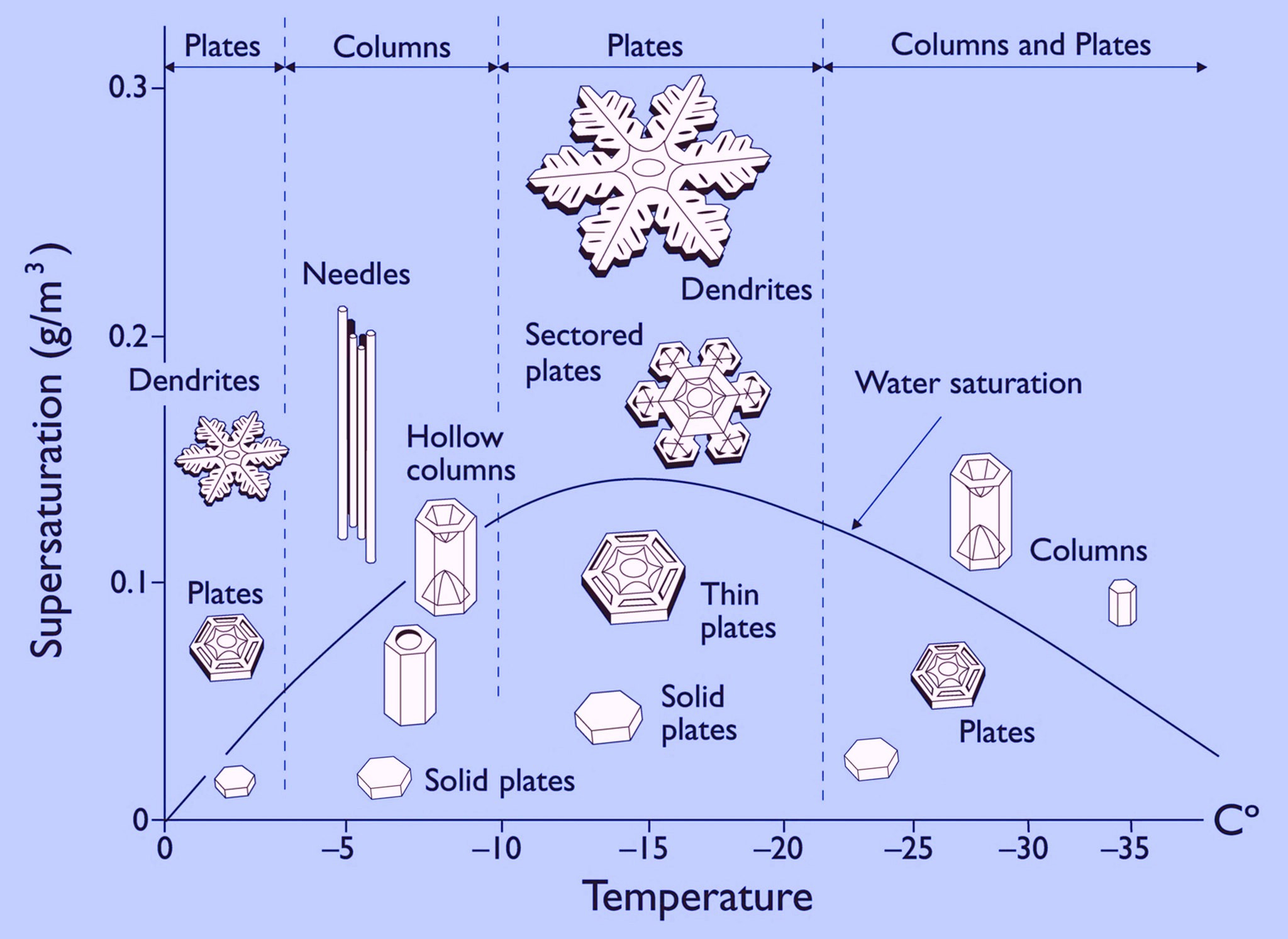
Research summarized in the newly released White Mountains Almanac, published by the Appalachian Mountain Club, Mount Washington Observatory and Hubbard Brook Research Foundation, shows that crystal shapes change predictably across temperature ranges.
The almanac, released as part of an ongoing effort to document mountain weather, snowpack and ecological conditions across northern New England, provides a data-driven look at how atmospheric conditions influence snow formation, climate and winter recreation.
“Dendrites are the form we typically think of when we think of snowflakes,” said Georgia Murray, staff scientist with the Appalachian Mountain Club and Mount Washington Observatory. “They actually form in a certain temperature range, not too cold because colder air can’t hold as much moisture, or too warm, as it won’t quickly freeze and grow into crystals. Humidity is important for the growth, as more water allows the crystal growth.”
Near 32 degrees Fahrenheit, snow crystals form flat plates. When humidity is high, these plates grow larger and stick together, producing dense snow that packs firmly. This type of snow creates stable walking surfaces and forms the base layer essential for ski areas.
At colder temperatures near 14 degrees Fahrenheit, especially when moisture levels are high, crystals form branching structures known as dendrites. These intricate crystals trap air, producing light powder snow. Powder snow allows skis and snowshoes to move more easily across the surface but may form weaker layers when buried beneath heavier snowfall.
Murray said these crystals form in what scientists call the dendrite growth zone in the upper atmosphere. After snowfall, colder conditions at higher elevations help preserve their delicate structure.
“That shape is what keeps the snow from packing down as much and staying more powdery,” she said. “Lower elevations may warm up more often and settle snow into a denser snowpack.”
Humidity plays a critical role in crystal development. Higher moisture allows crystals to grow larger and more complex, while lower moisture produces smaller, simpler crystals. Even at the same temperature, humid conditions produce deeper, softer snow than dry air.
These effects are especially important at higher elevations, but they also influence snow conditions on local terrain throughout the region, including trails on Spruce Mountain and the Whistle Stop Trail in the Jay/Farmington area. This is why snow in the region may feel heavy and wet during warmer storms but light and powdery during colder periods, even within the same winter season.
Snowpack along hills, forest trails and open ridgelines can vary significantly depending on elevation and exposure.
The Appalachian Trail crosses several of the region’s highest peaks, including Saddleback Mountain and the Bigelow Range, where colder temperatures and higher humidity often preserve lighter, powdery snow.
Community snow observations help researchers understand how these conditions vary across the landscape. Murray said collecting snow measurements across different elevations provides valuable insight into snowpack variability. The Mount Washington Observatory has studied mountain weather and snowpack in northern New England for more than 90 years.
“For the public, like backcountry recreators, they can look at the data through the app or online to see the latest mountain snow levels beyond the continuously monitored stations like our three winter huts,” Murray said.
“A Snow Blitz is an important tool to rally the community in a focused and meaningful way,” Murray said. “For researchers, it is particularly valuable to get observations over the same time period across the landscape, providing spatial variation that can help in improving models and other estimates.”
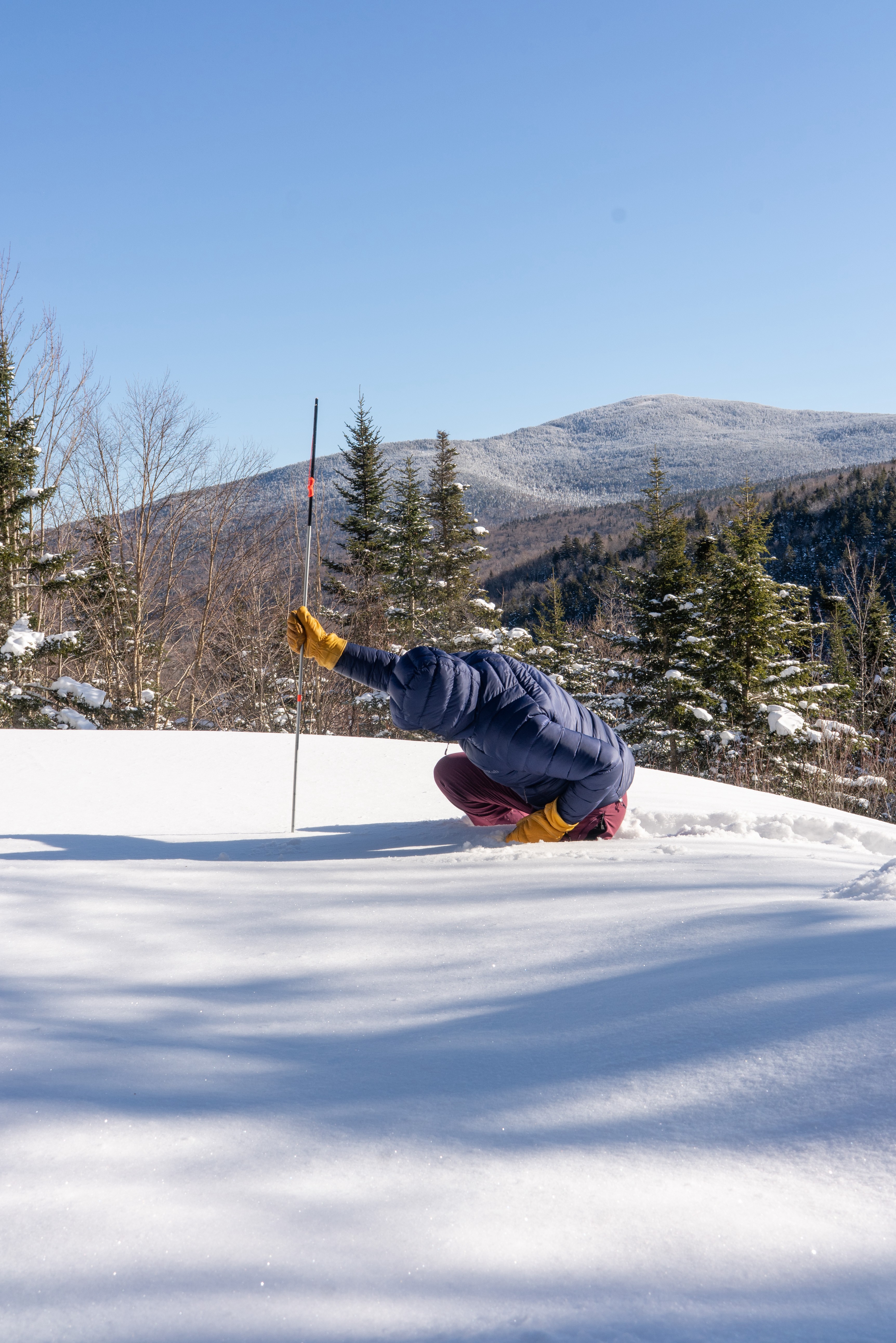
This winter, observers recorded snow depths ranging from 15–225 centimeters across elevations from 17–1,242 meters.
“This is great news,” Murray said. “The deepest depth was at the highest elevation.”
Local researchers are also contributing to snow science. Murray said collaborators at the University of Maine at Farmington, including Julia Daly and Rachel Hovel, are studying snowpack near mountain ponds and comparing field observations with automated sensors and cameras. That research helps scientists better understand how snow accumulates and persists in western Maine’s mountains.
“We are now working with Plymouth State, University of Maine at Farmington and others across the region, and CSO data has been a part of the Northeast Snow Survey feasibility study,” Murray said.
Along the Appalachian Trail and surrounding mountains, elevation, temperature and humidity combine to determine crystal structure and snow density.
The scientific model shown in the almanac, originally developed by physicist Ukichiro Nakaya and refined by modern researchers, demonstrates how crystal structure changes repeatedly as temperature falls. These structural differences influence how snow accumulates, compacts and supports winter recreation. Denser snow provides firmer footing for walking and snowshoeing, while lighter powder allows easier skiing but may compress more quickly under weight.
Though snow may appear uniform from a distance, its crystal structure reflects precise atmospheric conditions. The interaction of temperature, humidity and elevation determines the character, stability and quality of snow throughout the winter season. These microscopic differences influence everything from trail conditions to skiing, hiking and outdoor recreation throughout the region.
The observations of local researchers help explain why snow conditions can vary significantly even within short distances.
“We believe participants become more knowledgeable about their surroundings and thoughtful about the value of the resources that they are participating in hands on science,” Murray said. “I hope they walk away with a realization that science can be done through the help of many hands with simple tools.”

We invite you to add your comments. We encourage a thoughtful exchange of ideas and information on this website. By joining the conversation, you are agreeing to our commenting policy and terms of use. More information is found on our FAQs. You can modify your screen name here.
Comments are managed by our staff during regular business hours Monday through Friday as well as limited hours on Saturday and Sunday. Comments held for moderation outside of those hours may take longer to approve.
Join the Conversation
Please sign into your Sun Journal account to participate in conversations below. If you do not have an account, you can register or subscribe. Questions? Please see our FAQs.