


Maine has the second highest rate in the nation of students getting special education services. Laura Shaw of Auburn is among the many who are trying to figure out why.
“I ask myself, have we gotten better at identifying it? Is it something environmental? Genetic? Many of the students coming to us have significant needs,” Shaw, the special education director for Auburn schools, said.
Special education rates are at an all-time high nationally and keep trending upward. Depending on the study, Maine ranks second, sometimes third, in the nation, with just under 21% of the state’s 171,174 students qualifying for additional services in the 2023-24 school year. The national average is 15%.
To better support the students, school districts have invested in special education teachers and specialized providers equipped to serve students with special needs. The required services, however, come at a cost to local budgets.
There is no clear reason for Maine’s high rates, though experts mention factors like the aftereffects of the COVID pandemic, an aging teacher population and state regulations.
Maine’s identification rate is not far off from other New England states. All New England states have an identification rate of 17% or higher, according to The National Center for Education Statistics.
The state has started to look for solutions to help districts handle the number of special education students, including a legislative attempt to factor the identification rates into a new state funding formula. The amendment did not make its way into the final law, but if passed, it would have given school districts money based on its special education numbers.
In the meantime, school districts have started to come up with their own solutions. One is the Lewiston Public Schools and its CLIMB program, which brings services for special education students into the district, cutting travel time and overall costs.
IN THE CLASSROOM
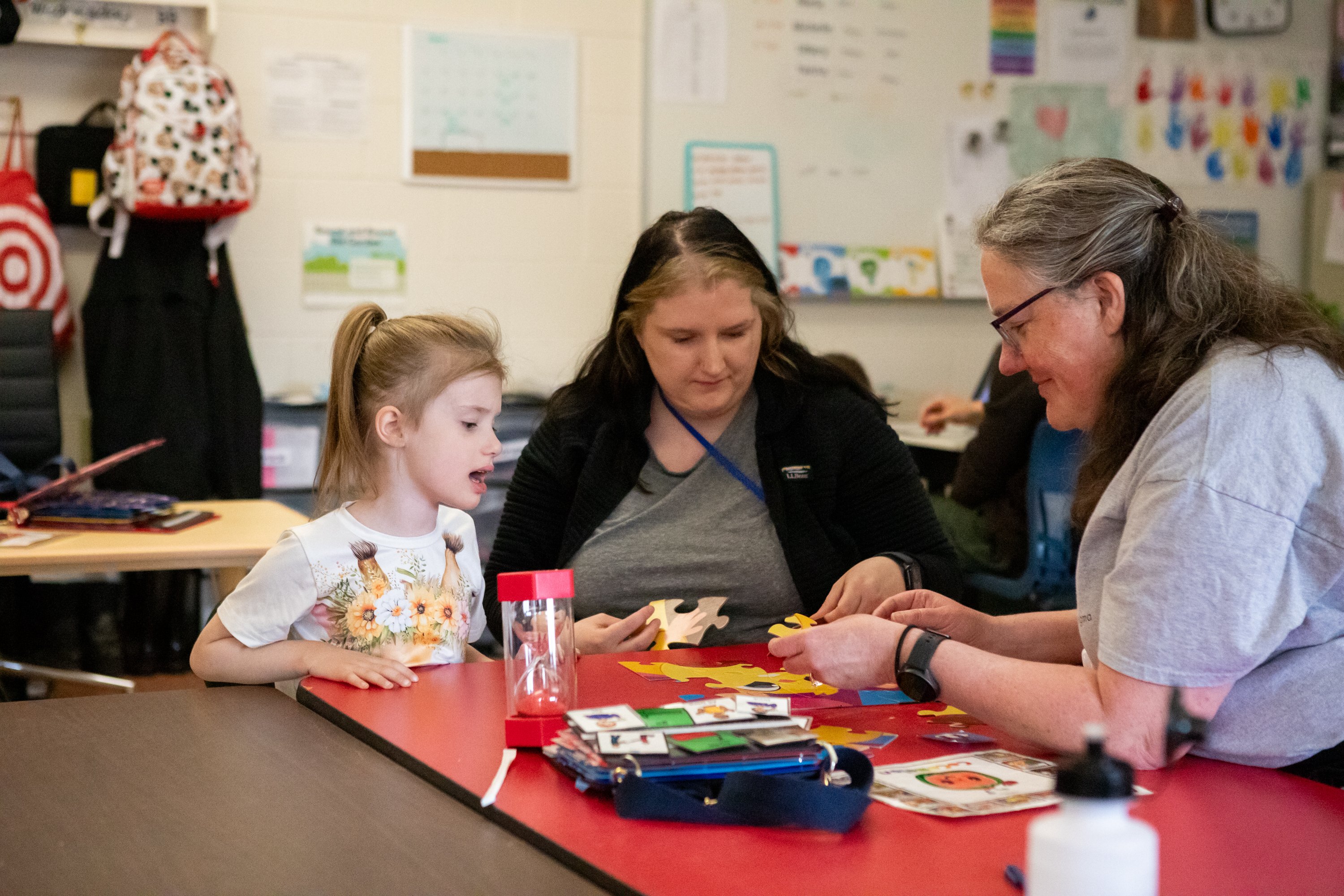
Several disabilities are looped into the special education identification rate. Autism seems to be the fastest growing learning disability, said Kirsten Crafts, special education director at Lewiston Public Schools.
Most students are diagnosed before they reach kindergarten, Crafts said, and they are arriving with higher needs compared to what she has seen in her 20 years of special education.
School districts are required to follow national guidelines for students with disabilities as well as Maine’s Unified Special Education Regulations. Three guiding principles are used to evaluate whether a student needs special education:
- Is the child diagnosed with a disability?
- Is there an adverse affect on their education?
- Is the adverse effect to the degree that they require special instructions and accommodations?
The state provides care for all special education students from birth to age 22. Districts have been required to include 22-year-olds since 2021, raising the cutoff from 21. Additionally, the state is adding 3- and 4-year-olds with special needs to the public schools in a prekindergarten program.
In 2020, the state’s identification rate was 18.12%. This current school year, it jumped to 20.48%, according to Maine Department of Education statistics.
It’s too soon to tell if the expanded ages have factored into the identification rate, experts said.
In that time, Lewiston’s special education rate went from 21% to 23%, Portland’s went from 16.4% to 18.6%, Augusta’s from 18.7% to around 19%, and Bangor’s from 20.2% to 23.8%.
Auburn’s rate went from 19.4% in 2020 to 21% in 2021, down to 19.8% in 2025.
WHY MAINE?
Experts don’t know why, but it likely involves a number of factors, said Erin Frazier, state director for the office of special services at the Department of Education.
First, research around autism has evolved, making it easier for professionals to identify while also widening the spectrum for what is considered a disability, she said.
Looking at the causes of autism, experts can point to socioeconomic factors such as the poverty rate of an area, substance use, and the environment that a child grew up in. But now, there’s another factor: the lingering effects of the pandemic that could be contributing to the rising rate.
“Because of COVID-19 and the challenges that happened with it, it led to a higher level of need for all of us,” Frazier said. “But there’s not one piece of evidence. There are so many things that can contribute to this.”
Crafts, the special education director in Lewiston, agrees with the pandemic theory.
Students who required higher levels of support couldn’t receive it on a daily basis like they could at school, leading to regression, she said.
“Going back to the regular routine was so much harder for those who struggle,” Crafts said.
The pandemic was not an experience unique to Maine, but could explain the nationwide increase of autism and learning disability rates.
Maine does stand out with its oldest-in-the-nation population, which brings in another factor: an aging teaching population, said Audrey Bartholomew, an assistant professor of special education at the University of New England.
Older teachers are more likely to use outdated methods, for example, which could lead to more students falling behind.
“We thought that we were teaching reading really well, but we were not,” Bartholomew said. “So kids who were labeled as not being able to read were labeled as having a learning disability and sent to special education.”
The situation encouraged 26 states to pass legislation to implement new reading methods. Maine did not adopt the laws.
BUDGET CONCERNS
It’s been a tough budget year for many school districts, with special education resources and the need for more teaching staff causing most budget increases.
Lewiston’s proposed budget for next year is up 8%, with $1.4 million of the budget increases going toward special education and related costs. Auburn‘s budget is up slightly, with most of the increases coming from transporting students to special purpose private schools, which are schools that provide additional services that public schools may not have the resources to accommodate.
Last year, the Augusta School Department had a $1.6 million budget shortfall amid unexpected special education costs, and the Gardiner-area school district created a special education reserve to cover any additional costs.
It’s expensive to run special education departments, and most schools, especially rural ones, are not equipped with the staff to cover students with high needs, yet the schools are legally required to provide all services needed.
Over the past 10 years, the number of special education teachers has grown 19% while the number of regular instruction teachers has grown by 5%, according to data from the Maine Education Policy Institute. The number of education technicians — who provide classroom support, especially for special education students, and are also known as teacher aides — has increased by 26% in the past 10 years.
At the same time, the number of students enrolled in public schools across the state has decreased.
“It requires a lot of staffing to keep students safe, and a lot of providers are needed,” said Auburn’s Shaw. “Typically, some students require speech and therapy. Sometimes physical therapy. Sometimes a board certified analysis.”
SEARCHING FOR SOLUTIONS
Inside a classroom at Thomas J. McMahon Elementary School in Lewiston are several kindergarteners learning how to write their names, while others are focusing on peer reading, working one-on-one with their classroom teacher.
It’s part of the CLIMB program created by Lewiston special education teachers who wanted to not only keep students with higher special needs in the district, but to also have them feel included in their community, which can create more positive outcomes.
The result is a program that aims to reintegrate students into general education by giving them the one-on-one or specialized learning that they need to thrive.
“It’s more about what’s best for their needs. We’ve also become more of a community due to being a community that has a lot of people transition in and out,” Crafts said.
At the same time, by investing in teachers who can address the high needs right here, Lewiston schools are saving money by avoiding the need to transport and pay for students to get more expensive out-of-district services. This budget season alone, Lewiston schools saved an estimated $8 million through the CLIMB initiative.
Lewiston’s effort may be a solution other schools now look to, given extra state support for special education was left out of the state’s funding formula.
Fortunately, Maine is great at producing special education teachers, Frazier said. Most special education teachers she works with started in general education then switched.
Statewide, there are avenues to train more special education teachers, she said.
The University of Maine just announced a four-year pathway for students to become certified special educators, and the state is working on ways to make the transition easier by assisting school districts with paying for special education certifications and extra schooling for teachers.
Meanwhile, Lewiston’s CLIMB program continues to grow, adding 10 more spaces for students next year so that it can accommodate some of the students from Shaw’s program in Auburn.

Comments are not available on this story. Read more about why we allow commenting on some stories and not on others.
We believe it's important to offer commenting on certain stories as a benefit to our readers. At its best, our comments sections can be a productive platform for readers to engage with our journalism, offer thoughts on coverage and issues, and drive conversation in a respectful, solutions-based way. It's a form of open discourse that can be useful to our community, public officials, journalists and others.
We do not enable comments on everything — exceptions include most crime stories, and coverage involving personal tragedy or sensitive issues that invite personal attacks instead of thoughtful discussion.
You can read more here about our commenting policy and terms of use. More information is also found on our FAQs.
Show less